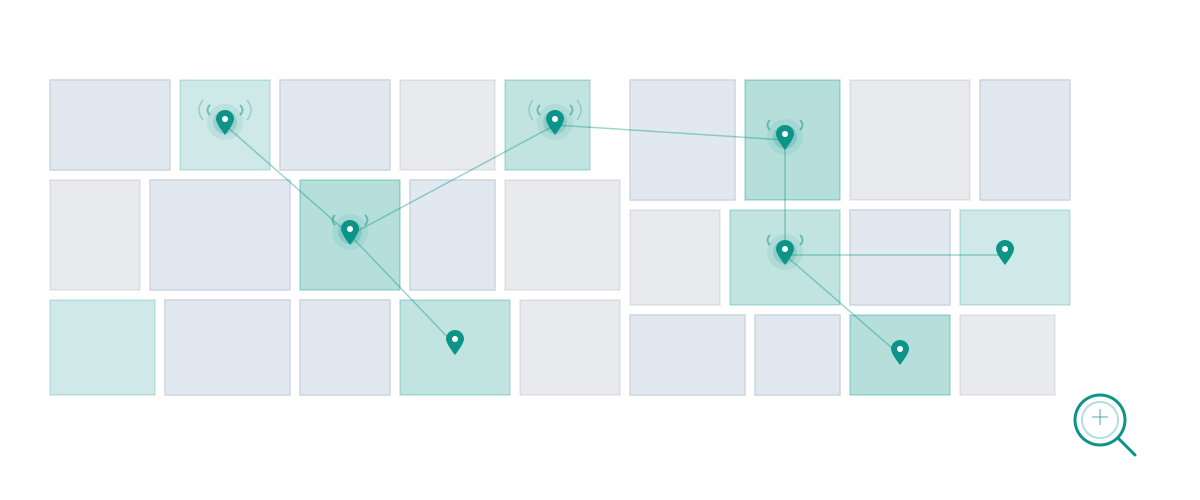
Most Melbourne businesses set up a Google Business Profile, add "Melbourne" to their page titles, and wonder why they only appear for searches in their immediate neighbourhood. The problem is not their product or service. The problem is that "Melbourne" as a keyword targets a city of 5.2 million people across 314 suburbs. A plumber in Fitzroy is not competing against other Fitzroy plumbers. They are competing against every plumber in the metro area, and losing to whoever has the most citations, reviews, and proximity signals in each suburb's local pack.
Melbourne suburb SEO fixes this by creating dedicated, location-specific signals for each suburb you want to rank in. When done correctly, a single business can appear in the local pack for Fitzroy, Richmond, Collingwood, and Abbotsford simultaneously, each ranking driven by a distinct set of suburb-level signals. This guide covers the complete system: keyword research, landing page structure, Google Business Profile strategy, citation building, schema markup, and the mistakes that undo all of it.
What this guide covers
What Melbourne Suburb SEO Actually Is
Melbourne suburb SEO is the practice of creating and optimising location-specific signals so your business ranks in the local pack and organic results for searches that include a specific suburb name, such as "electrician Fitzroy" or "best cafe Richmond". It is distinct from general Melbourne SEO in one critical way: the geographic targeting is granular enough that Google's proximity algorithm treats each suburb as a separate ranking context.
Google's local ranking algorithm uses three primary signals: relevance (does the business match what the user searched for), distance (how far is the business from the searcher or the named location), and prominence (how well-known is the business based on online signals).
For suburb-level searches, the distance signal becomes dominant. A business 4km from Footscray will be outranked in "plumber Footscray" searches by a business 800m away, even if the distant business has more total reviews. The only way to counter proximity disadvantage is to build strong relevance and prominence signals specifically for each target suburb.

The chart above shows the top 10 local pack ranking factors from the Whitespark 2026 Local Search Ranking Factors Survey, an annual study that aggregates weighted importance scores from practitioner consensus. Scores reflect how strongly specialists rate each factor, not official Google ranking weights. Three of the top four factors are GBP-related: your primary category selection, your physical proximity to the searcher, and keywords in your GBP business name. Notably, being open at the time of search (rank 5, score 189) ranks above high star ratings (rank 6, score 181), which means a business with 4.3 stars that is open will outperform a 4.8-star business that is closed.
Who this is for
Suburb SEO is most effective for service-area businesses (tradies, health practitioners, professional services, delivery businesses) that physically travel to or serve customers across multiple Melbourne suburbs. Single-location retail businesses or hospitality venues with a fixed address benefit more from proximity optimisation around their actual location than from suburb landing page campaigns.
How to Find High-Value Melbourne Suburb Keywords
Suburb keyword research begins with a priority matrix that ranks target suburbs by search volume, competitive density, and your realistic proximity advantage. Not all Melbourne suburbs are worth equal investment. Inner-city suburbs like Fitzroy, Richmond, South Yarra, and St Kilda typically carry higher search volumes but also higher competition. Outer suburbs often have lower volume but face fewer established competitors with suburb-specific pages.
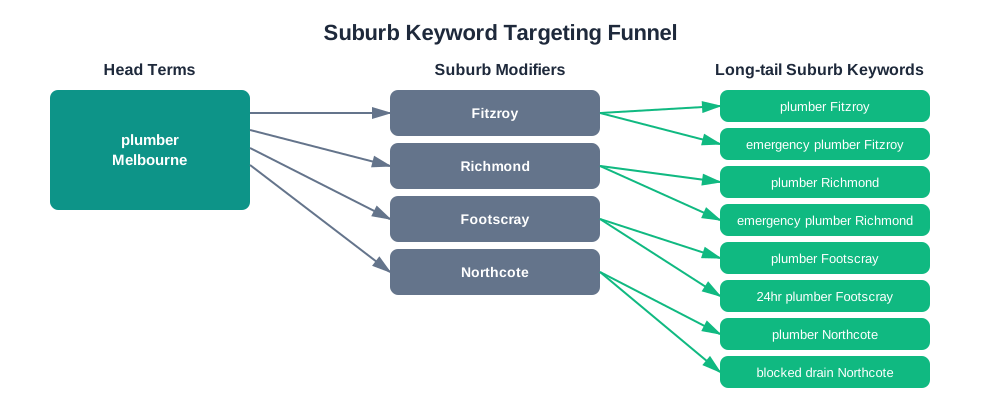
The targeting funnel above shows how to structure your keyword set. Start with your core service term (the head term), then systematically combine it with each suburb modifier to generate your suburb-level keyword list. Each combination is a distinct keyword with its own search volume, competitive landscape, and user intent.
Step 1: Build your suburb priority list
Map your service radius
List every Melbourne suburb your business actively serves or could realistically serve within a 30-minute travel time. For most Melbourne service-area businesses, this covers 15 to 40 suburbs. Do not include suburbs you would decline a job from.
Check monthly search volume for each suburb keyword
Use Google Keyword Planner, Ahrefs, Semrush, or KWFinder by Mangools to check volume for "[service] [suburb]" for each suburb on your list. In Melbourne, inner suburbs like Fitzroy (plumber Fitzroy: ~90 searches/month) typically outperform outer suburbs (plumber Sydenham: ~10-20/month). Volume below 10/month rarely justifies a dedicated page.
Score competitive density
Search each keyword in an incognito window and check the local pack. Count how many competitors have dedicated suburb landing pages (not just their homepage). Three or more competitors with suburb pages signals a mature, competitive suburb. One or zero signals an opportunity.
Assign proximity scores
Rate each suburb 1-3 based on your proximity advantage: 1 = you are within 2km (strong proximity signal), 2 = 2-8km (moderate), 3 = 8km+ (weak proximity, needs stronger relevance and prominence signals to compensate).
Prioritise by combined score
Build your production schedule from suburbs with high volume + low competition + proximity score of 1 or 2. These deliver the fastest ranking results. Address high-competition inner suburbs last, after your suburb SEO infrastructure is proven and generating leads.
Secondary keyword variants to include on each suburb page
Each suburb landing page should target multiple keyword variants, not just the primary "[service] [suburb]" phrase. Secondary variants extend the page's semantic coverage and improve its chances of appearing in voice search and conversational queries:
| Variant type | Example (plumber, Fitzroy) | Where to use |
|---|---|---|
| Primary | plumber Fitzroy | H1, meta title, first paragraph |
| Question format | best plumber in Fitzroy? | FAQ headings, conversational content |
| Intent + suburb | emergency plumber Fitzroy | H2 or H3, FAQ question |
| Suburb + postcode | plumber Fitzroy 3065 | NAP section, schema markup |
| Neighbouring suburb | plumber Fitzroy / Collingwood | Supporting paragraph |
| Service + area | blocked drain repair Fitzroy | Service list section |
Common misconception
Do not include "near me" as text on your suburb pages. Google resolves "near me" queries using the searcher's device location, not by matching the phrase in your page content. Writing "plumber near Fitzroy" in your body copy does not help you rank for "plumber near me" searches. What does help is strong suburb-specific signals: the suburb name in the H1 and meta title, consistent NAP citations with the suburb listed, and GBP signals tied to that suburb. Focus on those instead.
How to Build Suburb Landing Pages That Rank
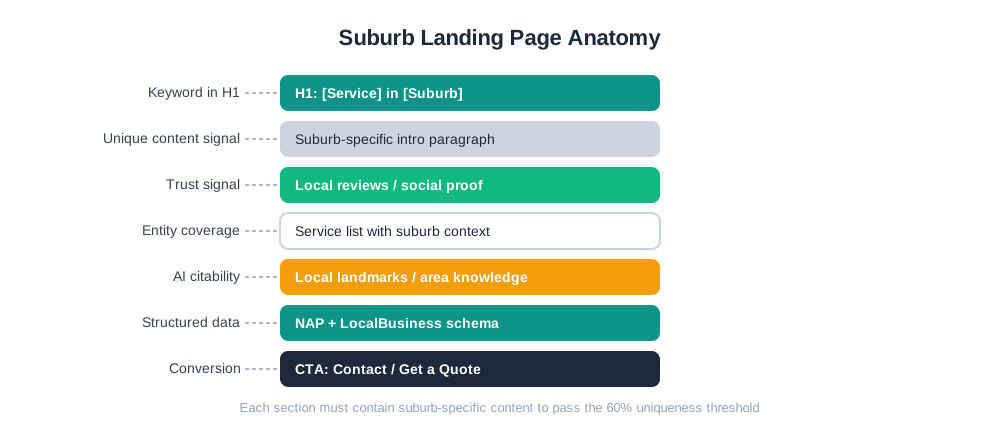
A suburb landing page ranks when it satisfies three conditions simultaneously: it contains the target suburb keyword in the right on-page positions, it provides content that is meaningfully different from your other suburb pages, and it accumulates external signals (citations, links, reviews) that confirm the suburb association. Most suburb page campaigns fail because they satisfy only the first condition and duplicate the rest.
On-page elements every suburb page must include
| Element | Requirement | Priority |
|---|---|---|
| H1 tag | "[Service] in [Suburb]" or "[Suburb] [Service]" | Critical |
| Meta title | Primary keyword front-loaded, under 60 characters | Critical |
| Meta description | Suburb name in first 10 words, specific benefit | High |
| First paragraph | Suburb name + service in first 100 words | Critical |
| H2 subheadings | Include suburb name in at least 2 H2s | High |
| NAP block | Business name, address (or service area note), phone | Critical |
| Suburb-specific content | Unique paragraphs referencing local context | Critical |
| Reviews/testimonials | At least 1 review from a customer in or near the suburb | High |
| Service list | Specific services relevant to the suburb (not a generic list) | Medium |
| Internal links | Link to main service page and related suburb pages | High |
The Unique Content Requirement vs Programmatic Content Generation
Programmatic SEO tools make it easy to generate suburb pages in bulk. A template, a spreadsheet of suburb names, and a content management system can produce 50 suburb pages in an afternoon. The problem is not the speed of production. The problem is that bulk generation without suburb-specific value produces 50 pages that are functionally identical. Each page has the same body copy, the same structure, and the same service description, with only the suburb name token swapped. Google's duplicate content filters treat these pages as thin content variations of a single page, and the entire campaign underperforms as a result. Programmatic generation is a valid production method only when the output contains genuinely unique, suburb-specific content for each page, not when the suburb name is the only variable.
Google's duplicate content filters flag suburb pages that are template copies of each other with only the suburb name swapped. A 10-page suburb campaign where each page shares 90% of its body copy will not rank. Each page will suppress the others' rankings rather than compound them. The minimum uniqueness threshold, based on practitioner experience across Melbourne local SEO campaigns, is roughly 60% unique content per page. In practice this means each suburb page needs at least 3 paragraphs of genuinely suburb-specific content.
Suburb-specific content does not need to be fabricated or stretched. It can come from real, verifiable local details:
- Local landmarks and geography: Reference actual streets, parks, train stations, or shopping precincts in the suburb. "We cover all of Fitzroy, including properties along Brunswick Street, Smith Street, and the Edinburgh Gardens precinct."
- Local housing stock: Melbourne's inner suburbs have specific housing types that affect service delivery. Fitzroy and Collingwood are dominated by Victorian terraces with heritage plumbing. Docklands has predominantly high-rise apartments. Mentioning the housing context creates both unique content and semantic relevance.
- Postcode reference: Including the suburb's postcode (e.g. Fitzroy 3065, Richmond 3121) in the NAP block and a body paragraph adds a geographic entity signal that confirms suburb association.
- Local customer references: A testimonial from a customer who lives in the suburb, even a first-name-only reference, adds a suburb-specific trust signal that also differentiates the page.
- Local service notes: Parking restrictions, council regulations, or infrastructure quirks specific to the suburb. "Many Fitzroy properties require permits for skip bin placement on Brunswick Street due to council by-laws."
The second version is longer, but the word count increase is secondary. What matters is that this content exists nowhere else on your site (or the internet), creates a genuine semantic relationship between your business and Fitzroy as a location entity, and demonstrates real local knowledge that builds trust with the reader.
Google Business Profile Strategy for Melbourne Suburbs
Your Google Business Profile is the single most powerful lever for suburb-level local pack rankings. The proximity algorithm pulls directly from your GBP's verified address to calculate distance to the searcher or named suburb. If your business has one verified location, you have one proximity anchor. The question is how to extend your visible footprint across multiple Melbourne suburbs without creating fake listings.
Service area configuration
Google Business Profile allows service-area businesses to hide their physical address and instead display a service area. Adding specific Melbourne suburbs to your service area in GBP does not directly improve your proximity score for those suburbs. Google does not treat service area listings as equivalent to physical location proximity. However, service area configuration is still worth completing because it determines which searches trigger your listing to appear in the local pack at all. A business without a configured service area may not appear in suburb-specific queries even when the searcher's location is within your delivery radius.
To configure service areas: in GBP Manager, navigate to Info, then Edit service area, and add each Melbourne suburb you serve by name. Google Maps will recognise Melbourne suburb names and suburbs' postcodes. Add your priority suburbs first. The maximum service area boundary is approximately 2 hours from your location, so there is no technical limitation to listing all serviceable Melbourne suburbs.
Review acquisition strategy for suburb coverage
Reviews that mention suburb names are more valuable for suburb-level rankings than generic 5-star reviews with no location context. A review that says "fast response in Fitzroy, sorted our burst pipe on Brunswick Street in 45 minutes" sends a named entity signal (Fitzroy, Brunswick Street) that associates your business with that location in Google's knowledge graph. Practitioner consensus suggests that 8 to 12 suburb-specific reviews per target suburb meaningfully improves local pack appearance rates for that suburb's queries.
To acquire suburb-specific reviews, your review request message should gently prompt location detail: "If you found us useful, we'd love a Google review. Mentioning your suburb and the specific job helps other [suburb] residents find us." Many customers will naturally include their suburb when given this prompt.
Warning
Do not create secondary GBP listings for suburbs you operate in without a verified physical address in that suburb. Google's guidelines prohibit listings at locations the business does not actually occupy. Fake suburb listings are subject to removal and can result in suspension of your primary GBP listing, which would eliminate your entire local search presence.
GBP posts for suburb visibility
GBP posts (Updates) that name specific suburbs contribute to the semantic entity profile of your listing. A post announcing "Now offering same-day blocked drain clearing in Northcote and Thornbury" creates a timestamped, Google-indexed association between your business and those suburb names. A cadence of two suburb-specific GBP posts per week, rotating through your priority suburb list, builds cumulative suburb entity signal over a 3 to 6 month period.
Citation Building for Suburb-Level Rankings
Local citations are mentions of your business name, address, and phone number (NAP) on third-party websites. For suburb SEO, citations need to be suburb-specific: they should include the suburb name in the address field and ideally in the listing's description or category. A citation listing that shows only "Melbourne, VIC" without a suburb is a weaker suburb signal than one that shows "Fitzroy, VIC 3065."
Priority citation sources for Melbourne suburbs
| Citation source | Domain authority | Suburb-level targeting |
|---|---|---|
| Google Business Profile | Very High | Service area + review suburb mentions |
| Yellow Pages (yellowpages.com.au) | High | Suburb field in address |
| True Local | High | Suburb-specific listing categories |
| Yelp Australia | High | Neighbourhood/suburb filter |
| Hotfrog | Medium | Suburb address field |
| Local.com.au | Medium | Melbourne suburb directory structure |
| Whereis | Medium | Address-based suburb mapping |
| Industry-specific directories | Varies | Service area or location filter |
Beyond general directories, suburb-specific citations carry disproportionate weight because they confirm the geographic entity from a hyperlocal source. For Melbourne, these include local council business directories (each Melbourne council runs its own business register), local community Facebook groups' linked business pages, suburb-specific Nextdoor profiles, and local newspaper digital listings (such as the Inner East Observer or the Leader network's local suburb pages).
NAP consistency across all suburb citations is non-negotiable. If your business name appears as "Smith Plumbing" on your website, "Smith's Plumbing" on Yellow Pages, and "Smith Plumbing Pty Ltd" on a council directory, those three mentions fail to reinforce each other's authority. Google's entity reconciliation system uses string matching and contextual proximity to determine whether two NAP mentions refer to the same business. Inconsistencies reduce the confidence score, weakening the cumulative citation effect across all sources.
How many citations do you need?
There is no universal citation count threshold for Melbourne or any market. The right target is determined by your competitors, not by an industry benchmark. Search your target keyword, identify the top 3 local pack results, and audit each business using a tool like Whitespark or BrightLocal. Build to the highest competitor count, then add 10 to 20 more. In practice, inner-suburb markets tend to have heavier citation profiles than outer-suburb markets, but that reflects competitive history, not a rule. Chase the leader in your specific niche and suburb, not a number you read in a blog post.
Schema Markup for Melbourne Suburb Pages
Schema markup on suburb landing pages communicates location entity relationships to search engines in machine-readable format. The relevant schema types for Melbourne suburb pages are LocalBusiness (or its service-specific subtypes), PostalAddress, and Service. When implemented correctly, schema markup helps Google's AI systems extract and confirm the suburb association without relying solely on crawled text.
LocalBusiness schema for a suburb page
<!-- LocalBusiness schema for Fitzroy suburb page -->
{
"@context": "https://schema.org",
"@type": "Plumber",
"name": "Smith Plumbing",
"url": "https://smithplumbing.com.au/plumber-fitzroy",
"telephone": "+61-3-XXXX-XXXX",
"areaServed": {
"@type": "City",
"name": "Fitzroy",
"postalCode": "3065",
"addressRegion": "VIC",
"addressCountry": "AU"
},
"hasOfferCatalog": {
"@type": "OfferCatalog",
"name": "Plumbing Services in Fitzroy"
},
"geo": {
"@type": "GeoCoordinates",
"latitude": -37.7963,
"longitude": 144.9780
}
}
Two elements of this schema block are particularly important for suburb SEO. First, using the areaServed property with a structured City or AdministrativeArea object (rather than just a text string) creates a machine-readable entity link between your business and the suburb as a named geographic entity. Second, including the postcode in the schema confirms the geographic specificity beyond the suburb name alone, which is valuable in the Melbourne context where some suburb names are shared across postcodes (Southbank, for example, spans postcodes 3006 and 3195 depending on context).
For businesses using a service-area model (no physical address shown), replace the address block with a structured areaServed array listing each suburb. This is the correct schema pattern for businesses that operate from a home base and travel to client locations.
Tip
Validate your schema with Google's Rich Results Test after adding it to each suburb page. Schema validation errors, particularly mismatched property types or missing required fields, silently prevent the schema from being processed, meaning you get no ranking benefit from the markup. Test each suburb page independently since the areaServed values differ per page.
Common Melbourne Suburb SEO Mistakes That Erase Your Rankings
Suburb SEO campaigns fail in predictable patterns. These five mistakes account for the majority of stalled or reversed suburb rankings we encounter when auditing Melbourne businesses.
Mistake 1: Launching suburb pages without any external signals
A suburb landing page with perfect on-page optimisation but zero external signals (no citations, no backlinks, no GBP service area association) rarely ranks in the local pack. On-page signals establish relevance; external signals establish prominence. Both are required. Before publishing a suburb page, the corresponding suburb should already be listed in your GBP service area, and you should have at least 3 to 5 suburb-specific citations in place. Launch the page into an existing external signal environment, not a blank one.
Mistake 2: Using the same template content across all suburb pages
As covered in the unique content section above, near-duplicate suburb pages suppress each other. The specific failure mode is Google choosing one version to index (usually the first one it crawled) and reducing the crawl frequency of the others. This means your Fitzroy page might rank, but your Collingwood and Richmond pages are effectively invisible. Audit your suburb pages with a similarity checker: any two pages with above 75% content similarity need differentiation before they will rank independently.
Mistake 3: Targeting suburbs you have no real proximity or service connection to
Creating a suburb page for Frankston when your business is based in Northcote and you have never completed a job in Frankston is both ethically problematic and practically ineffective. Google's spam detection systems analyse the consistency between your claimed service area, your GBP location, your citation footprint, and your review geography. A business with 40 reviews all mentioning inner-north suburbs but suburb pages claiming to serve the Mornington Peninsula will generate inconsistency signals that reduce the credibility of the entire local profile.
Mistake 4: Inconsistent NAP across suburb page footers and citations
Many businesses update their main website address correctly but leave old NAP information on suburb pages, directory listings, or their GBP profile. After a business relocation or phone number change, this inconsistency erodes the NAP signal across the entire citation network. Conduct a full NAP audit after any business detail change and update every citation source systematically. The NAP consistency guide covers the audit process in detail.
Mistake 5: Not building suburb-to-suburb internal links
Suburb pages should link to each other when they cover neighbouring or commonly combined suburbs. A Fitzroy page that links to your Collingwood, Fitzroy North, and Carlton pages passes crawl equity through the suburb cluster, raises the harmonic centrality score of each linked page, and creates a semantic relationship that signals geographic coverage depth to search engines. The absence of these internal links leaves each suburb page isolated, requiring Google to discover and rank each page independently rather than treating them as a coherent geographic cluster.
Need help with your Melbourne suburb SEO?
We build suburb targeting strategies for Melbourne service-area businesses, including landing pages, citation campaigns, and GBP optimisation. Book a free strategy call.
Get a free suburb SEO reviewMelbourne's local search landscape is more competitive than most Australian cities because the metro area is both densely populated and geographically specific. Searches in Melbourne frequently include suburb names rather than generic "near me" queries, which means the suburb-level targeting strategies described in this guide have a direct, measurable effect on which businesses appear. A well-executed suburb SEO campaign, combining dedicated landing pages, suburb-specific GBP signals, consistent citations, and targeted review acquisition, typically produces first local pack appearances within 3 to 4 months for low-to-moderate competition suburbs, and 6 to 9 months for high-competition inner suburbs.
For a broader view of how local search authority is built and measured, our local SEO services page covers the full strategy framework, including the technical and off-page components that underpin suburb-level rankings.
Frequently Asked Questions
How many suburb pages should a Melbourne service-area business create?
Start with 5 to 10 suburb pages targeting your highest-priority suburbs based on search volume, proximity, and competitive density. Each page requires genuinely unique content and a matching citation and GBP signal. Launching 30 suburb pages simultaneously without the content and external signal infrastructure in place typically results in none of them ranking. Build your suburb SEO system with your first 5 pages, prove the model with measurable ranking results, then scale to additional suburbs once the infrastructure is functioning.
Can a business with one physical location in Melbourne rank in suburbs it is not physically located in?
Yes, but proximity disadvantage must be compensated by stronger relevance and prominence signals. A business 5km from a suburb can rank in that suburb's local pack if it has a suburb-specific landing page, suburb-named citations, suburb-mention reviews, and its GBP service area includes the suburb. The further from the suburb your address is, the more external signal volume you need to compensate. In practice, most Melbourne service businesses can effectively rank in suburbs within an 8 to 10km radius of their location with a well-executed suburb SEO strategy.
How long does suburb SEO take to produce rankings in Melbourne?
For low-competition outer Melbourne suburbs with few established competitors, suburb landing pages can produce local pack appearances within 6 to 10 weeks of launch when supported by suburb-specific citations and GBP service area configuration. For high-competition inner suburbs like Fitzroy, Richmond, South Yarra, or St Kilda, expect 4 to 9 months to reach the top 3 local pack positions. The citation count you need is set by your competitors, not a fixed threshold. Audit the top 3 local pack results for your target keyword, find the highest citation count among them, and build to that number plus a buffer of 10 to 20 additional consistent citations.
Do suburb keywords in the URL path help with suburb SEO rankings?
Including the suburb name in the URL (e.g. /plumber-fitzroy or /service-areas/fitzroy) provides a keyword signal that contributes to relevance scoring, but it is a minor factor compared to the H1, first paragraph, NAP block, and external signals. The URL structure is worth doing consistently across your suburb pages, but it does not substitute for unique on-page content or external signals. Use a consistent URL pattern across all suburb pages to simplify internal linking and sitemap management.
Is suburb SEO the same as creating city landing pages?
No. City landing pages target a broad metropolitan area (e.g. "plumber Melbourne") and compete in a different, typically much higher-competition keyword context. Suburb pages target the specific geographic entity of a named suburb (e.g. "plumber Fitzroy") and compete against a smaller set of locally established competitors. Suburb pages are generally faster to rank, produce higher conversion rates because searchers in suburb-specific queries have stronger purchase intent, and face less established competition than city-level terms. Most Melbourne businesses benefit more from 10 well-executed suburb pages than from a single city-level page.
What Melbourne suburbs are most competitive for local SEO?
The highest-competition Melbourne suburbs for most service categories are Richmond, South Yarra, Fitzroy, St Kilda, Prahran, Hawthorn, and Carlton. These inner suburbs have high population density, high search volume, and a large number of established businesses with mature local SEO profiles. Medium-competition suburbs include Northcote, Brunswick, Footscray, Moonee Ponds, and Camberwell. Lower-competition opportunities typically exist in outer suburban corridors including Cranbourne, Pakenham, Wyndham Vale, and Melton, where fewer businesses have invested in suburb-specific SEO.

Tharindu Gunawardana
Founder & Director, SearchMinistry Media
Tharindu Gunawardana is the Founder of SearchMinistry Media and a search strategist with 17 years of experience across Sri Lanka, Singapore, and Australia. A former Agency SEO Director, he specialises in helping brands transition from traditional SEO to AI-driven discovery.