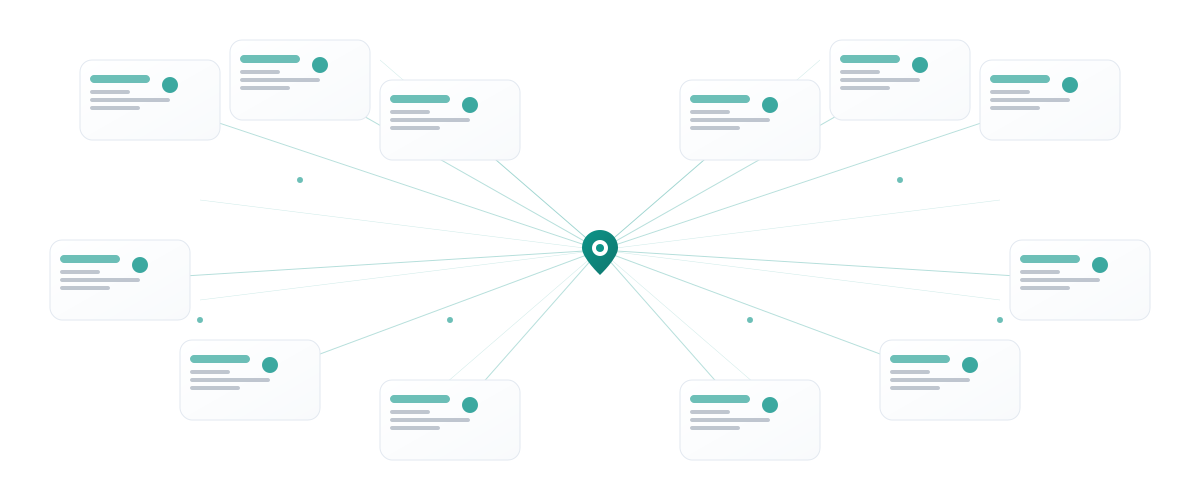
Local citations are online references to your business that include your name, address, and phone number. They appear on business directories, social platforms, review sites, and industry specific websites. For businesses that serve local customers, citations are one of the core building blocks of local SEO.
What Are Local Citations?
A local citation is any online mention of a business's name, address, and phone number (commonly referred to as NAP). Citations can also include additional details like your website URL, business hours, categories, and descriptions.
Search engines like Google use citations as one of several signals to evaluate the legitimacy and relevance of a local business. The logic is straightforward: if multiple trusted websites all list the same business with consistent information, that business is more likely to be real, established, and worth surfacing in local search results.
According to Google's own documentation on how local results are determined, prominence is a key ranking factor. Prominence is partly based on information Google finds about a business from across the web, including links, articles, and directories. Citations contribute directly to this signal.
Types of Citations
Citations fall into two categories: structured and unstructured. Both contribute to your local search presence, but they work in different ways.
Structured Citations
A structured citation is a listing on a formal business directory where your information is entered into specific fields (name field, address field, phone field). These are the most common and easiest to manage type of citation.
Examples include:
- Google Business Profile: The most important citation for any local business
- Yelp: Major review and directory platform
- Yellow Pages (Australia): Traditional directory now operating online
- True Local: Australian specific business directory
- Hotfrog: Global business directory with Australian listings
Unstructured Citations
An unstructured citation is a mention of your business details within regular content, such as a blog post, news article, event listing, or social media post. The information is not in dedicated data fields but appears naturally within text.
Unstructured citations are harder to build intentionally, but they carry strong trust signals because they typically come from editorial or organic mentions rather than self submitted listings.
Why Citations Matter for Local SEO
Citations influence local search rankings in several measurable ways:
- Discovery and indexing: Citations help search engines find and verify your business. A new business with no web presence can start appearing in local results faster by creating citations on established directories.
- Trust and verification: Consistent citations across multiple platforms signal to Google that your business information is accurate. This builds confidence in showing your business to searchers.
- Local Pack rankings: The Local Pack (the map and three business listings at the top of local search results) is influenced by citation volume and consistency. Businesses with more accurate citations tend to rank higher.
- Competitor benchmarking: In competitive local markets, citations can be a differentiator. If your competitor has 80 accurate citations and you have 20, that gap affects relative visibility.
Google's local search algorithm evaluates three primary factors: relevance, distance, and prominence. Citations primarily influence the prominence factor by establishing your business as a recognised entity across the web.
Key Citation Platforms in Australia
For Australian businesses, the following platforms are the most impactful for local citation building:
| Platform | Type | Priority |
|---|---|---|
| Google Business Profile | Search/Maps | Essential |
| Apple Maps (Apple Business Connect) | Maps | Essential |
| Bing Places for Business | Search/Maps | High |
| Yellow Pages Australia | General Directory | High |
| True Local | General Directory | High |
| Yelp Australia | Review Directory | Medium |
| Hotfrog | General Directory | Medium |
| Facebook Business Page | Social Platform | Medium |
Beyond general directories, look for industry specific platforms relevant to your niche. A restaurant should be on Zomato and TripAdvisor. A tradesperson should be on hipages and ServiceSeeking. A medical practice should be on HealthEngine and HotDoc.
How to Build Local Citations
Building citations effectively requires a systematic approach. Here is a practical process:
1. Audit your existing citations
Before building new citations, check what already exists. Search for your business name across Google, Bing, and major directories. Document every listing you find and note any inconsistencies in your name, address, or phone number.
2. Fix inconsistencies first
Incorrect or outdated citations do more harm than having fewer citations. Prioritise fixing existing listings before creating new ones. Pay special attention to old addresses, former phone numbers, and variations of your business name.
3. Claim and verify primary platforms
Start with the essential platforms: Google Business Profile, Apple Business Connect, and Bing Places. Complete every field available. Add photos, business hours, categories, and a detailed description.
4. Submit to general directories
Work through the major general directories next: Yellow Pages, True Local, Yelp, Hotfrog. Use exactly the same business name, address format, and phone number on every single listing.
5. Target industry directories
Identify directories specific to your industry and submit your business. Industry specific citations carry extra relevance signals because they establish your business within a defined category.
6. Monitor and maintain
Citations are not a one time task. Directories can change your data, duplicate listings can appear, and your own business details may change over time. Schedule quarterly audits to ensure everything remains accurate.
Common Citation Mistakes
These are the most frequent errors that undermine citation value:
- Inconsistent business name: Using "Smith's Plumbing" on one site and "Smith's Plumbing Pty Ltd" on another. Pick one format and use it everywhere.
- Address formatting variations: "St" vs "Street", "Rd" vs "Road". Google can usually resolve these, but exact consistency removes any ambiguity.
- Old phone numbers: If you changed your phone number, every citation with the old number is now working against you.
- Duplicate listings: Having two listings on the same directory confuses search engines and splits your authority. Merge or remove duplicates.
- Ignoring citations after creation: Directories sometimes merge, change, or auto populate incorrect data from aggregators. Regular monitoring catches these issues early.
How Local Citations Affect AI Local Search Visibility
For businesses serious about local SEO, citations are a foundational element that cannot be skipped. Citation density and directory coverage vary significantly by market, so if you operate in Melbourne, Sydney, or Brisbane, it is worth understanding which local directories carry the most weight in your city. Here is how to approach citations strategically:
- Quality over quantity: 30 accurate citations on relevant, authoritative platforms outperform 200 listings on low quality spam directories.
- Consistency is non negotiable: Every citation must display identical NAP information. Even minor discrepancies dilute trust signals.
- Citations alone are not enough: Citations work alongside other local ranking factors including reviews, on page signals, link authority, and Google Business Profile optimisation. They are one piece of a broader strategy. For a complete picture of how all these signals interact, see our Google Business Profile optimisation guide.
- Track competitor citations: If competitors appear on directories where you are absent, those are gaps worth filling.
- Pair with schema markup: Use LocalBusiness or Organisation schema on your website to reinforce the same business data that appears in your citations. This creates a consistent signal loop between your site and external listings.
Frequently Asked Questions
What is a local citation in SEO?
A local citation is any online mention of a business's name, address, and phone number (NAP). Citations appear on business directories, review sites, social platforms, and in editorial content. Search engines use citations to verify business legitimacy and determine local search rankings.
How many citations does a local business need?
There is no fixed number. Most businesses benefit from 30 to 50 high quality citations on relevant platforms. Focus on accuracy and relevance rather than volume. Citations on authoritative, industry specific directories carry more weight than listings on generic, low authority sites.
What is the difference between structured and unstructured citations?
Structured citations are formal directory listings with dedicated fields for business name, address, and phone number (like Yelp or Yellow Pages). Unstructured citations are mentions of your business details within regular content such as blog posts, news articles, or social media. Both types contribute to local SEO.
Do citations still matter for local SEO in 2026?
Yes. While Google's algorithm has become more sophisticated, citations remain a core local ranking factor. They contribute to the prominence signal that Google uses to rank local businesses. Accurate, consistent citations on authoritative platforms continue to influence Local Pack and Maps rankings.
What are the most important citation sites in Australia?
The most important platforms for Australian businesses are Google Business Profile, Apple Business Connect, Bing Places, Yellow Pages Australia, True Local, Yelp Australia, and Facebook. Industry specific directories relevant to your business category should also be prioritised.

Tharindu Gunawardana
Founder and Director of SearchMinistry
Tharindu Gunawardana is the Founder of SearchMinistry Media and a search strategist with 17 years of experience across Sri Lanka, Singapore, and Australia. A former Agency SEO Director, he specialises in helping brands transition from traditional SEO to AI-driven discovery.