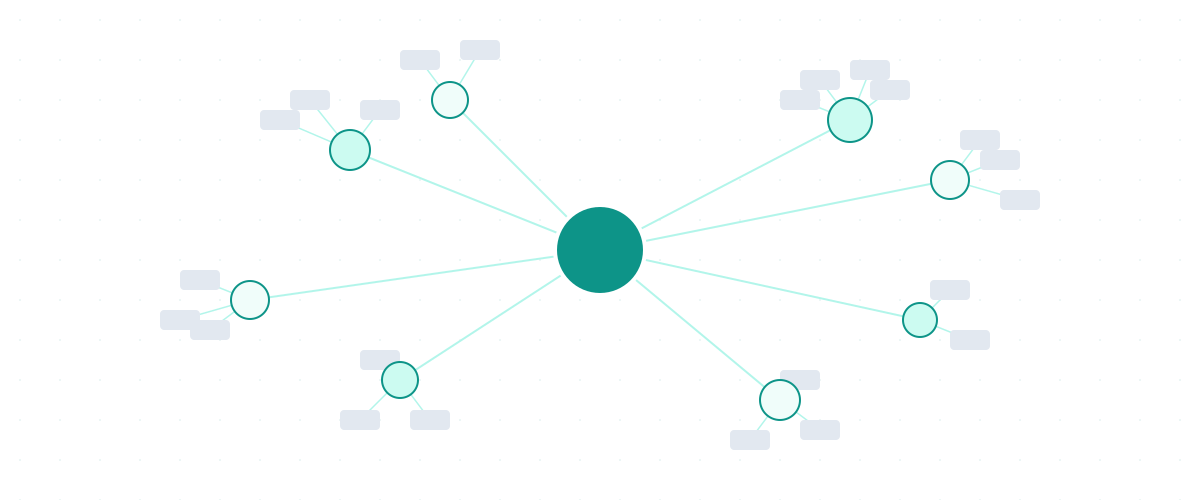
Search engines no longer read your content the way a person does. They parse it the way a database does: looking for things, the properties of those things, and the specific facts that confirm what those properties are. The model behind this parsing is called Entity-Attribute-Value, and understanding it is one of the most direct ways to improve how AI systems interpret and cite your content.
An entity is a thing. An attribute is a property of that thing. A value is the specific fact that fills that property. Together, these three elements form the structural unit that search engines use to build knowledge graphs, rank pages, and generate AI search answers.
What Is an Entity?
An entity is any distinct, real-world thing that can be unambiguously identified and separated from other things. Entities are not keywords. A keyword is a string of text. An entity is a concept, object, or actor in the world that the text refers to.
Google's entity taxonomy (drawn from Freebase and expanded through the Knowledge Graph) includes several core types:
- Person: a specific individual, identifiable by name, role, and biographical facts
- Organisation: a business, institution, government body, or association
- Place: a geographic location, landmark, region, or address
- Product: a specific item, software, device, or service offering
- Concept: an idea, topic, or abstract subject such as "retrieval-augmented generation" or "harmonic centrality"
- Event: an occurrence with a time, location, and participants
- Creative work: a book, film, article, dataset, or piece of content
The key property of an entity is disambiguation. "Apple" is a word. It becomes an entity only when a system determines whether it refers to the fruit, Apple Inc., or Apple Records. The disambiguation relies on the attributes and values associated with it in context.
For AI SEO purposes, every page on your site should clearly assert which entity or entities it is about. Pages that fail to declare their primary entity leave search engines to infer it, which reduces certainty and citation likelihood.
What Are Attributes?
An attribute is a named property of an entity. It is a category of information that the entity possesses. Attributes define what kind of facts are relevant to describe an entity fully.
For a LocalBusiness entity, relevant attributes include:
name: the trading name of the businessaddress: the physical locationtelephone: the contact numberopeningHours: when the business operatespriceRange: a cost indicatorserviceArea: the geographic coverageaggregateRating: the quality signal from reviews
Attributes are not tied to a specific fact. They are the slots into which facts fit. The attribute address exists as a property regardless of what the actual address is. This is why the same attribute vocabulary (Schema.org) can be shared across millions of different businesses.
In a knowledge graph, attributes appear as the labelled edges between entity nodes. In a database, they appear as column names. In structured data markup, they appear as JSON-LD property keys.
What Are Values?
A value is the specific fact assigned to an attribute for a particular entity. Values ground abstract attributes in reality. They are what makes an entity record distinct from every other entity of the same type.
Values can take several forms:
- String values: text, such as a business name or address ("123 Collins Street")
- Numeric values: numbers, such as a rating (4.9) or year founded (2008)
- Boolean values: true or false, such as whether a product is in stock
- Date and time values: timestamps, such as a publication date or event start time
- URL values: links, such as a logo URL or a sameAs reference to a Wikipedia page
- Nested entity values: another entity, such as a
PostalAddressobject nested inside anOrganization
Values are the most contested part of the EAV model from an SEO standpoint. A search engine that has indexed the same attribute with different values from different sources must decide which value to trust. Pages that state values clearly, consistently, and with corroborating signals (reviews, citations, other pages) receive higher confidence scores.
The Entity-Attribute-Value Model
The Entity-Attribute-Value (EAV) model is a data architecture pattern used to represent information about things without fixing a rigid schema upfront. Instead of defining every possible column in advance, the EAV model stores facts as flexible triples: the thing being described, the property being described, and the fact itself.
In database terms, a single EAV row looks like this:
// entity | attribute | value
Smith Dental Clinic | location | "Melbourne CBD"
Smith Dental Clinic | rating | "4.9"
Smith Dental Clinic | service | "Dental Implants"
In semantic web terms, these same triples are called RDF triples: subject, predicate, object. The subject is the entity. The predicate is the attribute. The object is the value (or another entity). This is the foundation on which the semantic web, Wikidata, and Google's Knowledge Graph are all built.
The EAV model is powerful because it is extensible. You can add new attributes to an entity at any time without changing the underlying data structure. This is why Google can add new types of information to the Knowledge Graph continuously, without rebuilding the entire database schema each time.
For SEO, understanding the EAV model means understanding that search engines are trying to fill in attribute slots for every entity they encounter. Your content either helps fill those slots with accurate, corroborated values, or it leaves them empty and reduces your entity's completeness score.
EAV and Schema.org Structured Data
Schema.org is the most widely used vocabulary for implementing the EAV model on web pages. When you add JSON-LD structured data to a page, you are explicitly asserting an entity type (@type), a set of attributes (property keys), and a set of values (property values).
A named entity recognition model can extract entities from plain text, but it must infer their attributes and values from context. Structured data removes that inference burden entirely by making the EAV triple explicit and machine-readable.
The most important Schema.org types for EAV-aware SEO are:
OrganizationandLocalBusiness: for businesses and institutions, with attributes likename,address,telephone,sameAsPerson: for individuals, with attributes likejobTitle,affiliation,knowsAboutProduct: for items, with attributes likebrand,sku,offers,aggregateRatingArticleandBlogPosting: for content, with attributes likeauthor,datePublished,aboutFAQPage: for question-answer pairs, with attributesmainEntity,name,acceptedAnswer
The sameAs attribute deserves special attention. It allows you to link your entity to its corresponding entries in Wikidata, Wikipedia, LinkedIn, and other authoritative databases. This signals to search engines that your entity is the same real-world thing as the one already in their knowledge graph, which dramatically increases entity confidence.
EAV in Google's Knowledge Graph
Google's Knowledge Graph is a large-scale implementation of the EAV model. Each entity in the Knowledge Graph is a node. Each attribute is a labelled edge leading out of that node. Each value is either a data point or another entity node at the end of that edge.
When Google processes a new page, it attempts to match the content to existing entity nodes in the Knowledge Graph. If it finds a match, it extracts attribute-value pairs from the page and compares them to what it already knows. If the values are consistent with existing data, confidence in the page rises. If they contradict existing data, confidence falls.
This is why consistency across sources matters so much for entity SEO. If your schema says your business is at one address, your Google Business Profile says another, and your citations say a third, Google has three conflicting values for the same attribute. It cannot be confident which is correct, and your entity record remains incomplete.
Entities with complete, consistent, corroborated attribute-value records are more likely to:
- Appear in Knowledge Panels
- Be cited in AI Overviews
- Rank for conversational and question-based queries
- Be included in AI search engine answers (Perplexity, ChatGPT, Gemini)
How AI Search Uses EAV to Answer Queries
When a user submits a query to an AI search system, the first step is entity resolution: identifying which entities the query refers to, and which attributes and values the user is asking about.
"Best dentist in Melbourne CBD" resolves to: entity type = Dental Clinic, attribute = location with value = Melbourne CBD, attribute = quality with value = high. The system then retrieves documents that contain entities matching those attribute-value constraints.
Because vector embeddings capture semantic meaning rather than exact text, the retrieval step can match "dentist" with "dental practice" and "Melbourne CBD" with "central Melbourne" without those exact strings appearing together. Modern AI search uses contextual vectors specifically, which shift the representation of each word based on surrounding tokens, allowing the system to disambiguate entity meanings from context alone. But the EAV structure underpinning the Knowledge Graph is what allows the system to be confident that a match is correct, not just semantically similar.
Pages that explicitly declare their entity, its attributes, and their values reduce the ambiguity in this retrieval process. They are retrieved more reliably, grounded more accurately, and cited more consistently across AI search systems.
How EAV Structure Affects AI Entity Understanding
Understanding entities, attributes, and values gives you a practical framework for structuring content and markup that AI search systems can process without ambiguity.
1. Declare your primary entity explicitly
Every page should have a clear primary entity. Use the appropriate Schema.org @type in your JSON-LD markup. Do not leave the entity type for search engines to infer from context. An Organization with a declared type is always processed more reliably than a page that mentions a business name without structural context.
2. Complete your attribute set
For each entity type, Schema.org defines a recommended set of attributes. Fill as many as are relevant and accurate. An incomplete entity record (missing address, telephone, or openingHours for a local business) leaves attribute slots empty in the Knowledge Graph, reducing entity confidence. Use Google's Rich Results Test to identify missing recommended properties.
3. Make values consistent across all sources
Check that your entity's attribute values are identical across your website, Google Business Profile, social media profiles, industry directories, and press mentions. Conflicting values (different phone numbers, different trading names, different founding years) create contradictory signals in the Knowledge Graph. Resolve conflicts by updating the incorrect sources first, then verifying with structured data.
4. Use sameAs to anchor your entity
Add sameAs links in your schema pointing to your Wikidata entry, Wikipedia page (if one exists), LinkedIn company page, and any other authoritative external profiles. This explicitly tells search engines that your entity is the same real-world thing as the one already in their database, merging your attribute-value data with existing Knowledge Graph records.
5. Write content that states attribute-value pairs in prose
Structured data helps machines read your entity. Prose helps the retrieval step. Write content that clearly states attribute-value pairs in natural language: "Smith Dental Clinic has operated in Melbourne CBD since 2008 and holds a 4.9-star rating across 380 Google reviews." This sentence explicitly states five attribute-value pairs that an AI retrieval system can extract and verify against your schema. Use the LLMO Prompt Tester to verify how AI search systems interpret your entity content and whether they correctly resolve the entity type and values you have declared.
6. Link entities to each other
Real-world entities relate to each other. A person belongs to an organisation. A product is made by a brand. A service is offered at a location. Internal links and nested schema objects (linking author to a Person entity, linking location to a Place entity) create a connected entity graph on your site that mirrors how Knowledge Graphs represent the world. Connected entities are more fully understood and more reliably cited.
Frequently Asked Questions
What is the difference between an entity and a keyword?
A keyword is a string of text. An entity is a real-world thing the text refers to. "Apple" is a keyword. "Apple Inc. (technology company, founded 1976 by Steve Jobs)" is an entity. Search engines have moved from matching keywords to identifying entities because entities allow disambiguation, which is the ability to distinguish between two things that share the same name but are different objects in the world. SEO built around entity clarity is more durable than SEO built around keyword density.
Do I need structured data to benefit from entity SEO?
Structured data is not strictly required. Search engines can extract entities and attribute-value pairs from well-written prose using natural language processing. However, structured data removes all ambiguity by explicitly declaring entity type, attribute names, and values in a machine-readable format. For competitive verticals and for AI search citation, structured data consistently outperforms content that relies on implicit extraction. Think of structured data as a direct instruction to the search engine, while prose is an indirect hint.
What is a semantic triple and how does it relate to EAV?
A semantic triple is the RDF (Resource Description Framework) term for the same concept as an entity-attribute-value record. The triple consists of a subject (the entity), a predicate (the attribute), and an object (the value or another entity). Google's Knowledge Graph is built on RDF-style triples. When you write Schema.org structured data, you are creating semantic triples that search engines can ingest directly into their knowledge stores. The EAV terminology is common in database and content contexts; the subject-predicate-object terminology is common in semantic web and linked data contexts.
How does entity completeness affect AI search citation?
AI search systems use a grounding step before generating answers. This step checks whether the claims in a retrieved document are verifiable against known facts. An entity with a complete attribute-value record (name, address, type, rating, services, founded date, sameAs links) passes more grounding checks than an entity with only a name. Each additional attribute-value pair that is consistent across multiple indexed sources adds to the entity's confidence score. Higher confidence means higher likelihood of being cited in AI Overviews, Perplexity answers, and ChatGPT responses.
Can a single page represent multiple entities?
Yes. A page can contain multiple entities. A local business homepage might contain the organisation entity, a person entity for the founder, a place entity for the location, and several product or service entities. Each entity should have its own structured data block with its own type, attributes, and values. However, every page should have one primary entity that the page is primarily about. Secondary entities should be clearly subordinate in the markup hierarchy, nested inside the primary entity record where the schema allows it.
How do I find which attributes I should declare for my entity type?
Schema.org lists all recommended and optional properties for each entity type at schema.org/[EntityType]. For example, schema.org/LocalBusiness shows every property available for local business entities. Google's Rich Results documentation also lists the properties it actively uses for rich results and Knowledge Graph population. Start with the properties Google marks as recommended, then add optional properties for which you have accurate data. Avoid declaring attributes whose values you cannot verify or maintain, as incorrect values reduce entity confidence.

Tharindu Gunawardana
Founder and Director of SearchMinistry
Tharindu Gunawardana is the Founder of SearchMinistry Media and a search strategist with 17 years of experience across Sri Lanka, Singapore, and Australia. A former Agency SEO Director, he specialises in helping brands transition from traditional SEO to AI-driven discovery.