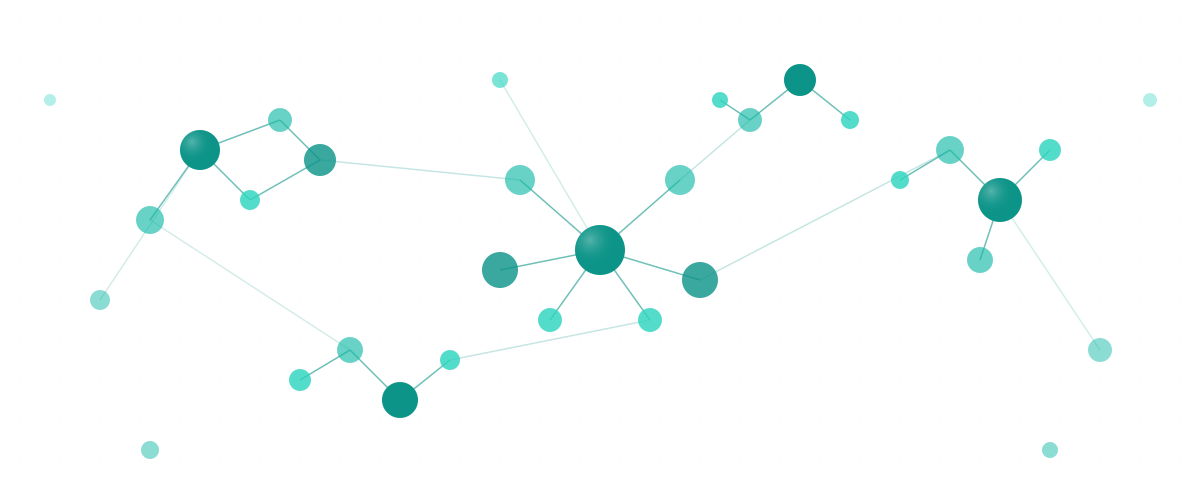
In the early days of search, engines treated the web as a collection of keywords. If you searched for "Apple," Google looked for pages that mentioned the word "Apple" frequently. Today, Google understands that "Apple" is an entity, a company founded by Steve Jobs, headquartered in Cupertino, and a competitor to Microsoft. This shift from "strings to things" is made possible by Knowledge Graphs.
What Are Knowledge Graphs?
A knowledge graph is a programmatic way of representing a network of real-world entities (people, places, organisations, and concepts) and the relationships between them. Unlike a traditional database that stores data in isolated rows and columns, a knowledge graph stores data in a web-like structure that mimics human understanding.
At its core, a knowledge graph is about semantics (meaning). It doesn't just store the fact that "Sydney" and "Australia" are related; it stores the specific nature of that relationship: "Sydney" is located in "Australia."
Simple definition
A knowledge graph is a giant, interconnected map of facts. It organises information by identifying "entities" (objects or concepts) and defining how they are related to one another, allowing computers to "understand" the world rather than just read text.
How Knowledge Graphs Work
Knowledge graphs build a structured representation of knowledge using a simple yet powerful data model. Every piece of information is broken down into its most basic form.
The Triple Structure
The fundamental building block of a knowledge graph is the semantic triple. A triple consists of three parts: a Subject, a Predicate (or relationship), and an Object.
By chaining millions of these triples together, a search engine can build a sophisticated understanding of reality. If the graph knows that Leonardo da Vinci painted the Mona Lisa and that The Mona Lisa is located in the Louvre, it can logically conclude that Leonardo da Vinci's work is in the Louvre even if that specific sentence is never written on a web page.
Entities, Relationships, and Properties
To build a functional graph, search engines categorise information into three categories:
- Entities: The "nodes" in the graph. These are the objects or concepts themselves (e.g., Google, Melbourne, SEO).
- Relationships: The "edges" connecting the nodes. These define how entities interact (e.g., is a member of, was founded by, is a type of).
- Properties: Attributes that describe an entity but don't necessarily point to another major entity (e.g., a person's birth date or a company's stock ticker symbol).
Google's Knowledge Graph
Launched in 2012, Google's Knowledge Graph was a revolutionary step in search technology. It allowed Google to move beyond keyword matching and start providing direct answers to factual questions.
Today, Google's Knowledge Graph contains billions of entities and trillions of facts. It is compiled from a variety of sources, including:
- Public Databases: Wikipedia, Wikidata, and Freebase (the original foundation).
- Licenced Data: Weather data, stock prices, and sports scores.
- Web Crawling: Extracting facts from web pages using Natural Language Processing (NLP).
- Structured Data: Schema.org markup provided by website owners.
How Knowledge Graphs Power Search
You interact with the Knowledge Graph every time you use Google, often without realising it. It powers several key search features.
1. Knowledge Panels
The information boxes that appear on the right side of the search results for specific entities. They provide a summary of key facts, social media links, and related entities.
2. Entity Disambiguation
If you search for "Mercury," the Knowledge Graph helps Google determine if you mean the planet, the element, or the car brand based on your search history and context.
3. Rich Results
Star ratings, recipe cooking times, and event dates in the search results are often pulled from the Knowledge Graph (verified by structured data on the page).
4. Voice Search & AI Overviews
When you ask a smart speaker "Who is the CEO of Google?", it queries the Knowledge Graph to find the specific entity (Sundar Pichai) and returns the answer directly.
The Role of Structured Data
Structured data (Schema.org) is the language webmasters use to talk directly to the Knowledge Graph. While Google's AI is excellent at extracting facts from natural language, structured data provides an unambiguous confirmation of those facts.
By implementing Organization, Person, or Product schema, you are essentially telling Google: "This text refers to this specific entity, and here are its properties." This significantly increases your chances of being included in the Knowledge Graph and earning a Knowledge Panel.
Optimising for Knowledge Graphs
In the era of AI SEO, you are no longer just optimising for keywords; you are optimising for entity salience. A well-structured AI SEO strategy puts entity clarity at its centre.
Example: Text-Only vs Structured Entity Data
Text-only entity mention
"SearchMinistry Media is an SEO agency based in Melbourne, founded by Tharindu Gunawardana."
Google extracts the entity via NER but cannot traverse its relations programmatically. Knowledge Panel data stays sparse and traversal reach is limited.
Schema.org structured data
{ "@type": "Organization", "name": "SearchMinistry Media", "founder": { "@type": "Person", "name": "Tharindu Gunawardana" }, "location": "Melbourne", "sameAs": "https://en.wikipedia.org/wiki/..." }
Machine-readable relations. Graph traversal can reach founder, location, and industry nodes directly. Knowledge Panel and AI answer citations improve.
Claim your Knowledge Panel
If your brand already has a Knowledge Panel, use the "Claim this knowledge panel" button to verify your identity and suggest edits. This gives you more control over the displayed facts.
Implement comprehensive Schema.org markup
Don't just use basic schema. Use sameAs properties to link your website to your social profiles and Wikipedia entries, helping Google connect the dots between your digital footprints.
Build topical authority
Create content that explores the relationships between your core topic and other established entities. If you are an SEO agency, write about your relationship with search engines, marketing technology, and business growth.
Consistency across the web
Ensure your brand's Name, Address, and Phone number (NAP) are consistent across all platforms. Inconsistent data creates friction for Knowledge Graph reconciliation.
Frequently Asked Questions
What is the difference between a database and a knowledge graph?
How do I get my business into Google's Knowledge Graph?
Does being in the Knowledge Graph improve SEO?
What is an "Entity" in SEO?
What are "triples" in knowledge graphs?

Tharindu Gunawardana
Founder and Director of SearchMinistry
Tharindu Gunawardana is the Founder of SearchMinistry Media and a search strategist with 17 years of experience across Sri Lanka, Singapore, and Australia. A former Agency SEO Director, he specialises in helping brands transition from traditional SEO to AI-driven discovery.