What Is Harmonic Centrality?
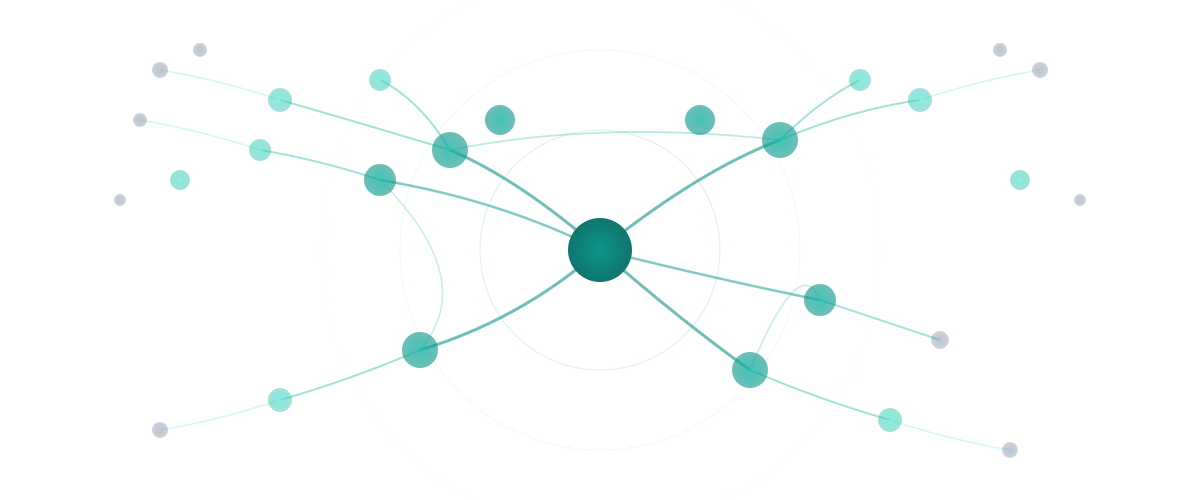
Harmonic centrality is a graph theory metric that measures how central a node is within a network. It calculates the sum of inverse shortest-path distances from a given node to every other node in the graph. The higher the score, the more easily that node can be reached from anywhere in the network.
The formula is straightforward:
// Harmonic Centrality formula
H(v) = sum of 1 / d(v, u) for all nodes u where u is not v
// d(v, u) = shortest path distance between node v and node u
// Unreachable nodes contribute 0 (since 1/infinity = 0)
If a node can be reached in one step from five other nodes, it adds 5 x (1/1) = 5 to its score. If another five nodes are two steps away, it adds 5 x (1/2) = 2.5. The score rewards proximity: nodes that are close to many other nodes accumulate a high harmonic centrality score quickly.
Harmonic centrality was introduced in the academic literature as an improvement on closeness centrality specifically because it handles disconnected graphs correctly. On the web, where not every page links to every other page, this robustness matters. A node in an isolated cluster does not inflate the scores of other nodes; it simply contributes zero to the sum.
How Harmonic Centrality Affects AI Search Authority
Harmonic centrality does not appear in any Google documentation as a named ranking factor. What it provides is a structural framework for understanding why certain architectural practices consistently produce better crawl coverage, stronger link equity distribution, and higher AI citability.
Four practical implications follow directly from the framework:
Example: Same Content, Different Click Depth
Two pages with identical content. Different harmonic centrality scores.
Homepage → Category → Subcategory → Article → Target page (5 clicks)
Harmonic centrality: low. Crawled infrequently. Link equity diluted across 5 hops. Lower AI citation probability due to weak graph reachability.
Homepage → Hub page → Target page (2 clicks)
Harmonic centrality: high. Crawled regularly. Link equity arrives with minimal dilution. Retrieval probability in AI search is significantly higher.
The tip: add the target page to a hub page linked from the homepage. One structural change improves crawl frequency, link equity, and AI citation probability simultaneously.
Crawl budget is a centrality problem
Google allocates crawl budget based on signals that include internal link strength. Pages with high harmonic centrality receive more frequent crawl visits, meaning updates are indexed faster and new content ranks sooner. For large sites with thousands of pages, low-centrality pages may go weeks between crawl visits.
Link equity flows through centrality paths
PageRank passes through links. Pages that are close to the homepage within the link graph receive more of that equity. Redesigning architecture to reduce click depth for important pages, measured as an improvement in harmonic centrality, directly improves the authority those pages accumulate.
AI citation probability correlates with centrality
Retrieval augmented generation systems retrieve candidate documents before generating answers. Pages that are highly reachable in web graphs and well-connected within their topic clusters are more likely to appear in retrieval candidate sets. High harmonic centrality is not a sufficient condition for AI citation, but low centrality is close to a disqualifying one.
Entity disambiguation benefits from graph position
In Google's Knowledge Graph, entities with many relationships are easier to identify and distinguish from similar entities. Building structured citations, consistent NAP data, Schema.org markup, and mentions across authoritative sources increases your entity's harmonic centrality within the knowledge graph, improving confidence scores across all AI search systems.
For a structured assessment of how your site's current architecture performs across these dimensions, our AI SEO service includes a full internal link graph audit, entity footprint analysis, and crawl priority mapping. You can also test how AI systems currently retrieve and cite your content using our LLMO Prompt Tester.
How It Differs from PageRank and Closeness Centrality
Understanding harmonic centrality is easier once you contrast it with the two metrics it is most often compared to.
PageRank
PageRank models a random surfer who clicks links at random. Each time a page receives a link from a high-authority page, some of that authority flows to it. PageRank is directional and weighted by the quality of incoming links. Harmonic centrality, by contrast, is purely structural: it measures position within a network regardless of the prestige of individual connections. A page that receives one link from the homepage will have a higher harmonic centrality than a page buried three clicks deep, even if that buried page has many incoming links from other deep pages.
In practical SEO terms: PageRank tells you how much authority a page has accumulated. Harmonic centrality tells you how easy that page is to discover through the link graph.
Closeness Centrality
Closeness centrality calculates the average shortest-path distance from a node to all others, then inverts it. The problem is that if even one node is completely unreachable, the average distance becomes infinite and the score collapses to zero. On real websites with orphaned pages or broken link clusters, closeness centrality produces misleading results. Harmonic centrality sidesteps this by taking the sum of inverses rather than the inverse of the sum. Unreachable nodes simply contribute zero without corrupting the overall score.
This mathematical robustness is why harmonic centrality is the preferred metric in network analysis tools that work with real world web graphs, where disconnection is common.
Harmonic Centrality in Google's Knowledge Graph
Google's Knowledge Graph is itself a large graph of entities and relationships. Every entity in that graph, whether it is a business, a person, a location, or a concept, has a position defined by how many other entities relate to it and how closely. Harmonic centrality, or equivalent measures, plays a role in determining which entities Google treats as authoritative and which remain ambiguous.
An entity like "Melbourne" is connected to thousands of businesses, events, people, landmarks, and government bodies within Google's Knowledge Graph. Its harmonic centrality score is enormous. When your business is mentioned in relation to Melbourne, by having a Google Business Profile, consistent local citations, or coverage in Melbourne-based publications, some of that centrality is inherited. Google can more confidently disambiguate your entity because it sits close to many well-established nodes in the graph.
Contrast this with a brand that has no website, no consistent directory listings, no mentions in external publications, and no social profiles. That entity effectively has a harmonic centrality score of zero within Google's Knowledge Graph. It does not appear in Knowledge Panels, AI Overviews rarely cite it, and Google has low confidence associating any query with that specific entity.
This is why entity-building is a core component of modern AI driven SEO strategy. It is not just about keywords or links; it is about establishing your brand as a well-connected node in a broader knowledge network. When Google's algorithms perform graph traversal to answer a query, entities with high harmonic centrality are encountered more frequently and cited with higher confidence.
The connection to semantic search is direct. Semantic search systems do not match strings; they traverse entity graphs and weight results by entity confidence. An entity's position within the knowledge graph, which harmonic centrality captures structurally, directly influences whether that entity appears in AI-generated answers.
Internal Link Architecture: Designing for Centrality
The principles of harmonic centrality translate directly into practical internal linking strategy. Your website is a graph. Every page is a node. Every internal link is a directed edge. The structure of those edges determines the harmonic centrality score of every page on your site.
High-centrality pages are reachable from everywhere else in a small number of clicks. Low-centrality pages require many hops to reach, and some pages, orphaned pages with no inbound internal links, have a centrality score of zero.
The Topic Cluster Model Through a Centrality Lens
The topic cluster model makes sense from a harmonic centrality perspective. A pillar page sits at the centre of its cluster. Every cluster page links to it. The pillar page links back to all cluster pages. This bidirectional linking creates a dense sub-graph where the pillar page has the highest harmonic centrality within its topic cluster, exactly where you want it.
Cluster pages benefit too. Because they are linked from the pillar page and from sibling cluster pages, they are reachable in just two hops from any page that links to the pillar. Their centrality scores are moderate but consistent.
What Kills Centrality
Several common architectural mistakes dramatically reduce harmonic centrality for important pages:
- Orphan pages: Pages with no inbound internal links have zero centrality. Googlebot may never discover them through crawling alone.
- Flat navigation with no cross-linking: If every page only links to the homepage and one or two service pages, cluster pages remain at a distance of three or more hops from each other. Their centrality stays low.
- Pagination chains: Category pages buried behind /page/2, /page/3 chains are two or three extra hops from the main category page. Their centrality plummets with each added layer.
- Seasonal or campaign pages left disconnected: Landing pages built for a single campaign and never linked from permanent navigation become orphans the moment the campaign ends.
Vector embeddings power the semantic relevance side of search, but crawlability and discoverability are prerequisites. A page that is semantically perfect but has a centrality score of zero may never be crawled frequently enough to rank.
Measuring and Improving Your Site's Centrality Profile
You do not need a custom graph database to apply harmonic centrality principles. Several practical proxies help you approximate centrality across your site.
Using Google Search Console
Pages that Google crawls frequently are, by definition, highly reachable within your link graph. In Search Console, check crawl frequency under the URL Inspection tool. Pages crawled daily or weekly typically have high harmonic centrality. Pages crawled monthly or rarely are likely low-centrality pages sitting deep in your architecture.
Using Log File Analysis
Server logs show exactly which pages Googlebot visits and how often. Pages visited rarely despite being important content are candidates for centrality improvement: add inbound internal links from high-traffic, frequently-crawled pages.
Using Screaming Frog or Similar Crawlers
Any desktop crawler can report inbound internal link counts per page. Pages with zero inbound links are orphans. Pages with one or two inbound links from low-traffic pages have low effective centrality. Sort by inbound link count and prioritise adding links to high-value pages that are undersupported.
Applying the Principle: Three Actions
- Audit orphan pages. Export every page on your site from a crawl report. Filter to pages with zero inbound internal links. For each one, decide: delete it, redirect it, or add it to the navigation or to a relevant cluster page.
- Strengthen pillar page centrality. Your most important service and product pages should be linked from the homepage, from every related cluster page, and from the footer or sidebar where appropriate. The goal is single-hop access from as many pages as possible.
- Cross-link cluster pages. When a cluster page mentions a topic covered in another cluster page within the same pillar, add a contextual internal link. This reduces average path length between cluster pages and raises their individual centrality scores.
The named entity recognition systems that AI models use to parse content are only effective if those pages are actually crawled. Strong harmonic centrality ensures your best content is discovered consistently.
Frequently Asked Questions
Does Google explicitly use harmonic centrality as a ranking signal?
What is the difference between harmonic centrality and PageRank?
How do orphan pages affect harmonic centrality?
How does harmonic centrality apply to Google's Knowledge Graph?
What tools can I use to measure internal link centrality?
How many internal links does a page need to have good harmonic centrality?

Tharindu Gunawardana
Founder and Director of SearchMinistry
Tharindu Gunawardana is the Founder of SearchMinistry Media and a search strategist with 17 years of experience across Sri Lanka, Singapore, and Australia. A former Agency SEO Director, he specialises in helping brands transition from traditional SEO to AI-driven discovery.