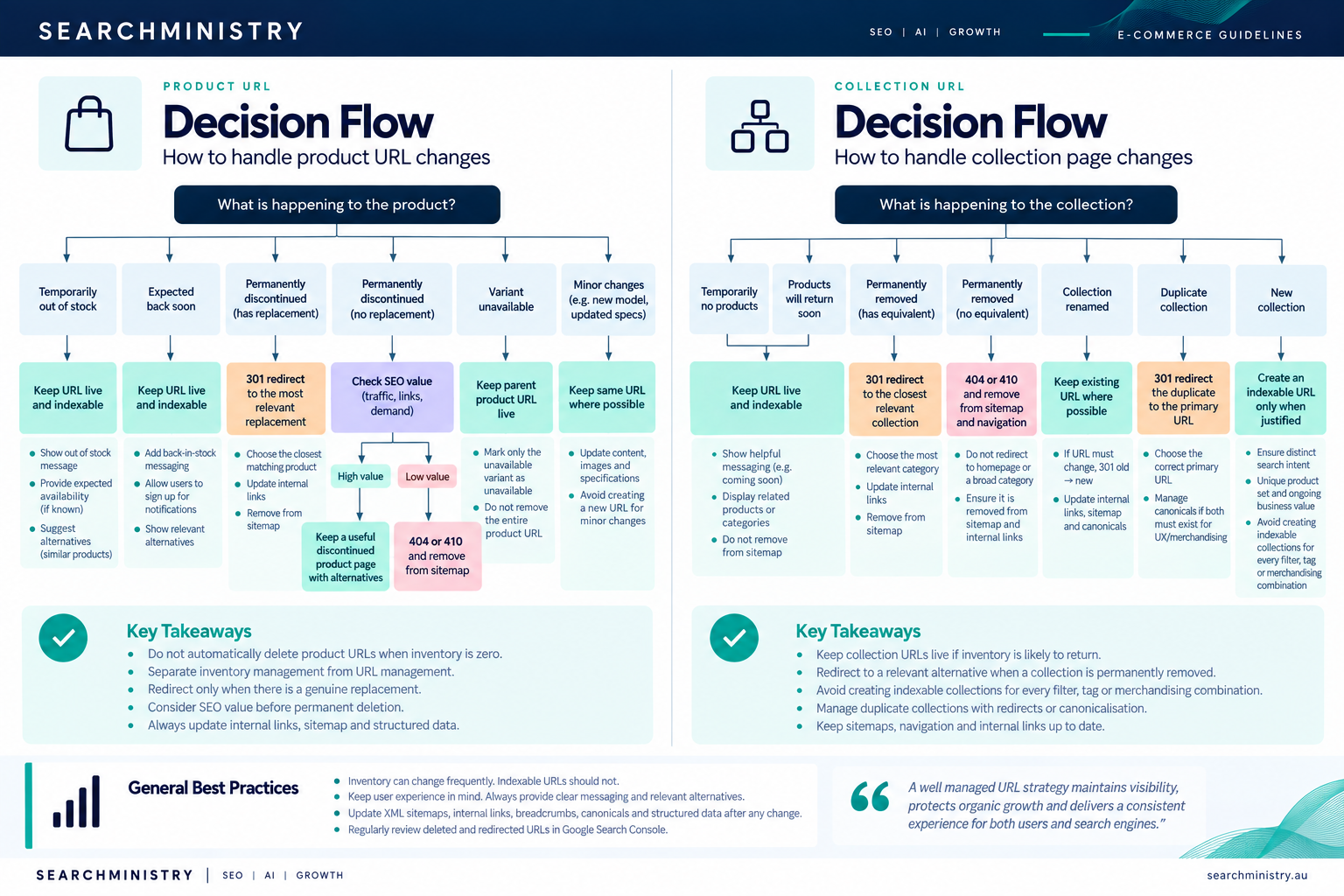
E-commerce URL management gives every product and collection page a deliberate lifecycle instead of allowing inventory software to decide whether a URL exists. Large online stores change constantly as products sell out, models are replaced, seasonal ranges disappear and merchandising teams create new categories.
SearchMinistry Media helps large retailers separate stock operations from technical SEO decisions through controlled page retirement, redirect mapping and indexation governance. This protects organic visibility while preserving a consistent experience for users and search engines.
The principle is simple: inventory changes frequently, but indexable URLs should remain stable. This guide explains how to retain, redirect, consolidate or retire product and collection pages using stock status, search intent and accumulated SEO value.
Download the free e-commerce URL decision flow
Save the one-page PDF for SEO, merchandising, development and inventory teams.
Download Free PDFFrequent URL Changes Create SEO Risk at Scale
Product and collection URLs accumulate search signals that inventory feeds do not measure. A page might rank for product queries, receive backlinks, appear throughout internal navigation and help Google understand relationships between brands, attributes and categories.
If that URL disappears when inventory reaches zero, the store discards some of those signals. A catalogue containing 100,000 products compounds the problem because thousands of URLs repeatedly appear, disappear and redirect as feeds change. Search engines must crawl and reassess the same catalogue instead of spending resources on stable, useful pages.
Stock status, merchandising status and SEO indexation status are separate concepts. A technical e-commerce search optimisation strategy defines how each system communicates without giving inventory software control over crawlable URLs.
Stock Status Guides Product Page Decisions
A temporarily unavailable product should remain live and indexable when stock is expected to return. The page should communicate current availability while retaining the same canonical URL.
- Display a clear out-of-stock message.
- Provide an expected return date when the business knows it.
- Offer a back-in-stock notification.
- Recommend genuinely similar products.
- Update availability in Product and Offer structured data.
This approach preserves the page while helping shoppers continue their purchase journey. It also avoids the repeated deindexing and reindexing that occurs when a product URL follows short-term inventory movements.
Critical
Do not automatically delete product URLs when inventory reaches zero. Confirm whether the product is temporarily unavailable or permanently discontinued first.
Discontinued Products Require a Genuine Intent Match
A permanently discontinued product should redirect only when a true replacement satisfies approximately the same user intent. An old appliance model that has been directly replaced by a newer equivalent is a valid 301 redirect case.
Valid replacement relationship
Old Product A 301 redirects to New Product B
Do not automatically redirect a discontinued item to its parent category or homepage. First assess organic traffic, Google Search Console impressions, rankings, backlinks, historical demand and internal references. A valuable page could remain useful as a discontinued-product resource that explains the change and recommends appropriate alternatives.
If the item has no meaningful search or user value and no equivalent replacement exists, return a 404 or 410 and remove the URL from the XML sitemap. A legitimate 404 is not inherently an SEO problem. Use the free 301 redirect generator to create platform-ready redirect rules when a suitable destination exists.
Unavailable Variants Preserve the Parent Product
An unavailable variant should not remove the parent product page. If one shoe size sells out while five sizes remain available, the product entity and its primary URL still exist.
Mark only the affected SKU or variant as unavailable. Keep the parent product accessible, preserve its canonical URL and retain the other purchasable options. This distinction prevents inventory integrations from removing entire product detail pages whenever one colour, size or configuration reaches zero stock.
Product teams should also review the broader product page SEO checklist when changing variant selectors, schema or internal links, because each interface change affects both crawling and conversion.
Collection Pages Require Tighter URL Governance
A useful collection URL represents a meaningful relationship between search intent, a product category and a relevant product set. The ability to create a collection in a merchandising platform does not justify making that page indexable.
Temporarily empty collections should remain live when relevant inventory will return. Explain the availability situation and surface related products or categories. This approach works particularly well for seasonal or inventory-sensitive ranges that would otherwise disappear and reappear each year.
Permanently removed collections need an equivalent destination or a clean retirement. Redirect the old URL to the closest semantically equivalent category when one exists. If no relevant replacement exists, return a 404 or 410 and remove the retired page from XML sitemaps and active navigation.
Duplicate Collections Fragment Search Signals
Multiple URLs representing the same product set divide internal links, relevance and canonical signals across competing pages. Categories, tags, brands, filters and campaigns often create these duplicates on large commerce platforms.
/collections/stick-vacuums/
/collections/cordless-stick-vacuums/
/collections/cordless-vacuum-cleaners/
If multiple versions must remain available for customer experience or campaign tracking, manage canonicalisation and indexation deliberately. The primary URL should receive the strongest internal links and appear in the XML sitemap.
Filter Combinations Do Not Automatically Justify Indexation
Most faceted navigation combinations do not represent independent search intent. A vacuum category with filters for brand, colour, price, power, floor type and availability can generate hundreds or thousands of crawlable combinations.
Before making a collection indexable, confirm that it represents a distinct query, a useful product set and an ongoing business opportunity. Strategic subcategories such as stick vacuums, robot vacuums and handheld vacuums satisfy separate user needs. Arbitrary combinations such as a narrow colour, price and availability state usually do not.
A category page SEO assessment helps teams check indexation, canonical tags, headings and content before promoting a filtered collection into a permanent landing page.
A Decision Framework Controls the URL Lifecycle
A shared decision framework gives SEO, merchandising, inventory and development teams the same rules for retaining, redirecting and retiring pages. Apply the following product and collection outcomes before changing status codes or internal links.
Product conditions determine the technical response
| Product condition | URL action | Implementation |
|---|---|---|
| Temporarily out of stock | Keep live and indexable | Show availability, expected return and alternatives |
| Discontinued with replacement | 301 redirect | Send users to the closest genuine replacement |
| Discontinued without replacement | Assess value, then retain or 404/410 | Check traffic, links, demand and user usefulness |
| Single variant unavailable | Keep parent product URL | Update availability for the affected variant only |
| Minor product update | Keep the existing URL | Update content, images and specifications |
Collection conditions determine indexation and consolidation
| Collection condition | URL action | Implementation |
|---|---|---|
| Temporarily empty | Keep live and indexable | Explain availability and show related categories |
| Permanently removed with equivalent | 301 redirect | Choose the closest semantically equivalent collection |
| Permanently removed without equivalent | 404 or 410 | Remove from navigation, internal links and sitemap |
| Renamed collection | Keep URL where practical | If the URL changes, redirect old to new |
| Duplicate collection | Consolidate | Select a primary URL and redirect the duplicate |
| New collection | Index only when justified | Require distinct intent, a useful product set and ongoing value |
URL Changes Trigger a Complete SEO Cleanup
A status code change is only one part of page lifecycle management. Every permanent removal, consolidation or redirect should trigger updates to XML sitemaps, internal links, breadcrumbs, canonical tags, structured data and navigation.
If Collection A redirects to Collection B while hundreds of internal links still point to Collection A, the website continues to communicate an outdated relationship. Update those links to point directly to the final destination and keep only canonical, indexable URLs in the sitemap.
SEO cleanup checklist after a URL change
- Update internal links to point directly to the final URL
- Remove retired and redirected URLs from XML sitemaps
- Align breadcrumbs and canonical tags with the preferred page
- Update Product, Offer, ItemList and BreadcrumbList structured data
- Remove retired pages from navigation and merchandising modules
- Monitor crawl errors, indexation and organic landing-page traffic
Inventory systems manage stock and merchandising systems manage presentation. Neither system should automatically determine the SEO lifecycle of a URL. A controlled sequence of create, index, maintain, update, consolidate and retire makes catalogue changes predictable for search engines, developers and customers.
Protect search visibility as your catalogue changes
SearchMinistry plans URL governance, redirect rules, faceted navigation controls and page retirement processes for large online stores.
Explore E-commerce SEO ServicesFrequently Asked Questions About Product and Collection URLs
Should an out-of-stock product page return a 404?
No. A temporarily out-of-stock product page should remain live and indexable when inventory is expected to return. Show a clear availability message, offer a back-in-stock notification, recommend suitable alternatives and update Product structured data to reflect the current stock status.
When should a discontinued product use a 301 redirect?
Use a 301 redirect when a genuine replacement satisfies approximately the same user intent as the discontinued product. Do not redirect every removed product to a broad category or the homepage. An unrelated destination creates a poor user experience and weakens the semantic relationship communicated by the redirect.
Is a 404 or 410 bad for ecommerce SEO?
A legitimate 404 or 410 is not an SEO error when a product or collection has permanently disappeared and no suitable replacement exists. Remove the retired URL from XML sitemaps and internal navigation, then allow search engines to process its removal. The problem is not the status code, but using it for valuable or temporarily unavailable pages.
Should empty collection pages remain indexed?
An empty collection should remain live when relevant products are expected to return. Add a helpful message and surface related categories or products instead of presenting a dead end. Permanently removed collections need a relevant redirect or a 404/410 response, depending on whether an equivalent destination exists.
How should duplicate collection URLs be handled?
Choose one primary collection URL and consolidate duplicates around it. Use a 301 redirect where the duplicate does not need to remain available. If multiple versions must exist for customer experience or merchandising, manage canonical tags and indexation deliberately so search engines understand which URL represents the concept.
Should every faceted navigation filter be indexable?
No. Most filter combinations do not represent distinct search intent or a durable business opportunity. Make a filtered collection indexable only when it provides a useful product set, supports a specific query and has enough ongoing value to justify crawling, internal linking and content maintenance.

Tharindu Gunawardana
Founder & Director, SearchMinistry Media
Tharindu Gunawardana is the Founder of SearchMinistry Media and a search strategist with 17 years of experience across Sri Lanka, Singapore, and Australia. A former Agency SEO Director, he specialises in ecommerce SEO, technical SEO and website migrations.