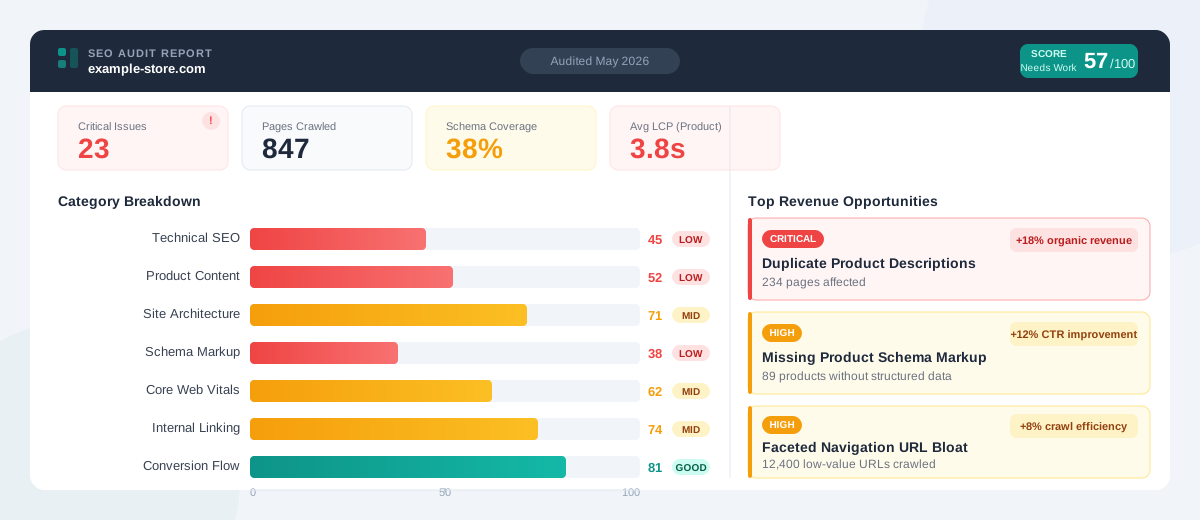
Declining organic traffic costs ecommerce stores millions in lost revenue each year because even small ranking drops can reduce visibility across hundreds of product pages simultaneously. Unlike content-focused websites, ecommerce stores generate constant SEO instability through duplicate manufacturer descriptions, faceted navigation, thin category pages, and inventory changes that alter internal linking and indexation patterns daily.
When Google encounters duplicated product content or inconsistent URL structures, it becomes harder for the search engine to determine which pages should rank, often diluting authority across similar URLs. Inventory fluctuations can also remove high-performing pages from the index unexpectedly, causing traffic losses that compound across entire product categories.
This ecommerce SEO audit framework identifies the technical and content issues most commonly responsible for ranking declines, then maps each issue to a prioritised recovery approach for product and category pages. Every section includes quantified thresholds, examples, and remediation triggers so ecommerce teams can identify problems earlier, prioritise fixes based on impact, and prevent small SEO failures from escalating into major revenue loss.
Run a free audit before you start
Use the free tools below to benchmark your pages before working through this framework. Each tool analyses the live URL and returns a prioritised report in under 60 seconds.
What Makes Ecommerce SEO Auditing Different
Ecommerce SEO auditing is fundamentally different from auditing a content site or a service website. Product-driven platforms must simultaneously optimise for discovery, conversion, and user experience across thousands of product pages, category hierarchies, and purchase pathways. A standard technical SEO audit misses the commerce-specific failure modes that are responsible for most ranking declines in online retail.
According to Baymard Institute research, 68% of shopping carts are abandoned, with poor site search and navigation accounting for a significant portion of that drop-off. An ecommerce SEO audit must address both the factors that bring organic traffic in and the structural issues that prevent that traffic from converting.
Three Interconnected Systems
Ecommerce SEO success depends on three systems working together. When any one of them is broken, the other two cannot compensate.
- Product discoverability: How search engines find, crawl, and rank your product and category pages. This is driven by site architecture, crawl budget management, structured data implementation, and content originality.
- Internal site navigation: How users and crawlers move through your catalogue. Poor navigation concentrates authority on homepage and top-level categories while leaving mid-tier and product pages with insufficient internal link support.
- Technical infrastructure: Core Web Vitals, mobile performance, JavaScript rendering, and server response times. These directly affect both user experience and Googlebot's ability to process and index your pages efficiently.
Each product page must serve two roles at once: ranking for specific product queries and contributing to broader category-level authority signals. This creates a cascading effect where individual product page decisions affect category performance, and category performance affects domain-level authority. Ecommerce audits must evaluate all three systems together, not in isolation.
Audit scope reminder
Ecommerce audits must evaluate both traditional SEO factors and commerce-specific elements: structured data implementation, faceted navigation crawlability, and inventory-based content management. Audit findings must be prioritised not just by search visibility impact, but by their direct correlation to conversion rates and revenue metrics.
Technical SEO Audit Framework for Ecommerce
Technical SEO auditing for ecommerce sites requires a systematic approach that addresses the unique challenges of large product catalogues and dynamic inventory. Ecommerce sites typically contain 10 to 100 times more pages than standard websites, creating exponential complexity in crawl budget optimisation, duplicate content management, and site architecture planning.
Four Diagnostic Phases
Run these four phases in sequence. Each phase informs the next, and skipping ahead will cause you to treat symptoms rather than root causes.
Crawl accessibility assessment
Use Screaming Frog or Sitebulb to crawl the full site and identify orphaned product pages (pages with no internal links), pagination implementation problems, and faceted navigation parameter handling. Export the full crawl and filter for pages returning non-200 status codes, pages blocked by robots.txt, and pages with duplicate title tags or meta descriptions across more than three URLs.
Page load performance analysis
Measure Core Web Vitals using Google Search Console's Core Web Vitals report and PageSpeed Insights for individual product and category URLs. Focus on LCP first: product hero images are the most common LCP bottleneck on Shopify and WooCommerce stores. LCP must be under 2.5 seconds, INP under 200 milliseconds, and CLS under 0.1 to meet Google's Good threshold.
Mobile commerce functionality testing
Test the full purchase funnel on mobile: product discovery, product page, add-to-cart, checkout, and payment. Identify where organic mobile traffic drops off versus desktop. Mobile filter experiences, image carousels, and sticky add-to-cart buttons are common sources of CLS and INP problems that hurt both rankings and conversions simultaneously.
Structured data validation
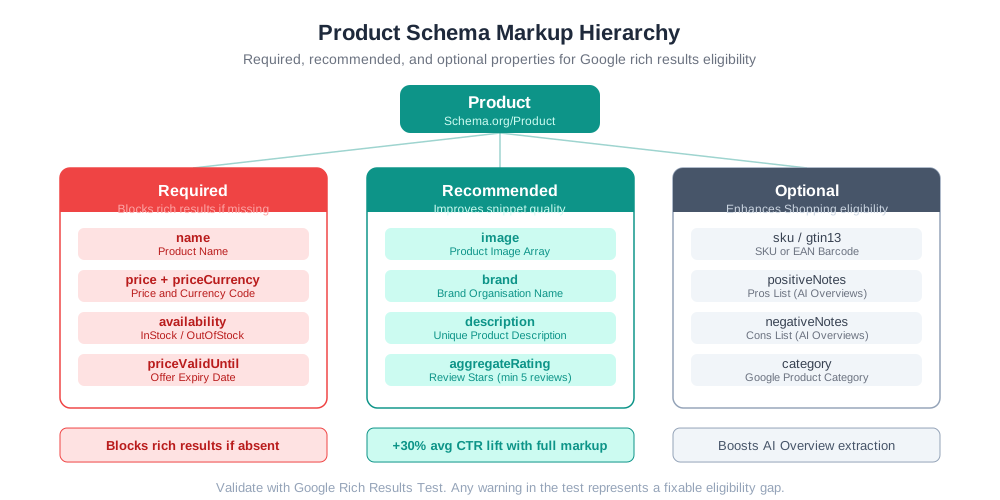
Run every product page template through Google's Rich Results Test. Validate that Product schema includes all required fields: name, image, description, brand, SKU, Offer (with price, priceCurrency, availability, and priceValidUntil), and AggregateRating where reviews exist. Use the Schema Markup Validator to catch property-level errors that the Rich Results Test sometimes misses.
Technical auditing typically reveals three categories of issues. Blocking problems prevent search engines from accessing product content. Efficiency problems waste crawl budget on low-value pages. User experience problems increase bounce rates despite successful organic traffic acquisition. Technical fixes must be prioritised by their combined impact on search visibility and conversion funnel performance, not on technical severity alone.
Critical: Crawl budget on large catalogues
Sites with more than 10,000 indexed faceted URLs can see a substantial portion of their crawl budget consumed by duplicate or thin filtered pages. Check Google Search Console's Coverage report for the scale of faceted indexation on your store before prioritising any other technical fix.
Product Page Content Audit Methodology
Product page content auditing demands a systematic evaluation methodology that balances search optimisation with conversion optimisation. Product pages serve as both search landing pages and sales conversion tools, requiring content that satisfies search intent while providing sufficient detail to drive purchase decisions.
Research from Salsify indicates that 87% of consumers rate product content as extremely important when making purchase decisions online. This creates a direct connection between content quality and revenue that most technical SEO audits fail to measure.
Five Content Dimensions to Evaluate
Evaluate each product page template across these five dimensions. A page that scores poorly on any single dimension will underperform relative to competitors who have addressed all five.
- Title optimisation: Product titles must lead with the primary product keyword, include the brand name, and match the search query format buyers use. Manufacturer part numbers should appear in the title only if buyers search by part number in your category.
- Description quality and uniqueness: At least 20% of the product description must contain information that does not appear on the manufacturer spec sheet or on competitor listings. Descriptions that restate manufacturer copy verbatim cannot earn a unique ranking signal from Google's Helpful Content system.
- Image optimisation: Product images require descriptive alt text that follows the three-part reasoning framework (what it shows, what this demonstrates, why it matters to the buyer), proper file naming using the product name rather than auto-generated identifiers, and compression to under 100KB for standard product shots.
- Technical specification completeness: Specifications must appear in a structured HTML table with scope attributes. Tables are disproportionately extracted by AI systems for comparison queries. Missing specifications are a common reason product pages lose visibility in AI Overviews.
- User-generated content integration: Review markup using AggregateRating schema must match the visible on-page rating exactly. Google cross-validates schema values against on-page content and suppresses rich results when they do not match.
The rewritten version contains original observations, specific use cases, and comparative information that a manufacturer spec sheet will never include. Google's Helpful Content system rewards exactly this type of expertise-driven originality and penalises pages that add no information gain beyond what a supplier's PDF already contains.
Product Page SEO Checker
82 checks across technical SEO, schema, conversion, and content quality. Sample of what the tool evaluates:
LCP image optimisation
Hero product image must have fetchpriority="high" and must not use loading="lazy". Explicit width and height required to prevent CLS.
Product schema (core)
JSON-LD must include name, image array, description, brand name, SKU, and URL. Missing any of these blocks rich result eligibility.
Offer schema
Price, priceCurrency, availability (full URI e.g. https://schema.org/InStock), priceValidUntil, and itemCondition all required. Price must match the visible on-page price.
Information gain
At least 20% of product content must not appear on the manufacturer spec sheet or competitor listings. Spec rehashes score zero on information gain.
GTIN / MPN identifiers
gtin13 (EAN), gtin12 (UPC), or mpn required in schema. Each variant needs its own unique GTIN. Google validates GTIN checksums for Shopping eligibility.
AggregateRating schema
ratingValue, reviewCount, bestRating, and worstRating all required inside Product schema. Must match visible on-page rating exactly.
AI-ready product summary
50 to 80 word conversational product summary before the specs section. Covers what it is, who it's for, primary benefit, and key feature. The primary block LLMs extract for AI Overviews.
Specifications table
Technical specs in a structured HTML table with scope attributes and a caption element. Tables are disproportionately extracted by LLMs for comparison queries.
The full tool checks 74 more signals including canonical tags, CRO elements, trust badges, BNPL display, FAQ schema, video transcripts, and INP performance.
Run free product auditContent auditing typically identifies patterns of deficiency across product categories rather than isolated individual pages. This reveals opportunities for template improvements that can scale across thousands of products at once. Common systemic findings include thin product descriptions that fail to differentiate from manufacturer copy, missing or poorly optimised images that reduce both search visibility and user confidence, and inadequate structured data implementation that limits rich snippet eligibility.
Conversion Flow SEO Diagnostics
Conversion flow SEO diagnostics examine the intersection between search optimisation and ecommerce funnel performance. SEO efforts become commercially meaningless if users abandon the conversion process due to technical barriers, content gaps, or user experience friction. Studies by Baymard Institute show that the average cart abandonment rate across industries exceeds 70%, with mobile users abandoning at higher rates than desktop.
The diagnostic mechanism involves tracking user behaviour through the complete purchase funnel from initial organic landing through checkout completion, identifying SEO-related obstacles at each stage. This analysis requires integrating Google Analytics 4 enhanced ecommerce data with technical SEO audit findings to pinpoint where organic traffic encounters conversion barriers.
- Product page engagement metrics: Analyse time on page, scroll depth, and add-to-cart rate for organic traffic specifically, not all sessions. Organic visitors often have higher commercial intent than direct or social traffic, so a low add-to-cart rate from organic visitors typically indicates a content or trust signal gap rather than a traffic quality issue.
- Add-to-cart conversion rates by traffic source: Segment organic traffic by landing page type (product pages versus category pages) and compare conversion rates. A significant gap between product page and category page conversion rates suggests category page content is not adequately pre-qualifying purchase intent before the user reaches the product page.
- Checkout drop-off by device: Google Analytics 4's purchase funnel report, segmented by organic traffic and device type, shows exactly where mobile organic users abandon the checkout. Compare mobile and desktop abandonment rates at each checkout step. A disproportionate mobile drop-off at the payment step typically indicates a page speed or payment UI problem specific to mobile browsers.
- Trust signal gaps: Organic traffic from new users (visitors who have never visited your site before) converts at a significantly lower rate if trust signals are absent or below the fold. Shipping timeframes, returns policies, security badges, and customer review counts must be visible without scrolling on product pages.
Seasonal product warning
Seasonal products such as Christmas decorations, back-to-school stationery, and Easter gifts should never be deleted between seasons. Keep category pages live year-round with evergreen content. Update the category to reflect the off-season status rather than removing it. Categories deleted and recreated each season lose their accumulated ranking history every cycle.
Prioritising Audit Findings by Revenue Impact
Revenue impact prioritisation is the critical synthesis phase where audit findings transform into actionable business strategy. Not all SEO issues carry equal business impact. A technical problem affecting high-converting product categories demands immediate attention, while similar issues on low-value pages can be addressed in subsequent optimisation phases.
According to research by Wolfgang Digital, the top 10% of product pages typically generate over 50% of organic ecommerce revenue. This concentration of value means that fixing SEO issues on your top-performing pages will almost always deliver a higher return than fixing the same issues across a broad swath of lower-value pages.
Create a scoring matrix that weights each audit finding by:
- Organic traffic volume to affected pages: Issues on pages receiving more than 500 organic sessions per month deserve higher priority than the same issue on pages receiving fewer than 50.
- Conversion rate of the impacted user segment: An issue affecting a product category with a 4% conversion rate has twice the revenue impact of the same issue on a category converting at 2%.
- Average order value for affected product categories: Technical issues on high-AOV categories have an outsized revenue impact relative to the page count affected.
- Competitive visibility gaps for high-value keywords: If a competitor outranks you for a keyword driving significant purchase intent, the potential revenue recovery from closing that gap should weight the priority score upward.
- Implementation complexity and timeline: A fix that can be deployed in one day should be weighted higher than a fix of equal revenue impact that requires a 3-month development cycle, because the faster fix generates compounding returns sooner.
Prioritisation analysis typically reveals that 20% of identified issues account for 80% of potential revenue recovery. Common high-priority findings include technical problems affecting top-converting product categories, mobile optimisation issues that impact the growing mobile commerce segment, and page speed problems that reduce conversion rates across the entire funnel. The implementation implication requires developing a phased project roadmap with clear revenue milestones so stakeholders can track the commercial return from SEO investment.
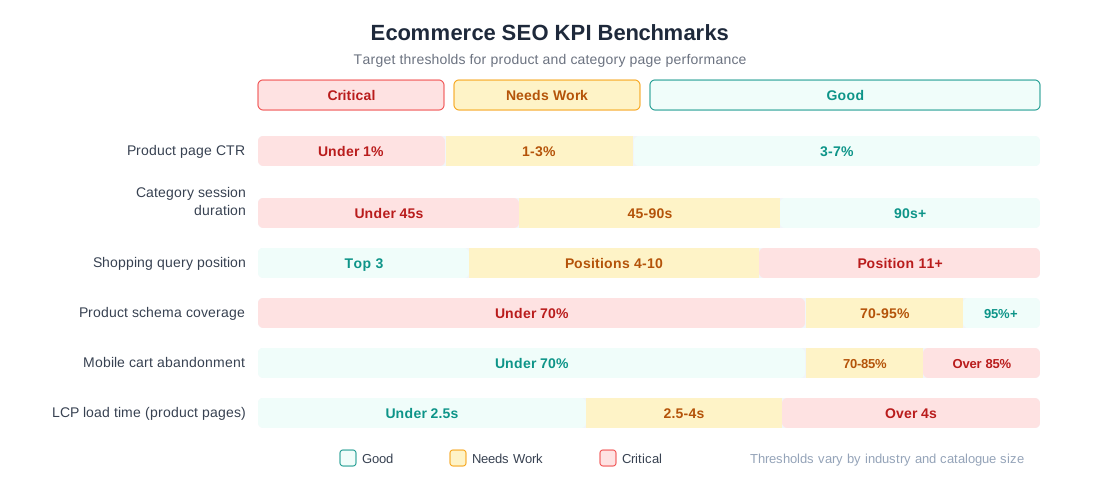
Metrics are indicative and vary by industry and catalogue size. Use as benchmarks for internal comparison rather than absolute targets.
Complete Ecommerce SEO Audit Checklist
This checklist synthesises all diagnostic methodologies into a systematic evaluation framework. Use it as both a diagnostic tool and a project management reference, organised by priority level and expected business impact. Work through each group sequentially: technical infrastructure issues must be resolved before content and conversion optimisations can deliver their full impact.
Technical Infrastructure
- Site crawlability assessment including robots.txt validation and XML sitemap optimisation
- Page speed analysis across product, category, and checkout pages using Core Web Vitals metrics
- Mobile responsiveness testing with specific focus on product browsing and checkout functionality
- SSL certificate implementation and security signal optimisation
- Structured data validation for products, reviews, breadcrumbs, and organisation markup
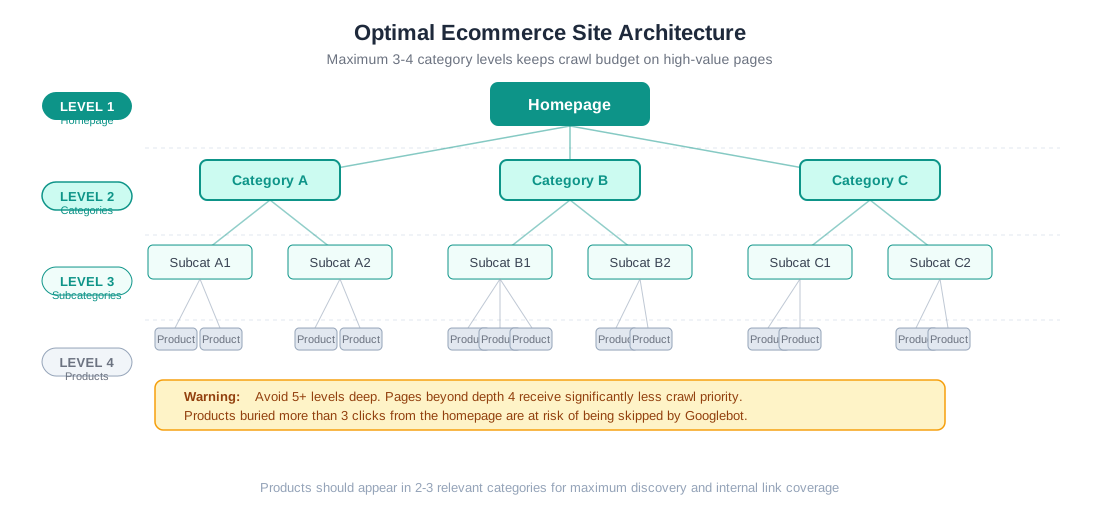
- Crawl depth audit confirming all priority pages are reachable within 3 clicks from the homepage
- Log file analysis (where available) to identify which pages Googlebot is actually crawling versus which are being skipped
Product Catalogue Optimisation
- Product page content quality assessment including description uniqueness and keyword optimisation
- Image optimisation including file compression, alt text implementation, and schema markup
- Internal linking analysis to ensure proper link equity distribution across product categories
- Duplicate content identification and canonicalisation strategy implementation
- User-generated content integration including review optimisation and Q&A functionality
- Out-of-stock page handling audit: verify redirect, noindex, or keep-live decisions for all discontinued and temporarily unavailable SKUs
- GTIN/MPN identifier audit across all product schema to confirm Google Shopping eligibility
Category and Navigation Analysis
- Category hierarchy evaluation for optimal depth and internal linking structure
- Faceted navigation SEO compatibility including parameter handling and canonicalisation
- Breadcrumb implementation and structured data markup validation
- Site search functionality optimisation including search result page SEO
- URL structure consistency and optimisation across product and category pages
- Seasonal category continuity audit: confirm no category pages are being deleted and recreated between seasons
- Pagination audit confirming Googlebot can reach page 2 and beyond on all paginated category pages
Conversion Flow Diagnostics
- Organic traffic conversion rate analysis by landing page type and user segment in GA4
- Checkout process technical optimisation including page speed and mobile functionality
- Trust signal implementation audit: security badges, customer reviews, and guarantee statements visible above the fold
- Cart abandonment analysis with specific focus on organic traffic versus other channels
- Payment page optimisation and technical performance validation
- Mobile checkout funnel comparison versus desktop to identify device-specific friction points
- Above-the-fold shipping and returns visibility check on all product page templates
Need a professional ecommerce SEO audit?
SearchMinistry's e-commerce SEO services include full diagnostic audits, prioritised remediation roadmaps, and ongoing technical implementation for product-driven stores of all catalogue sizes.
Talk to an ecommerce SEO specialistFrequently Asked Questions
How long does an ecommerce SEO audit take?
A thorough ecommerce SEO audit takes 2 to 5 business days depending on the size of the catalogue. A store with under 500 products can be fully audited in 2 days using a structured checklist. Stores with 5,000 or more SKUs require crawler-assisted audits using tools such as Screaming Frog alongside manual sampling of category and product pages. The audit itself is only one part: remediation planning and prioritisation add another 1 to 2 days for larger stores.
What is the most common ecommerce SEO issue found during audits?
Duplicate product descriptions are the most common issue found across ecommerce sites. Most online retailers copy manufacturer-supplied descriptions directly onto their product pages. Because the same text appears on hundreds of competitor sites, Google cannot identify a unique ranking signal for any individual page. The fix is to rewrite descriptions with original feature analysis, real-world usage context, and buyer-specific information that manufacturers do not provide.
How does faceted navigation damage crawl budget?
Faceted navigation generates a unique URL for every combination of filters a visitor can select. A store with 10 colour options, 8 size options, and 5 material options can produce 400 URL combinations from a single category page. Googlebot attempts to crawl each unique URL, spending crawl budget on thin or duplicate content rather than on canonical product and category pages. Sites with more than 10,000 indexed faceted URLs can see a substantial portion of their available crawl budget consumed by non-ranking pages.
Should out-of-stock product pages be deleted or kept?
Out-of-stock product pages should almost never be deleted. If the product is temporarily unavailable, keep the page live with an updated availability status in both the on-page content and the Product schema. If the product is permanently discontinued, redirect the URL to the most relevant category page or to the closest substitute product. Deleting the page and returning a 404 wastes any accumulated link equity and ranking history the page has built, which can take years to recover.
How many reviews does a product need before Google shows star ratings?
Google requires a minimum of 5 reviews before it will display AggregateRating star snippets in search results for most product categories. The reviews must be marked up with valid Review and AggregateRating schema, the review content must be genuine and verifiable, and the reviewRating values must fall within the schema's declared bestRating and worstRating range. Self-review or incentivised-only review schemes risk a manual action under Google's product reviews guidelines.
What Core Web Vitals thresholds apply to ecommerce product pages?
Google's Core Web Vitals thresholds are the same for all page types: LCP under 2.5 seconds is Good, 2.5 to 4 seconds needs improvement, and above 4 seconds is poor. INP under 200 milliseconds is Good, CLS under 0.1 is Good. For ecommerce, product image carousels are the most common LCP problem. Images above the fold should use fetchpriority="high" and loading="eager". Lazy-loading the hero product image is one of the most common LCP mistakes on Shopify and WooCommerce stores.
How often should an ecommerce store run an SEO audit?
Run a full structural audit twice a year: once before peak trading periods (September before Christmas, late January before back-to-school) and once after any significant site change such as a platform migration, a catalogue restructure, or a major template update. Run a lightweight monthly audit covering new product pages, broken links, and Core Web Vitals for high-traffic category pages. Google Search Console should be reviewed weekly for any indexing anomalies or crawl errors.
Does product schema work differently on Shopify versus WooCommerce?
Both platforms auto-generate some Product schema from their native product data fields, but neither generates complete markup by default. Shopify's native schema omits AggregateRating, review markup, and offer condition fields. WooCommerce's native schema often uses incorrect availability values and misses GTIN/MPN fields required for Google Shopping integration. Both platforms require either a dedicated SEO plugin or custom theme-level schema injection to produce schema that passes Google's Rich Results Test without warnings.

Tharindu Gunawardana
Founder & Director, SearchMinistry Media
Tharindu Gunawardana is the Founder of SearchMinistry Media and a search strategist with 17 years of experience across Sri Lanka, Singapore, and Australia. A former Agency SEO Director, he specialises in ecommerce SEO, helping online stores recover organic traffic and fix the structural issues that block product and category page rankings.