A traffic drop signals an algorithm impact or an active penalty, and neither resolves itself without deliberate action. One morning your organic traffic is where it should be. The next, Google Analytics shows a 30 percent, 50 percent, or 80 percent decline. Rankings that took months to build have vanished from the first page. For Australian businesses that depend on organic search for lead generation, the financial impact begins immediately.
This guide explains exactly what causes ranking drops, how to distinguish between an SEO penalty and an algorithm update, and how a structured recovery strategy restores rankings without repeating the mistakes that caused the problem in the first place. Every section maps to a real diagnostic or remediation action you can take today.
| Section | What It Covers | Priority |
|---|---|---|
| Ranking Drop Causes | Algorithm updates vs manual actions, how to tell them apart | High |
| Backlinks and Authority | How backlinks influence rankings and when toxic links trigger penalties | High |
| Content and Technical Issues | Content quality signals and crawlability problems | High |
| The Audit Process | Google Search Console reports, log file analysis, link audits | High |
| Recovery Strategy | Step-by-step restoration including disavow file submission | High |
| AI Visibility Impact | How penalties reduce AI search citations and what to fix | Medium |
| Monitoring Stack | Tools and cadence to prevent future ranking drops | Medium |
What Causes a Ranking Drop
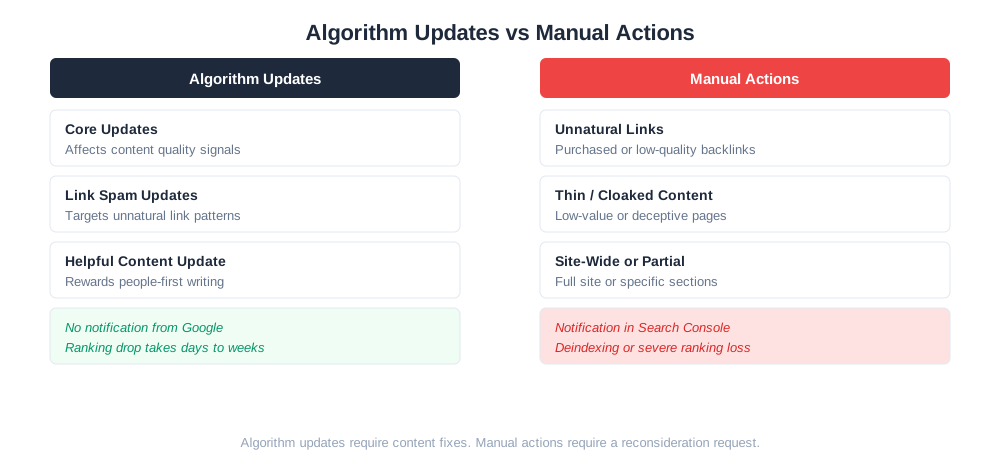
Not every ranking drop has the same cause, and treating them as identical is the most common mistake in recovery. An SEO penalty causes a ranking loss that is deliberate, targeted, and reversible through a formal process. An algorithm update impacts search visibility across all sites simultaneously, favoring those whose content and technical foundation align with the updated quality criteria. Diagnosing which one you are dealing with is the first step before any recovery work begins.
The clearest diagnostic is timing. Log into Google Search Console and note the exact date your impressions and clicks dropped. Then check that date against published Google algorithm update timelines. If your drop coincides with a confirmed Core Update, Spam Update, or Helpful Content system update, you are dealing with an algorithmic shift. If Google Search Console shows a notification under Security and Manual Actions, you have a manual penalty requiring a formal reconsideration process.
Key distinction
Algorithm updates require you to improve your site to align with updated quality standards. Manual actions require you to fix specific policy violations and file a reconsideration request. Submitting a reconsideration request for an algorithm-related drop wastes time and gets rejected. Waiting for an algorithm to recover from an active manual action is equally fruitless.
Algorithm Updates vs Manual Actions
A manual action results in deindexing or severe penalties when a Google reviewer determines that a site, section, or page violates the Google Search Essentials. Common triggers include unnatural link patterns, thin or doorway content, cloaking, sneaky redirects, and hidden text. Manual actions can be site-wide, meaning they affect your entire domain, or partial, targeting specific sections or page types.
Algorithm updates impact search visibility differently. There is no notification, no reviewer, and no appeal process. Google's systems re-evaluate every page in the index against updated signals, and sites that previously benefited from keyword matching without genuine authority lose positions to sites with stronger semantic relevance, better engagement metrics, and cleaner technical foundations.
Google's 2024 and 2025 core updates placed particular weight on the Helpful Content system, which evaluates whether content is written primarily for people or primarily for search engines. Sites in Australia that relied on templated suburb landing pages, AI-generated product descriptions without human review, or content farms saw ranking losses ranging from 40 to 90 percent of their previous organic traffic.
How Backlinks Influence Site Authority
Backlinks influence site authority as one of Google's strongest ranking signals, but the relationship is not linear. A single link from a trusted government, university, or national publication carries more authority than 500 links from low-quality article directories. What matters is the relevance, trustworthiness, and editorial nature of the linking source.
Google's PageRank algorithm, still active beneath layers of more recent systems, distributes link equity through a site's link graph. Pages with strong incoming authority pass that equity to the pages they link to internally. A healthy backlink profile creates a rising tide across your entire domain. A toxic link profile, concentrated with spammy or paid links, suppresses authority across every page, not just the targeted one.
74%
of manual actions
Most manual actions are link-related
Search quality evaluator data consistently shows that unnatural inbound links account for the majority of site-wide manual actions. Private blog networks, paid guest post schemes, and expired domain redirects are the most frequent offenders across Australian business sites.
When Toxic Links Trigger Penalties
Toxic links trigger penalties when Google determines that the links were placed to manipulate PageRank rather than because of genuine editorial endorsement. The clearest indicators of a toxic link are: the linking site exists solely to sell links, the anchor text is exact-match keyword-rich across multiple domains, the linking page has no topical relevance to yours, or the site has a Spam Score above 40 percent in tools like Moz or Semrush.
Private blog networks, or PBNs, are particularly problematic. These are clusters of expired domains purchased and redirected or maintained to create the appearance of organic linking. Google's algorithms identify PBN patterns through IP clustering, WHOIS data, link velocity anomalies, and content fingerprinting. Once a PBN is detected, all sites linked from it face either algorithmic suppression or manual review.
Warning
Do not disavow links without first attempting to remove them directly. Google's guidelines require genuine removal efforts before a disavow file is considered. Skipping direct outreach and going straight to disavow may result in reconsideration requests being denied.
Content Quality and Technical Issues
Content quality affects rankings through multiple signal layers that Google evaluates both at the page and site level. The Helpful Content system applies a site-wide classifier, meaning that a large volume of low-quality content on your domain suppresses rankings for all pages, including your strongest ones. Sites where more than 30 percent of indexed pages are thin, duplicated, or AI-generated without human review are particularly vulnerable.
Google's quality rater guidelines use the E-E-A-T framework: Experience, Expertise, Authoritativeness, and Trustworthiness. Pages that demonstrate first-hand experience, cite credible sources, provide original analysis, and show clear authorship score better under human quality review. These human quality assessments train the machine learning systems that ultimately determine automated rankings.
Technical Issues That Reduce Crawlability
Technical issues reduce crawlability when they prevent Google's crawlers from discovering, rendering, or indexing your pages correctly. Crawlability problems are distinct from content quality issues because they affect whether Google can access your content at all, regardless of its quality. A page blocked by robots.txt, returning a 5xx server error, or gated behind JavaScript that Googlebot cannot render is invisible to the index.
| Technical Issue | Crawlability Impact | Diagnostic Signal |
|---|---|---|
| robots.txt blocking key pages | Complete crawl block | Coverage report: Blocked by robots.txt |
| noindex tags on important pages | Removed from index | Coverage report: Excluded by noindex |
| Server errors (5xx) | Crawl failures accumulate | Coverage report: Server error |
| Slow TTFB (above 800ms) | Crawl budget waste | Core Web Vitals: TTFB field data |
| JavaScript-gated content | Content not rendered | URL inspection: rendered HTML check |
| Redirect chains (3+ hops) | PageRank dilution | Log file analysis: redirect loop flags |
| Soft 404 pages | Quality signal degradation | Coverage report: Soft 404 |
Crawl budget matters most for large sites. Google allocates a crawl rate to each domain based on its authority and server speed. If your site has thousands of pages, crawlers will not visit all of them on every crawl cycle. Pages that load slowly, return errors, or are duplicated across multiple URLs consume crawl budget without adding index value, leaving important pages crawled less frequently.
Running the Audit to Identify Root Cause
An audit identifies the root cause by systematically ruling out each possible explanation for the ranking drop. A structured audit covers five areas: manual action status, algorithm update timing, backlink profile health, content quality signals, and technical crawlability. Working through all five before drawing conclusions prevents misdiagnosis, which is the primary reason recovery efforts fail.
Start the audit within 48 hours of noticing the drop. Rankings that have fallen due to a technical issue, such as a faulty robots.txt pushed in a site update, can be recovered quickly if caught early. Rankings that have fallen due to a Core Update require longer remediation, but the sooner the audit identifies the misaligned signals, the sooner content improvements can be prioritised.
Reading Google Search Console Reports
Google Search Console reports penalties under the Security and Manual Actions section. A manual action notification describes the specific violation, whether it is site-wide or partial, and provides guidance on the expected remediation. Google Search Console also reports on index coverage, Core Web Vitals field data, mobile usability issues, and the links pointing to your site, all of which are relevant to diagnosing a ranking drop.
Check Security and Manual Actions
Open Google Search Console and navigate to Security and Manual Actions. A green tick means no active manual actions. Any message here requires immediate attention and documents the specific violation Google found.
Compare performance data with update dates
In the Performance report, set the date range to the last six months and look for sudden drops in impressions and clicks. Note the exact date and cross-reference it with the Google algorithm update timeline at developers.google.com/search/updates.
Review Coverage and Index reports
Under Indexing, check Coverage for a spike in errors, excluded pages, or soft 404s. A sudden increase in 'Crawled but not indexed' warnings suggests quality issues at scale.
Audit the Links report
Under Links, review your top linking sites. Export the full list and flag any domain with obvious spam signals: no real content, unrelated niche, or exact-match anchor text pointing to your money pages.
Run URL Inspection on affected pages
Use URL Inspection on your highest-traffic pages that dropped. Compare the rendered HTML with your source HTML to identify JavaScript rendering gaps. Confirm the indexing status and last crawl date.
Recovery Strategy: Restoring Rankings Step by Step
A recovery strategy restores rankings by systematically removing the signals that caused the penalty or algorithmic suppression and replacing them with signals that align with Google's current quality standards. Recovery is not a single action. It is a sequential process where each step depends on the completion of the previous one, and where premature submission of a reconsideration request results in rejection and an extended waiting period.
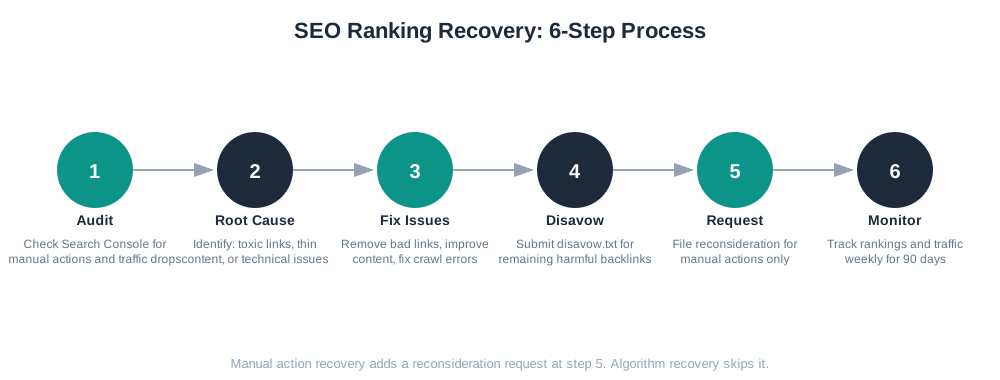
For algorithm-related drops, the recovery path is improvement, not appeal. You cannot petition Google to reverse an algorithm update's effect on your site. You can only improve the quality signals that the algorithm evaluated unfavorably. This typically involves rewriting thin content, consolidating duplicate pages, removing low-quality posts, improving page experience metrics, and building legitimate authority through editorial link acquisition and digital PR.
A digital PR strategy builds the authority signals that both ranking systems and AI retrieval engines weight heavily. Securing coverage in credible Australian publications such as SmartCompany, Inside Small Business, and industry-specific outlets creates editorial backlinks that improve domain authority while also establishing brand entity signals that feed into AI knowledge systems.
Using a Disavow File to Remove Harmful Links
A disavow file removes harmful links from Google's evaluation of your site's link profile by instructing Googlebot to discount specific URLs or domains when calculating your authority. It is a tool of last resort, used only after genuine attempts to remove links through direct outreach to site owners have failed or received no response within 30 days.
Critical
Disavowing high-quality links from authoritative sites causes ranking drops. Before adding any domain to your disavow file, verify it is genuinely harmful. A domain with real traffic, editorial content, and relevance to your niche should never be disavowed, even if the anchor text is unusual.
The disavow file uses a plain text format. Each line specifies either a full URL (to disavow a single page) or a domain (to disavow all links from a site). Comments use the hash character. Upload the file through Google Search Console under Links, then Disavow Links.
# Disavow file for searchministry.au
# Created: April 2026 — Links confirmed unnatural after outreach
# Disavow entire spammy domains
domain:cheap-links-network.com
domain:expired-domain-farm.net
domain:pbn-article-directory.org
# Disavow individual URLs where only one page links to us
https://random-guest-post-site.com/sponsored/keyword-anchor-text/
# Format rules:
# domain:example.com — disavows ALL links from this domain
# https://example.com/page — disavows only this specific page
# Do NOT use http:// as a prefix for domain-level disavow
After uploading the disavow file and completing all content and technical fixes, file a reconsideration request through Google Search Console. The request must explain specifically what was found, what actions were taken to remove or disavow each harmful link, and what process is in place to prevent recurrence. Vague requests citing "we cleaned up our links" are denied at high rates. Documentation of outreach emails sent, responses received, and a link-by-link account of what was disavowed and why produces far better outcomes.
AI Visibility After a Ranking Drop
AI systems reduce visibility for content that is weak, penalised, or deindexed, because AI search platforms retrieve from the same web index that powers organic rankings. Google AI Overviews, ChatGPT Search, and Perplexity draw their citations from crawled and indexed web content. A page that has been deindexed due to a manual action is invisible to AI retrieval systems. A page that remains indexed but carries thin content or poor entity clarity ranks lower in AI citation probability even without a formal penalty.
The content quality signals that the Helpful Content system uses to rank pages are closely aligned with the passage-level relevance signals that AI retrieval systems use to decide which content to cite in generated answers. Both systems prefer content with clear subject-verb-object relationships, named entities with defined attributes, specific factual claims, and contextual depth that goes beyond surface-level definitions.
| Recovery Action | Traditional SEO Benefit | AI Visibility Benefit |
|---|---|---|
| Rewrite thin content with depth and specificity | Helpful Content recovery | Higher citation probability in AI answers |
| Build entity-rich structured data | Rich result eligibility | Stronger entity recognition in LLMs |
| Acquire editorial backlinks via digital PR | Domain authority improvement | Brand entity validation in AI knowledge graphs |
| Fix crawl errors and indexing blocks | Full page indexation | AI crawler access restored |
| Improve page load speed and Core Web Vitals | Better ranking signals | Faster retrieval by AI crawlers |
| Disavow toxic links and restore authority | Algorithm suppression lifted | Trust signal restoration for AI ranking |
Sites that complete a full recovery and then invest in retrieval-optimised content structure, including semantic chunking, answer-first paragraph format, and clear entity attribute coverage, tend to see faster AI citation growth than sites that stop at the technical recovery stage. The recovery process creates an opportunity to rebuild content to a higher standard than it was before the penalty.
Monitoring to Prevent Future Penalties
Monitoring prevents future penalties by creating an early-warning system that detects harmful signals before they accumulate to the point of triggering a penalty or algorithm-driven suppression. The most damaging ranking drops are those that were preventable. A backlink profile that takes three months to corrupt with spammy links from a negative SEO attack, a lapsed robots.txt configuration that inadvertently blocks key sections, or a content decline that the Helpful Content system suppresses gradually over six months: all of these are detectable weeks before their impact is visible in rankings.
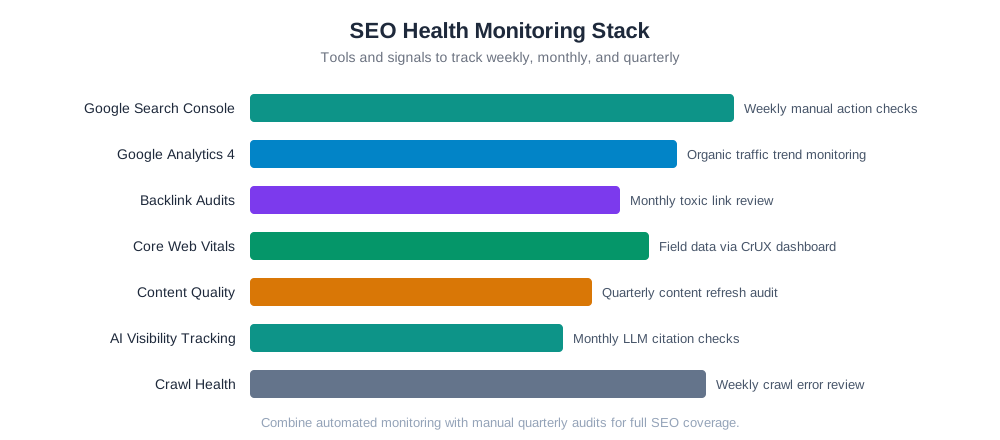
| Signal | Cadence | What to Flag |
|---|---|---|
| Google Search Console manual actions | Weekly | Any notification in Security and Manual Actions |
| Organic traffic trend (GA4) | Weekly | Drop of 10% or more week-on-week with no seasonal explanation |
| New referring domains | Weekly | Spike in low-quality or irrelevant new linking domains |
| Core Web Vitals field data | Monthly | LCP above 2.5s, CLS above 0.1, INP above 200ms |
| Crawl error rate | Weekly | Spike in 5xx errors or sudden increase in Coverage warnings |
| Content quality review | Quarterly | Pages with under 300 words, duplicated sections, or zero engagement |
| AI citation monitoring | Monthly | Test key queries in ChatGPT, Perplexity, and Google AI Overviews |
Negative SEO is a real risk for Australian businesses in competitive industries. A competitor can point thousands of spammy links at your site using automated tools, and while Google's algorithms are better at ignoring these than they were five years ago, a concentrated attack from recently expired domains with previously clean histories can still trigger a manual review. Monitoring new referring domains weekly with a threshold alert (more than 50 new linking domains in seven days from sites with no organic traffic) catches these campaigns early enough to disavow them before they accumulate.
Recovery Support for Australian Businesses
SearchMinistry Media conducts penalty recovery audits and reconsideration request preparation for Australian businesses. If your site has experienced a ranking drop in the past 90 days, an SEO audit identifies the root cause across all five diagnostic areas and produces a prioritised remediation plan.
Request a Penalty AuditFrequently Asked Questions
How long does it take to recover from an SEO penalty?
Recovery time depends on the penalty type. Manual action recovery typically takes 4 to 12 weeks after a successful reconsideration request, assuming all issues are resolved. Algorithm-based ranking drops can take one to three Google core update cycles, which occur roughly every two to four months. Sites with widespread toxic link profiles or thin content issues should budget six to nine months for full recovery.
What is the difference between a Google penalty and an algorithm update?
A Google penalty is a deliberate manual action applied by a Google reviewer after detecting a policy violation such as purchased links or cloaked content. An algorithm update is an automated change to Google's ranking systems that affects all sites differently based on quality signals. Penalties appear in Google Search Console under Security and Manual Actions. Algorithm impacts do not trigger notifications and require comparative traffic and ranking analysis to diagnose.
Can I recover from a Google manual action myself?
Yes. Manual action recovery requires three steps: identify every issue flagged by Google, remediate each one completely, then submit a reconsideration request through Google Search Console with detailed documentation of what was found and fixed. Partial fixes or incomplete documentation cause reconsideration requests to be denied. Most Australian businesses benefit from a professional audit before filing to avoid a second denial, which resets the waiting period.
What does a disavow file do and when should I use one?
A disavow file instructs Google to ignore specific backlinks when evaluating your site's link profile. It should be used only after you have made genuine efforts to remove harmful links directly, and only when the links are clearly unnatural, spammy, or part of a link scheme. Incorrect disavow usage, such as disavowing authoritative links or submitting a file with syntax errors, can worsen rankings. Format each line as domain:example.com for domains or the full URL for individual pages.
How do I know if my traffic drop is from an algorithm update or something else?
Cross-reference your traffic drop date against published Google algorithm update dates using sources such as Google's Search Central blog and third-party trackers including Semrush Sensor and MozCast. If the drop aligns with a confirmed update, the cause is algorithmic. If the drop is gradual or precedes any updates, check for crawl errors, indexing issues, or technical changes on your site. A sudden drop with no update alignment may indicate a manual action or a server issue.
Does a ranking penalty affect AI search visibility as well?
Yes. AI search systems including Google AI Overviews, ChatGPT Search, and Perplexity retrieve content from the same web index that powers organic rankings. A penalised or deindexed page is unavailable for AI retrieval. Beyond direct penalties, thin content and poor entity clarity reduce AI citation probability even without a formal penalty. Recovery work that improves content depth and semantic clarity benefits both traditional rankings and AI visibility simultaneously.
What are the most common causes of ranking drops for Australian small businesses?
The most common causes seen across Australian small business sites are low-quality backlinks from expired domain schemes, thin location pages duplicated across suburb targets, Core Web Vitals failures on mobile, missing or incorrect schema markup, and content that targets keywords without genuine topical depth. Google's Helpful Content system has particularly affected sites using templated location content with less than 60 percent unique copy per page.
How often should I audit my site's backlink profile?
Conduct a full backlink audit at least quarterly for active sites and monthly for any site that has previously received a manual action or participated in link building campaigns. Use Google Search Console's Links report alongside a third-party tool such as Ahrefs or Semrush to identify new referring domains. Flag any domain with a spam score above 30, sites unrelated to your industry, and links from private blog networks or article directories.

Tharindu Gunawardana
Founder & Director, SearchMinistry Media
Tharindu Gunawardana is the Founder of SearchMinistry Media and a search strategist with 17 years of experience across Sri Lanka, Singapore, and Australia. A former Agency SEO Director, he specialises in helping brands recover organic visibility after penalties and algorithm impacts.