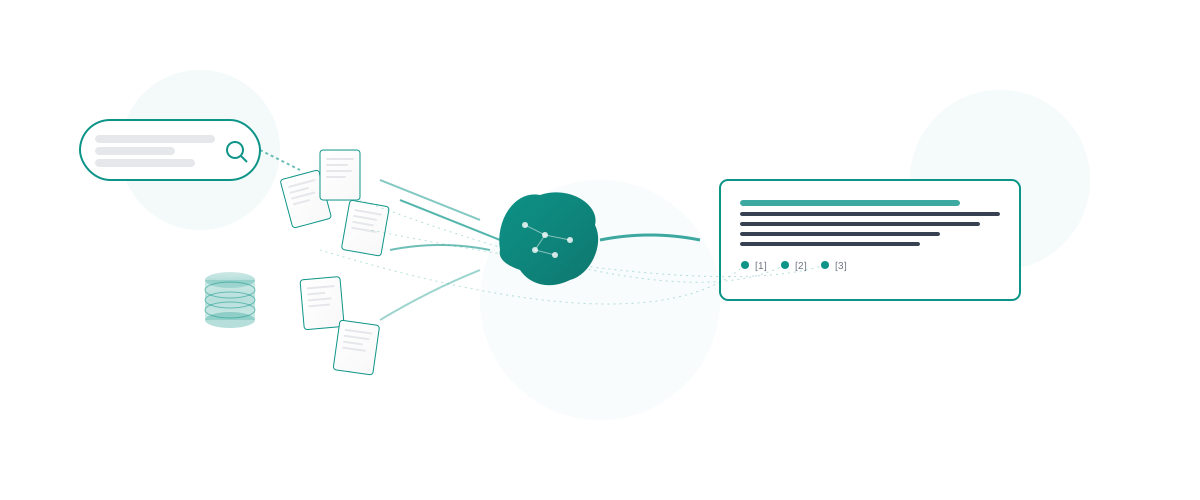
Retrieval Augmented Generation (RAG) is the core technique behind how AI search products like Google AI Overviews, Perplexity, and ChatGPT search generate answers. It is the reason your content can appear as a cited source in AI-generated responses. Understanding RAG is essential for anyone optimising content for AI-driven search.
What Is RAG?
Retrieval Augmented Generation (RAG) is a technique that combines two capabilities: retrieving relevant information from external sources and generating a natural language response using that retrieved information as context. Instead of relying solely on what a language model learned during training, RAG pulls in fresh, specific information at the moment a question is asked.
Simple definition
RAG is a method where an AI system first searches for relevant documents, then reads those documents, and then generates an answer based on what it found. It is like giving the AI a research assistant that gathers sources before writing.
The term was introduced in a 2020 paper by Facebook AI Research (now Meta AI), titled "Retrieval-Augmented Generation for Knowledge-Intensive NLP Tasks." The concept has since become the standard architecture for AI search products.
Why RAG Exists
Large language models (LLMs) like GPT and Gemini have a fundamental limitation: they can only work with knowledge from their training data. This creates several problems.
Knowledge cutoff
Training data has a cutoff date. Without RAG, a model cannot answer questions about events after its training. With RAG, it can retrieve current information from the web.
Hallucination
Without external grounding, LLMs sometimes generate plausible but incorrect information (known as "hallucination"). RAG reduces hallucination by providing real source material the model can reference.
Specificity
A general-purpose model may not have detailed knowledge about niche topics. RAG allows it to retrieve specialist content and generate accurate, detailed answers about any subject.
Verifiability
RAG enables citations. Because the model generates its answer from retrieved sources, it can point back to those sources, giving users a way to verify the information. This is why Perplexity and Google AI Overviews show source links.
How RAG Works
The RAG pipeline has two phases. The first is ingestion: documents are chunked, embedded, and stored in a vector database before any query arrives. The second is query time: the user's question triggers retrieval, re-ranking, and generation. Understanding both phases is key to optimising content for AI citation.
Step 1: Ingestion Pipeline
Before a RAG system can answer any question, it must process and store the source documents. This happens in three stages.
First, the document is split into chunks: smaller segments of text, typically 200 to 500 words each. Chunking breaks the document into units that a retrieval system can individually score for relevance. A 5,000-word article becomes 15 to 25 retrievable chunks, each representing a discrete topic or argument.
Second, each chunk is passed through an embeddings model, which converts the text into a numerical vector. This vector encodes the semantic meaning of the chunk, not just its keywords. Two chunks that discuss the same topic in different words will produce similar vectors.
Third, the vectors are stored in a vector database, indexed so that similarity searches can be run in milliseconds across millions of documents. Each vector is linked back to its source chunk so the system can retrieve the original text when a match is found.
Step 2: Retrieval
When a user submits a query, the system encodes it using the same embeddings model used during ingestion. This produces a query vector that sits in the same semantic space as the stored document vectors.
The query vector is compared against all stored vectors using approximate nearest-neighbour search. The system returns the top 20 to 50 most semantically similar chunks, ranked by cosine similarity score. In web-based RAG systems (like AI search products), this retrieval can also involve traditional web search, fetching pages and extracting clean text in real time.
OpenAI's WebGPT paper describes how their system uses a text-based browsing environment where the model searches the web, fetches page content as cleaned text (not raw HTML), and collects references while browsing. The model sees a processed, windowed view of each page rather than the full document.
Step 3: Re-ranking
Initial retrieval is fast but imprecise. Vector similarity finds chunks that are topically nearby in embedding space, but nearby does not always mean directly relevant to the specific question asked. The re-ranker addresses this.
A re-ranker is a cross-encoder model that takes each (query, chunk) pair and scores them together in a single pass. Unlike the bi-encoder used for initial retrieval, which processes query and document separately, the cross-encoder reads both at once, producing a much more accurate relevance score. The trade-off is speed: cross-encoders are slower, so they only process the top candidates from the initial retrieval, not the entire database.
The re-ranker outputs a ranked list with explicit relevance scores. Only the top 3 to 5 highest-scoring chunks are passed forward to the language model. The rest are discarded. This filter is what separates RAG systems that produce accurate, cited answers from those that hallucinate or generalise.
For SEO, the re-ranker is the quality gate your content must pass. A chunk that is merely topically similar will be filtered out. A chunk that directly and precisely answers the query with clear, specific information will be kept. Content written in self-contained, directly answerable blocks survives re-ranking at a higher rate than content that buries answers in long paragraphs.
Step 4: Augmentation
The retrieved documents are combined with the original query to form a single prompt for the language model. This is the "augmentation" step. The model receives something like:
// Simplified RAG prompt structure
Context:
[Document 1: "Machine learning is a subset of AI..."]
[Document 2: "Neural networks use layers of nodes..."]
[Document 3: "Supervised learning requires labelled data..."]
Question: How does machine learning work?
Instruction: Answer the question using only
the provided context. Cite your sources.
The quality and relevance of the re-ranked chunks directly determines the quality of the generated answer. Poor retrieval and weak re-ranking produce poor answers, regardless of how capable the language model is.
Step 5: Generation
The language model reads the combined prompt (context + question) and generates a natural language answer, drawing on the retrieved documents rather than its training data. Because the model has access to specific, relevant source material, it can produce detailed, accurate answers and cite where each piece of information came from.
Google's Thematic Search patent (US12158907B1) reveals an additional layer: query fan-out. A single user query can trigger multiple sub-queries, each focused on a different sub-theme. The system clusters results by theme and generates concise summaries for each cluster. This is the architectural foundation behind Google AI Overviews.
RAG in AI Search Products
Every major AI search product uses some form of RAG. Here is how it manifests across different platforms.
| Product | Retrieval Method | Citation Style | SEO Relevance |
|---|---|---|---|
| Google AI Overviews | Google Search index + thematic clustering | Inline source cards with links | Directly tied to organic rankings and content quality |
| Perplexity | Web search + document fetching | Numbered inline citations with source list | Favours authoritative, well-structured content |
| ChatGPT Search | Bing search + web browsing | Source links in response with hover previews | Content must be crawlable and well-structured |
| Claude (with search) | Web search + page fetching | Inline source references | Values information density and unique insights |
The common thread is that all of these systems retrieve web content and use it to generate answers. If your content is well-structured, authoritative, and semantically aligned with user queries, it has a higher chance of being retrieved, read, and cited by these AI systems.
How RAG Affects AI-Generated Answer Quality
RAG fundamentally changes the relationship between content and search. Adapting your AI SEO approach to account for retrieval based systems is now essential. Here is what it means for your optimisation strategy.
Example: Which Content Gets Retrieved and Cited
Target query: "How does Google AI Overviews choose which sources to cite?"
"Google AI Overviews retrieves candidate passages using embedding similarity, then applies a reranker to surface the top sources. Selection factors include passage-level relevance, domain authority signals, and content freshness."
"AI is changing SEO in many ways. Google has introduced new AI features. These changes are important for your digital marketing strategy and you should keep up to date with them."
The cited passage directly answers the query with specific mechanism detail. The skipped passage discusses the topic without surfacing any retrievable factual content about the selection process.
Your content is now a source for AI, not just a destination for clicks
In traditional SEO, your page appears as a link. In RAG-based search, your page is read, processed, and quoted. The content itself becomes the product. This means information quality, accuracy, and uniqueness matter more than ever.
Front-load key information
RAG systems process content in chunks. The most important information should appear early and clearly. Lead with your conclusion, then expand with supporting evidence. AI systems are more likely to cite content that provides direct, clear answers near the top.
Structure for extraction
Clear headings, short paragraphs, bulleted lists, and comparison tables make it easier for RAG systems to extract relevant passages. Content that is easy for a machine to chunk and retrieve will be cited more often than dense, unstructured prose.
Unique data and original research win citations
RAG systems retrieve from multiple sources and synthesise. If your content contains information that cannot be found elsewhere, such as original research, proprietary data, or unique case studies, it becomes indispensable to the AI's answer. Generic, rewritten content is easily replaced by competing sources.
Crawlability is non-negotiable
If AI crawlers cannot access your content, it cannot be retrieved. Ensure your robots.txt allows AI crawlers (GPTBot, ClaudeBot, PerplexityBot), your content loads without JavaScript dependencies, and your pages are indexed by major search engines.
Deep dive: the 7-stage pipeline and grounding failure modes
For a patent-by-patent breakdown of how the full RAG pipeline works in production, including the grounding verification step, the hallucination guard, and the three most common grounding failure modes, see our analysis: RAG and Grounding: How AI Search Stays Accurate.
Test your content for AI citation
Use our LLMO Prompt Tester to simulate how AI search engines handle your content. It scores your content across five dimensions (Content Authority, Structural Clarity, Information Density, Unique Value, and Query Alignment) that directly correspond to what RAG systems look for when deciding which sources to cite.
Frequently Asked Questions
Is RAG the same as AI search?
RAG is the underlying technique that powers AI search products. Google AI Overviews, Perplexity, and ChatGPT search all use RAG (or RAG-like architectures) to retrieve web content and generate answers. RAG is the method; AI search is the product built on top of it.
Does RAG mean AI will steal my content?
RAG systems typically cite their sources and link back to the original content. While the AI summarises information rather than sending users directly to your page, being cited as a source still provides brand visibility and can drive traffic when users click through to verify or learn more. The alternative, not being cited at all, is worse.
How many sources does a typical RAG system retrieve?
This varies by system. Perplexity typically retrieves and cites 5 to 10 sources. Google AI Overviews usually reference 3 to 6 sources. ChatGPT search may browse 5 to 15 pages. The number depends on query complexity and the system's configuration. More complex queries tend to trigger more retrieval.
Can I block AI from using my content in RAG?
You can block specific AI crawlers using robots.txt (for example, blocking GPTBot or ClaudeBot). However, blocking AI crawlers means your content will not appear in AI-generated answers at all, which increasingly means losing visibility as more users rely on AI search products. For most publishers, the better strategy is to optimise for AI citation rather than block it.
What is the difference between RAG and fine-tuning?
Fine-tuning modifies the model's weights by training it on additional data, permanently embedding knowledge into the model. RAG retrieves external information at query time without modifying the model. RAG is preferred for factual, up-to-date content because it can access current information. Fine-tuning is better for teaching the model new behaviours or styles.

Tharindu Gunawardana
Founder and Director of SearchMinistry
Tharindu Gunawardana is the Founder of SearchMinistry Media and a search strategist with 17 years of experience across Sri Lanka, Singapore, and Australia. A former Agency SEO Director, he specialises in helping brands transition from traditional SEO to AI-driven discovery.