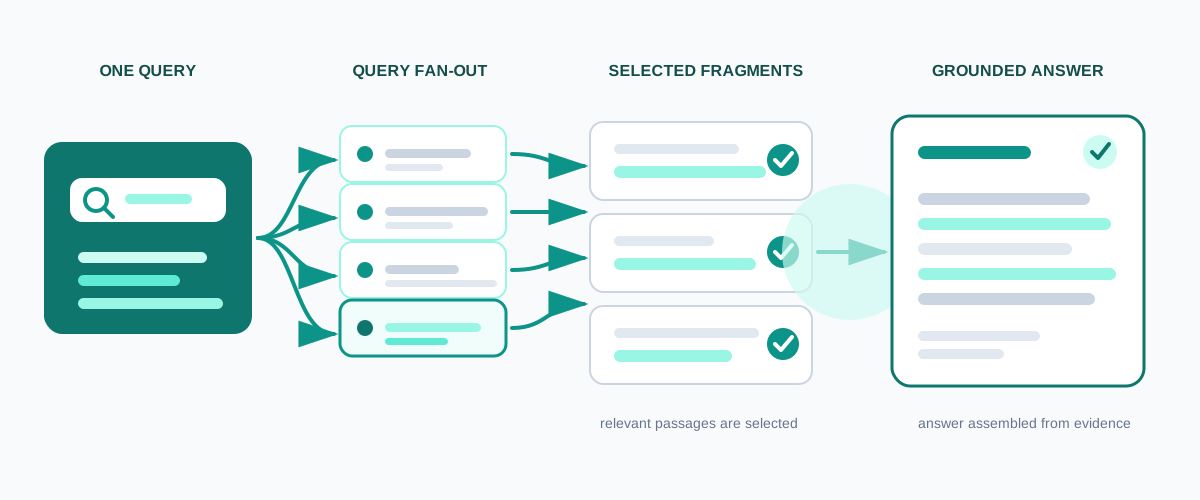
To rank in AI search results, make your website and business easy for search and AI systems to discover, understand, retrieve, verify, select, cite and mention. There is no single AI ranking factor that guarantees this outcome.
The practical work combines technical SEO, clear entity information, useful topic coverage, first-hand expertise, supporting evidence and real-world authority. Traditional SEO remains the foundation because information that cannot be crawled, indexed or retrieved cannot support an AI-generated answer.
To improve your visibility in AI search, focus on this sequence:
Technical accessibility → entity understanding → topic coverage → retrieval → evidence → source selection → citation → mention
- Fix crawlability, indexability and rendering before adding more content.
- Build pages around customer questions and connected topics, not isolated keyword repetitions.
- State who your business is, what it does, who it serves and where it operates.
- Support important claims with first-hand examples, credentials, projects, data and corroboration.
- Measure citations, mentions and qualified referral activity alongside rankings and conversions.
What Does “Ranking in AI Search” Actually Mean?
The word ranking can be misleading in an AI search context. Traditional search commonly presents a list of pages in a particular order. An AI-generated result may instead retrieve several passages, combine information from multiple sources, and produce an answer with links or citations.
Your business or content may therefore:
- be retrieved as a source for part of an answer;
- receive a visible citation or link;
- be mentioned without a direct citation;
- appear in a comparison or shortlist; or
- be recommended when the question includes a particular location, need or constraint.
The better question is not only “What position does my page hold?” It is “For which questions does an AI system consider my website or business useful enough to retrieve, cite, mention or recommend?” That change in measurement prevents teams from treating AI SEO as a collection of speculative tricks.
The AI Search Visibility Pipeline
AI search is a chain of decisions. A technically excellent page may still be irrelevant to a particular query. A relevant page may be retrieved but not selected if the claim is weakly supported. A strong source may be cited for an explanation but not recommended for a purchase or service decision.
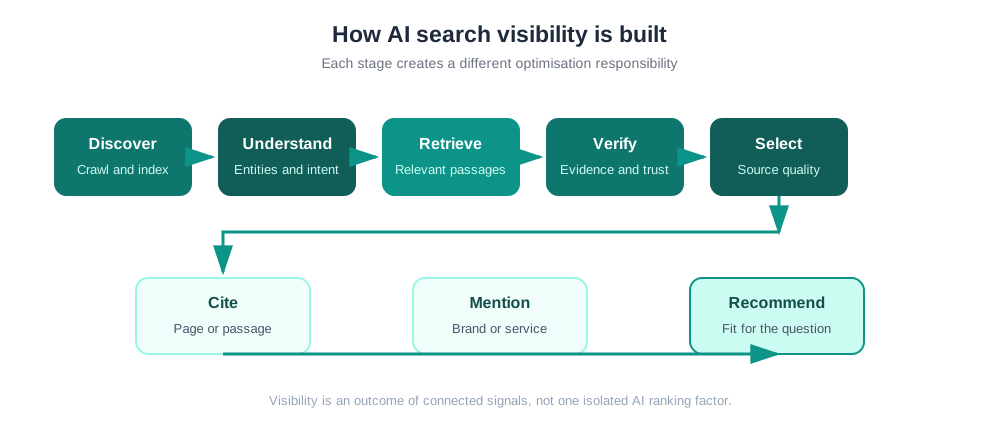
This is why the most durable AI SEO work looks less like trying to influence one opaque output and more like improving the evidence system around a business. Search and AI systems need accessible documents, coherent entities, useful passages and signals that help them judge whether a source fits the question.
1. Make Sure Search and AI Systems Can Find Your Information
AI search optimisation begins with search fundamentals. If an important service, product or guide cannot be crawled and indexed, it has fewer opportunities to be retrieved as a source. Google’s AI search experiences continue to build on core Search systems, and retrieval-augmented generation depends on finding relevant information before generating a grounded response.
Review these foundations before publishing more AI-focused copy:
- Crawlability: robots.txt, server responses, crawl paths and internal links allow crawlers to reach important URLs.
- Indexability: canonicals, noindex directives, duplicate URLs and thin pages do not prevent valuable content from entering the index.
- Accessible text: the primary explanation is present in the rendered HTML, not only inside an interaction or image.
- Rendering: JavaScript applications deliver meaningful content and metadata to crawlers and users.
- Performance: mobile usability and Core Web Vitals do not make a page relevant, but poor experiences can undermine access and trust.
Discovery controls also differ between services. OpenAI, for example, documents OAI-SearchBot as the crawler publishers can allow when they want public content to be discoverable in ChatGPT Search. Review the current controls for the AI surfaces that matter to your audience, while keeping your core content available through normal, standards-based web access.
A useful first step is a crawl and rendering audit. Our SEO audit services approach treats crawlability, indexability, content quality and AI visibility as connected diagnostic areas rather than isolated checkboxes.
2. Optimise Around Topics and Customer Questions, Not Just Exact Keywords
Exact keywords still describe demand, but they rarely describe the full information need. A plumber may target “plumber Melbourne”, while a customer asks whether a leaking hot water system should be repaired or replaced. A family lawyer may target “family lawyer Melbourne”, while a potential client asks what to prepare before a property settlement.
AI search expands, combines and rewrites queries. A system may explore several sub-questions before creating a response. This query fan-out means your site should cover the connected decision, not just one short phrase.
| Customer need | Useful content response | Evidence to add |
|---|---|---|
| Understand the problem | Definition, symptoms, causes and terminology | Clear explanation reviewed by a subject specialist |
| Compare options | Comparison table, trade-offs, cost drivers and constraints | Methodology, product or service criteria, updated date |
| Choose a provider | Scope, process, location, fit and expectations | Team experience, case studies, service areas and reviews |
| Take the next step | Checklist, decision guide, enquiry path or tool | Specific requirements, transparent limitations and contact details |
Use query fan-out as a planning idea, not a reason to produce one page for every possible sentence. Group questions with the same intent and create a small set of strong, connected pages. Headings, short answer-first openings, definitions, tables and FAQs make those pages easier for people and retrieval systems to navigate.
3. Make Your Business Entity Clear
AI systems need to distinguish a business from similarly named businesses, understand its services and connect it with locations, people, industries and proof. This is entity clarity. It is not achieved by repeating a brand name; it comes from consistent, explicit relationships across the site and the wider web.
Make these relationships unambiguous:
- the organisation’s name, website and primary business category;
- the services or products it provides and the problems they solve;
- the people responsible for expertise, delivery and leadership;
- the locations or markets genuinely served;
- the industries, audiences or use cases where the business has experience; and
- the evidence connecting the business to those claims.
Consistency matters across the About page, service pages, contact details, author bios, structured data, profiles, directories, reviews and media coverage. Use appropriate schema when it describes visible information, but remember that schema clarifies content; it does not manufacture authority.
Our guide to entities, attributes and values explains how to turn vague brand copy into explicit semantic relationships that are easier to interpret.
4. Publish Information Worth Retrieving
Helpful content is not the same as content that merely sounds polished. Retrieval systems have more reason to select a source when it contains a direct answer, specific terminology, useful context and information that is difficult to replace with generic copy.
Strengthen important pages with:
- First-hand process: explain how the work is actually done, including decisions and constraints.
- Original examples: show anonymised scenarios, before-and-after reasoning or implementation patterns.
- Useful data: include measurements, benchmarks, definitions and dates when they are accurate and maintainable.
- Decision support: explain when an option is suitable, unsuitable, expensive, urgent or dependent on another condition.
- Clear structure: use descriptive headings, short paragraphs, tables, definitions and related links.
Avoid the temptation to write “for AI” in an unnatural way. People-first writing remains the correct standard. The practical difference is that important answers should be clear enough to stand on their own when a retrieval system selects one passage from a longer page.
For a deeper technical explanation, read how LLM retrieval methods select passages, including vector similarity, hybrid retrieval, reranking, semantic chunking and knowledge graph traversal.
5. Support Important Claims with Evidence
AI systems can repeat a claim, but repetition is not the same as verification. When a page says a business is experienced, trusted, affordable, fast or best, the reader and the system both benefit from knowing why that claim should be believed.
Match claims to the evidence that can support them:
- Experience: named team expertise, years in practice, relevant qualifications and described methods.
- Results: case studies with context, timeframe, baseline, activity and limitations.
- Trust: genuine reviews, client references, professional memberships and independent coverage.
- Accuracy: citations, source dates, transparent methodology and a visible review process.
- Local relevance: genuine service areas, local projects, location details and consistent business information.
Be precise about what the evidence proves. A traffic increase does not automatically prove revenue growth. A citation in one AI answer does not prove broad AI visibility. Cautious claims are more credible than absolute promises and easier to keep accurate over time.
7. Measure Visibility Without Overclaiming
Measurement is still developing. Google Search Console and analytics can show important search and referral patterns, but they do not expose every AI impression or every influence an AI answer has on a later conversion. Treat AI visibility as an evidence-led measurement programme, not a perfect attribution report.
| Signal | What it can tell you | Important limitation |
|---|---|---|
| AI answer testing | Whether a defined question set returns a citation, mention, comparison or recommendation | Results vary by model, location, time, wording and personalisation |
| Referral analytics | Visits arriving from identifiable AI or assistant referrers | Many journeys are indirect, untagged or completed elsewhere |
| Search Console | Organic queries, pages, clicks and impressions that support the broader search programme | It does not provide a complete AI answer visibility report |
| Lead and sales quality | Whether enquiries mention an AI assistant or show improved fit and awareness | Self-reported attribution is incomplete and sample sizes can be small |
Build a fixed question set across informational, comparison, local and commercial intent. Test it on a schedule, record the exact prompt and result, capture cited sources, and check whether your own answer is accurate. You can use the LLMO Prompt Tester to make this kind of brand visibility check repeatable across multiple models.
A 90-Day Implementation Framework
A practical programme should create compounding improvements rather than a one-off content burst. The order below keeps technical risk and measurement visible while building useful topical coverage.
| Period | Priority work | Output |
|---|---|---|
| Days 1–30 | Crawl, indexability, rendering, entity consistency and baseline question testing | Technical issue register, entity map and starting visibility record |
| Days 31–60 | Improve priority service pages, answer customer questions and add first-hand evidence | Reworked commercial pages and a connected question cluster |
| Days 61–90 | Strengthen internal links, corroboration, digital PR and repeatable measurement | Authority plan, monthly test set and qualified referral review |
Choose a small number of commercially important topics first. A focused programme for one service, audience or location gives you a better chance to connect content, proof and measurement than a broad set of shallow pages.
Turn Customer Questions into Content
The strongest question-led content does not just answer a query. It also explains the surrounding decision, shows what makes the answer trustworthy and clarifies whether the business is a suitable source.
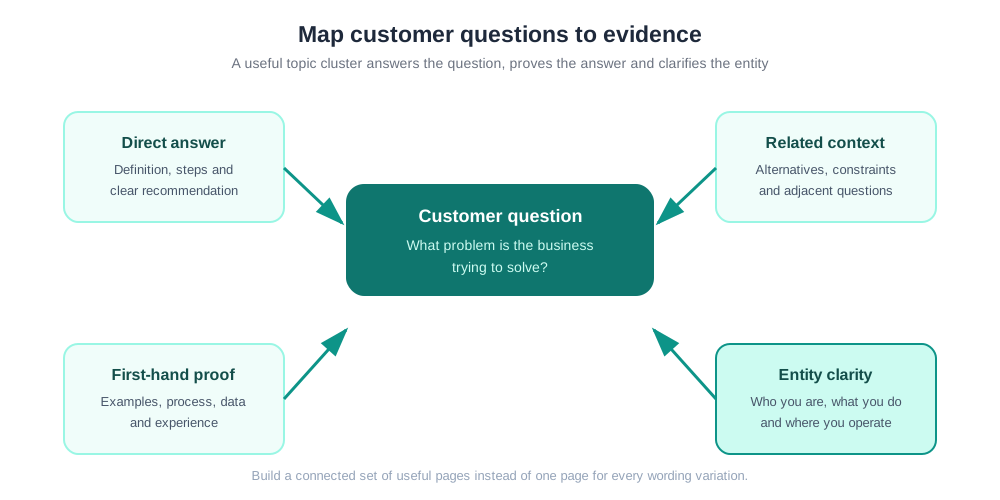
For each priority question, ask:
- What is the direct answer a customer needs first?
- What related terms, constraints or alternatives change that answer?
- What first-hand experience or original information can we add?
- Which business, service, person or location entity should be clear?
- What evidence supports the important claims?
- Which service page, guide or tool should the reader visit next?
This framework keeps content useful for people while making its meaning more explicit to retrieval systems. It also gives your team a defensible reason to create, improve or consolidate a page.
Build a stronger AI search foundation
SearchMinistry Media helps Australian businesses connect technical SEO, semantic content, entity clarity and AI visibility measurement into one search strategy.
Explore AI SEO servicesFrequently Asked Questions
Do I need special AI schema to rank in AI search?
No. Use appropriate structured data for the page type when it accurately describes the visible content, but there is no special AI schema that guarantees inclusion in Google AI Overviews, Google AI Mode, ChatGPT or other AI search experiences. Clear HTML, crawlability, relevant content and trustworthy evidence remain more important foundations.
Does traditional SEO still matter for AI search?
Yes. AI search systems need to discover and retrieve information from an index or another accessible source. Crawlability, indexability, internal links, canonicalisation, page quality, mobile usability and performance still influence whether your information is available to the retrieval process.
Should I create a page for every question my customers ask?
No. Group closely related questions into useful pages, sections, tables, comparisons and FAQs. Create a separate page when a question represents a distinct intent, audience or service. Hundreds of near-identical pages create maintenance and quality problems without guaranteeing more AI visibility.
Do I need to create an llms.txt file?
Not for Google Search visibility. Google has stated that llms.txt does not improve or reduce visibility or rankings in Google Search. Other services may develop different discovery mechanisms, but an llms.txt file should not replace crawlable, well-structured and useful website content.
How can I check whether my business appears in AI search results?
Create a repeatable set of customer questions and test them across the AI search surfaces that matter to your audience. Record whether your business is cited, mentioned, compared or recommended, which sources appear, and whether the answer is accurate. Combine this with Search Console, analytics, referral data and lead quality. Current reporting does not provide perfect visibility into every AI impression or influence.
How long does it take to appear in AI search results?
There is no reliable universal timeframe. A technically accessible site with established authority may be retrieved sooner than a new site, but visibility depends on the query, source competition, freshness, evidence and the AI system being tested. Treat improvements as an ongoing programme and measure visibility trends rather than promising a fixed result.
Should AI write all of my SEO content?
AI can support research, outlining, editing and content operations, but it should not replace subject expertise or evidence. Generic generated copy often repeats common claims and lacks first-hand detail. Review important claims, add original experience, keep the language accurate and ensure the final page helps a real customer make a decision.

Tharindu Gunawardana
Founder & Director, SearchMinistry Media
Tharindu Gunawardana is the Founder of SearchMinistry Media and a search strategist with 17 years of experience across Sri Lanka, Singapore, and Australia. A former Agency SEO Director, he specialises in helping brands transition from traditional SEO to AI-driven discovery.