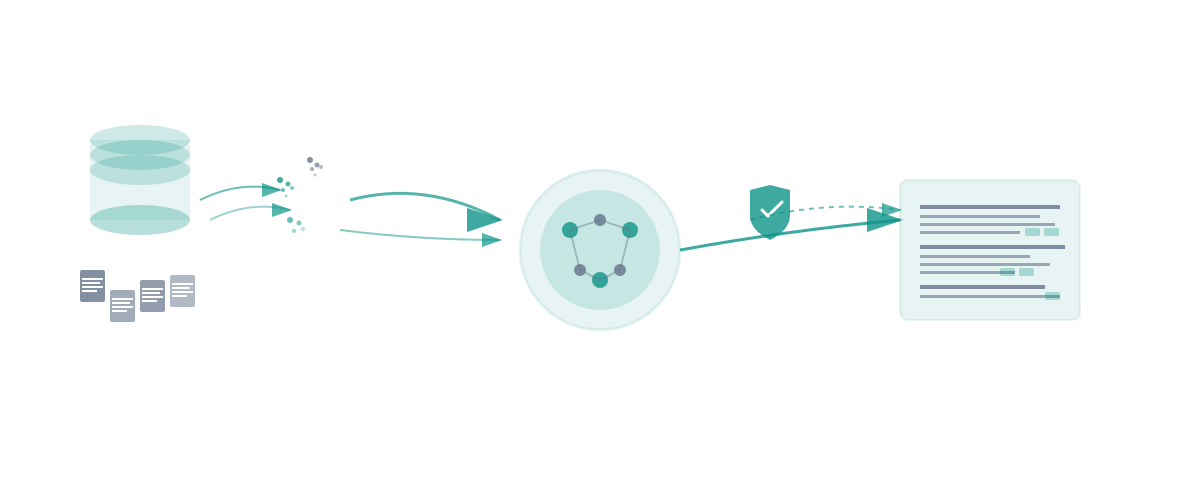
The Hallucination Problem That Changed Everything
Ask a large language model a question about something that happened last month, and you might get a confident, detailed, and entirely wrong answer. This is the hallucination problem: the tendency of AI systems trained on static datasets to fabricate plausible-sounding facts when their knowledge runs out.
It is not a minor inconvenience. It is the central reliability challenge of generative AI, and solving it has become one of the most actively patented and researched areas in the entire technology industry.
The solution that has emerged as the dominant architectural pattern is called Retrieval-Augmented Generation (RAG), combined with a technique called grounding, which anchors every AI-generated claim to a verifiable, real-world source.
This post explains exactly how both work, stage by stage, with reference to the actual patents that describe these mechanisms.
Key findings in this post
- 1RAG retrieves live documents at query time, eliminating the knowledge cutoff problem without retraining the model.
- 2The 7-stage pipeline runs from intent analysis through a final hallucination guard before any response is shown.
- 3Three specific failure modes explain why grounding is harder than retrieval or generation.
- 4Google's Vertex AI Agent Engine ships RAG as production infrastructure, not as a research prototype.
- 5Hybrid BM25 and dense vector retrieval reduces the risk of missing exact-match queries.
What Is RAG?
If you are not already familiar with Retrieval-Augmented Generation as a concept, our RAG guide covers the fundamentals in full, including how it differs from base LLM responses and why it has become the foundation of AI Overviews and Perplexity-style search.
The short version: the term was formally introduced in the landmark 2020 paper by Patrick Lewis, Ethan Perez, and colleagues at Facebook AI Research, University College London, and New York University. The core observation was that large pre-trained models store factual knowledge in their parameters, but their ability to access and precisely manipulate knowledge is limited, and on knowledge-intensive tasks their performance lags behind task-specific architectures.
The fix was direct: instead of relying solely on what the model learned during training (called parametric memory), give it real-time access to an external knowledge store (non-parametric memory) at query time.
The core principle
An AI that reads before it writes is fundamentally more trustworthy than one that writes from memory alone. RAG is the architecture that makes this possible at scale.
Why not simply retrain the model on up-to-date information? Cost, speed, and flexibility. Retraining a large model takes weeks and costs millions of dollars. RAG, by contrast, updates the moment the knowledge base updates. A news article published this morning can inform an answer this afternoon, with no model retraining required.
The 7-Stage RAG Pipeline
Modern AI search systems implement RAG as a multi-stage pipeline. Here is each stage, with the patents that describe the underlying mechanisms.
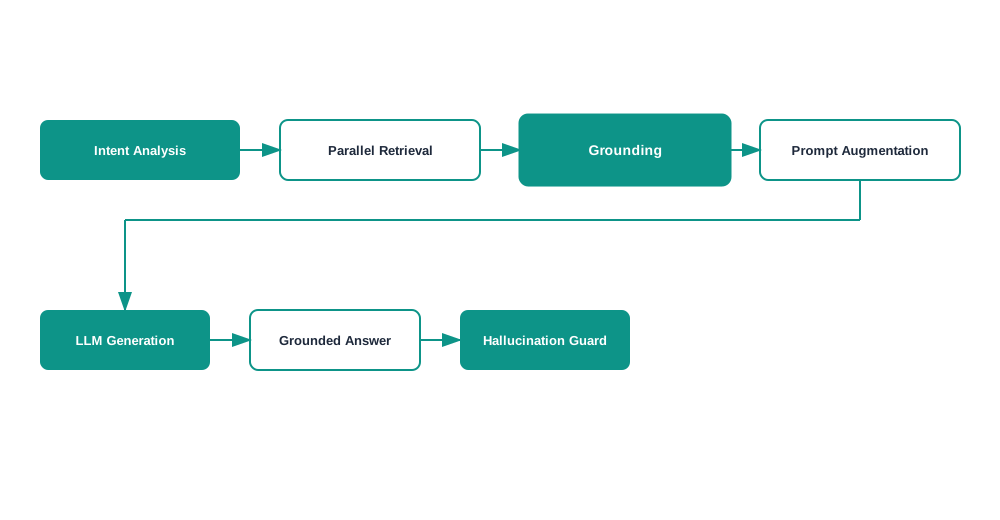
Intent Analysis
The system infers what the user actually wants: comparison, explanation, recent news, or a specific fact. This feeds into query fan-out in Stage 2.
Parallel Retrieval
Multiple knowledge sources are queried simultaneously using vector embeddings. Semantic similarity replaces keyword matching.
Grounding
Retrieved chunks are verified and anchored to real sources. Authority scoring and recency filtering determine which chunks carry the most weight.
Prompt Augmentation
Verified document chunks are injected into the LLM prompt. The model is constrained to answer only from this context.
LLM Generation
The model synthesises a coherent answer from the provided chunks, inserting inline citations and confidence markers.
The Grounded Answer
The output includes the synthesised response, inline citations, source metadata, confidence qualifications, and follow-up suggestions.
Hallucination Guard
A final verification pass checks every claim against retrieved sources before the response is shown. Unsupported claims are flagged or removed.
Stage 1: Intent Analysis
The pipeline begins when a user submits a query, but the system does not treat it as a simple bag of keywords. It performs intent analysis: inferring what the user actually wants (comparison, explanation, recent news, a specific fact), what domain the question belongs to, and whether recency matters.
This classification directly shapes Stage 2. A query classified as "recent news" triggers aggressive recency filtering. A query classified as "how-to explanation" prioritises comprehensive documentation over freshness. The intent layer is the filter that makes everything downstream more efficient.
Stage 2: Parallel Retrieval
The system simultaneously queries multiple knowledge sources: web indexes, news corpora, knowledge graphs, product databases, and curated academic sources. The key technology is vector retrieval, which converts both the query and stored documents into mathematical representations called vector embeddings. This allows semantic similarity to be measured rather than just keyword overlap.
Patent reference
US20240346256A1: Response Generation Using a Retrieval Augmented AI Model (Microsoft Technology Licensing, filed 2023)
This patent discloses a system where a first feature vector is generated based on the query, compared to a plurality of second feature vectors to determine a subset that satisfies a predetermined condition, and augmentation information corresponding to the determined subset is retrieved. This is the mathematical core of vector-based RAG retrieval: embed the query, find the nearest matching document chunks, retrieve them.
Stage 3: Grounding (The Critical Step)
If retrieval fetches the raw material, grounding is the quality control step that ensures the AI is actually anchored to that material, rather than drifting back into fabrication.
Patent reference
US12131123B2: Grounded Text Generation (Microsoft Technology Licensing, filed 2023)
This patent describes a controllable grounded response generation framework that includes a machine learning model, a grounding interface, and a control interface. The grounding interface anchors outputs to verified sources, preventing the model from drawing on parametric memory during generation.
Grounding in practice involves four operations:
- Chunking and embedding: Documents are broken into segments and converted into vector representations. Chunk granularity significantly affects quality: chunks too large lose specificity, chunks too small lose context.
- Vector similarity matching: The embedded query is compared against embedded document chunks using cosine similarity. Only the most relevant chunks are passed forward.
- Source credibility scoring: Not all retrieved content is equally reliable. Grounded systems apply authority scores based on domain reputation, citation counts, and publication date.
- Recency filtering: For time-sensitive queries, newer documents are prioritised. Grounding systems can encode this preference explicitly so a 2020 article does not outrank a 2025 article on the same topic.
Additional patent supporting grounding
US9916366B1: Query Augmentation (Google Inc., granted)
This Google patent describes query fan-out: a single user query is decomposed into multiple targeted sub-queries, each optimised for a specific retrieval layer. Synthetic queries can be machine-generated to expand coverage beyond what the user explicitly typed.
Stage 4: Prompt Augmentation
Once relevant, grounded document chunks have been retrieved, they are injected into the prompt that the language model will receive. This is sometimes called "in-context learning": the model does not need to know anything from training, because everything it needs is placed directly in front of it.
A well-constructed augmented prompt has three components:
System instruction:
"You are a factual assistant. Use only the provided context to answer. If the context does not support a claim, say so."
Context:
[Retrieved, grounded document chunks, with source labels]
User query:
[The original question]
Patent reference
US20240256582A1: Search with Generative Artificial Intelligence (published 2024, pending grant)
This patent describes a search and knowledge management system that identifies the top documents for a particular query and includes them with an input prompt to a machine learning model. A second model may confirm that the generated response provides a truthful answer. Only verified reference documents are included with the input prompt.
Token budget constraint
Language models have context windows: limits on how much text they can process at once. RAG systems must balance breadth (more sources, more coverage) against depth (longer chunks, better context per source) within that fixed limit.
What is a token?
A token is roughly three-quarters of a word. "The quick brown fox" is 4 words but about 5 tokens. As a practical rule: 1,000 tokens is approximately 750 words, or about three pages of standard text. Punctuation, spaces, and word fragments each count as separate tokens.
Typical context window sizes (as of 2025-26)
128,000 tokens (~96,000 words)
200,000 tokens (~150,000 words)
1,000,000 tokens (~750,000 words)
4,096 tokens (~3,000 words)
Despite these large windows, RAG systems do not fill them arbitrarily. A well-designed pipeline reserves roughly 40-60% of the context window for retrieved documents, with the remainder split between the system prompt, user query, and space for the model's response. Packing in too many retrieved chunks degrades answer quality, so the prompt augmentation stage (Stage 4) applies strict token budgeting before the model ever sees the context.
Stage 5: LLM Generation
With the augmented prompt in hand, the language model generates its response. In a properly grounded RAG system, the model is constrained to synthesise from the provided context rather than from its parametric memory. The generation step involves reading and cross-referencing the context chunks, synthesising a coherent answer that reflects information from multiple sources, inserting inline citations, and assigning confidence levels to individual claims.
The dual-model verification described in US20240256582A1, where a second model checks the first model's output for truthfulness, is one of the more sophisticated implementations at this stage and represents the direction the industry is moving for high-stakes applications.
Stage 6: The Grounded Answer
The output is not a bare paragraph of text. A fully realised grounded answer includes:
- The synthesised response in natural language
- Inline citations linking every claim to its source document
- Source metadata: publication date, author or organisation, URL
- Confidence qualifications where evidence is limited or conflicting
- Follow-up query suggestions based on what adjacent context was retrieved
This is what separates AI search from both traditional search (which gives you links, not answers) and ungrounded generation (which gives you answers without evidence).
Stage 7: The Hallucination Guard
Even after grounding, a final verification pass checks the generated text against the retrieved sources before the response is shown to the user.
Patent reference
US12536233B1: AI-Generated Content Page Tailored to a Specific User (Google, granted 2025)
This patent describes validation tools that include engineered heuristics establishing certain thresholds applied to model outputs. Specifically, validation tools ground the outputs of machine-learned models to structured data sources to mitigate hallucinations.
The hallucination guard enforces four rules:
| Rule | What it checks |
|---|---|
| Claim vs. source check | Every factual claim must be traceable to a specific retrieved chunk. Unsupported claims are flagged or removed. |
| Out-of-context detection | If the model uses knowledge not from the retrieved context (parametric memory), the response is flagged. |
| Confidence qualification | Claims backed by weak or conflicting evidence are qualified: 'evidence suggests' rather than 'it is the case'. |
| Refusal on no source | If a query cannot be answered from retrieved context, the system says so rather than fabricating an answer. |
Grounding in Depth: Why It's the Hardest Part
Retrieval is relatively well-understood. Generation is a solved problem. But grounding, the bridge between the two, is where most real-world failures occur, and it is where the most active research and patenting is happening.
In the research literature, a sentence is considered to be grounded in a document if the text of the document supports the claim made in the sentence. Factuality refers to the quality of being based on a fact. Note the distinction: a model might output text that is grounded in its pre-training data yet is factually incorrect. Preventing a model from generating text that is neither grounded nor factually accurate remains a challenging problem.
This distinction is crucial: grounding is a necessary but not sufficient condition for accuracy. A model can be grounded to a source that is itself incorrect. Good RAG systems therefore evaluate source credibility, not just source presence.
The Three Failure Modes
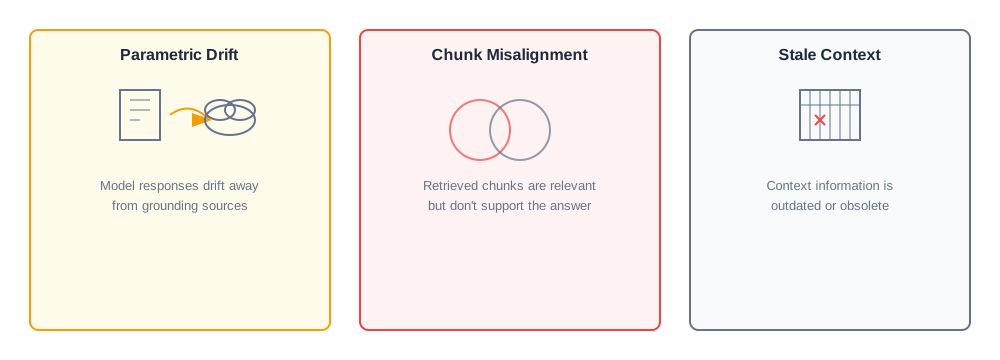
1. Parametric Drift
The model, mid-generation, slips from retrieved context back to its training data. A sentence starts grounded and ends fabricated. This is the most common failure and the hardest to detect without sentence-level verification.
2. Chunk Misalignment
The retrieved chunks are technically relevant but do not actually support the specific claim being made. The model uses them as superficial cover for a claim drawn from training. Strong grounding systems check at the claim level, not just the document level.
3. Stale Context
The retrieval returns documents that were correct at publication but have since been superseded. Recency filtering and source freshness scoring are the primary defences. This is particularly relevant for fast-moving areas like AI tooling or regulatory guidance.
Techniques Behind Grounding
Several retrieval and verification techniques work together to make grounding robust enough for production use.
Dense Vector Retrieval
The most widely deployed technique converts both documents and queries into high-dimensional vector representations using encoder models. Documents whose vectors are geometrically close to the query vector are retrieved as relevant. This allows semantic similarity rather than keyword overlap: a query for "how does memory work in computers" will retrieve documents about RAM and cache architecture even if they never use the word "memory". See our guide on how vector embeddings work for a deeper explanation of this mechanism.
BM25 Sparse + Dense Hybrid Search
Pure dense retrieval misses some exact-match cases. Hybrid systems combine dense vector search with BM25, a classical information retrieval algorithm based on term frequency, so that highly specific terms (product names, patent numbers, exact phrases) are matched precisely while semantic concepts are matched broadly. Most production RAG systems now use hybrid search rather than pure vector retrieval.
Knowledge Graph Entity Linking
Beyond document chunks, some RAG systems retrieve structured facts from knowledge graphs, databases of entities and their relationships. If you ask "who is the CEO of OpenAI?", a knowledge graph lookup can return a structured fact (entity: OpenAI, relation: CEO, value: Sam Altman) rather than relying on a document chunk to contain that information.
Patent reference
US12135740B1: Generating a Unified Metadata Graph via RAG (Citibank N.A., granted November 2024)
This enterprise patent discloses systems for reducing data retrieval times when accessing siloed data across disparate locations by generating a unified metadata graph via a RAG framework. It shows RAG being applied at enterprise scale to the problem of data silos, a significant real-world deployment context beyond consumer search.
Reranking with Cross-Encoder Models
Initial retrieval casts a wide net. A reranker then sorts the retrieved chunks by relevance, using a more computationally expensive model that evaluates query-chunk pairs jointly rather than separately. The top-ranked chunks are what actually enter the LLM context. This two-stage approach (broad retrieval then precise reranking) balances speed against quality.
Self-Consistency and Claim Verification
Some systems generate the same answer multiple times with slight variations, then cross-check outputs for consistency. Claims that appear consistently across generations are treated as higher confidence. Claims that vary are flagged for verification or qualification. This technique is particularly useful for complex multi-hop reasoning where a single generation pass may miss nuance.
RAG vs the Alternatives
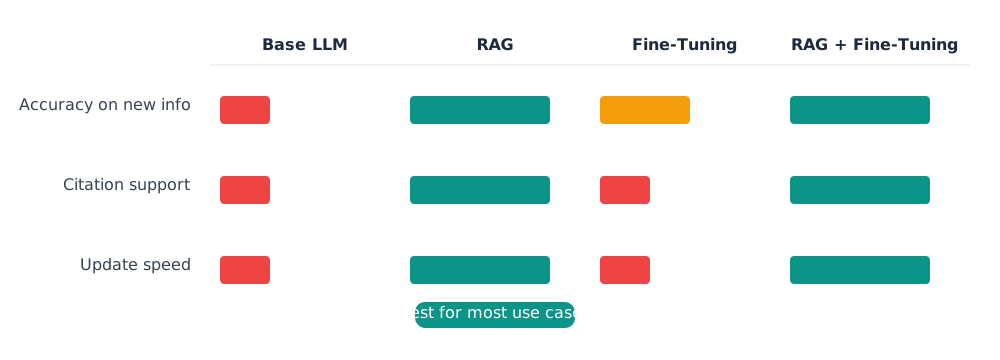
| Approach | Accuracy on new info | Citation support | Best for |
|---|---|---|---|
| Base LLM only | Low (knowledge cutoff applies) | None | General language tasks |
| RAG | High (real-time sources) | Full inline citations | Search, Q&A, research tools |
| Fine-tuning | Medium (static domain dataset) | Limited | Specialised domains (legal, medical) |
| RAG + Fine-Tuning | Highest (domain fluency + live retrieval) | Full inline citations | Enterprise AI search at scale |
The hybrid approach, RAG combined with fine-tuning, is increasingly the pattern for production enterprise systems. Fine-tuning provides domain fluency (the model understands the vocabulary and conventions of, say, financial analysis), while RAG provides factual currency (the model can answer questions about events from this week).
Not suitable for RAG
RAG is not a good fit when a task requires creative generation with no factual constraint (fiction writing, brainstorming), or when the required knowledge is entirely self-contained and does not change (a fixed reference table or lookup function). In these cases, the overhead of retrieval adds latency without benefit.
What This Means for AI Search Quality
The practical consequences of RAG and grounding for anyone working in AI search optimisation are significant and concrete:
Citations become auditable
Rather than hoping an AI is right, you can click through to the exact document that informed each claim. This turns AI search from a black box into a traceable reasoning chain. For content creators, this means individual pages can be assessed for their citation contribution.
Knowledge stays current
Because RAG retrieves at query time rather than relying on training, AI search systems can reflect information published minutes ago, not months. Regularly updated pages with visible publication and modification dates are prioritised by recency filters.
Refusals become informative
A well-grounded system that cannot find evidence for a claim will say so, 'I could not find recent sources on this', rather than confabulating. This is a feature: it signals where authoritative content is genuinely missing from the indexed web.
Confidence becomes graduated
Claims backed by multiple high-authority sources receive high confidence. Claims backed by a single low-authority source are qualified. Creating content that can be triangulated across multiple independent sources on your site raises your citation confidence score.
You can test how AI search tools currently handle queries about your brand or topic using our LLMO Prompt Tester, which simulates AI-generated answers and shows you which sources are being cited in your category.
How to Optimise for AI and Search Engines
Understanding how RAG pipelines work gives you a direct map to what makes content more likely to be retrieved, grounded, and cited. Each stage of the pipeline creates a specific opportunity:
Structure content for chunk-level retrieval
RAG systems split pages into smaller chunks before embedding them as vectors. A chunk that clearly answers one question scores higher than a paragraph that mixes three topics. Write in short, self-contained paragraphs, each with a single clear claim. Use descriptive subheadings so each section can stand alone when extracted.
Make every factual claim independently anchored
The grounding stage checks whether model outputs are tied to specific source passages. Pages with named sources, attributed statistics, and explicit dates provide stronger grounding anchors than pages with vague assertions. If you cite a study, name the author and year. If you state a figure, link to the original data source.
Signal authorship and recency clearly
Retrieval systems apply recency filters. Pages with a visible author byline, a publication date, and an explicit last-updated date are easier for AI systems to score for freshness and authority. Add structured data (Article or BlogPosting schema) so these signals are machine-readable, not just human-readable.
Build topical depth rather than broad coverage
RAG retrieves documents most semantically similar to the query. A cluster of 10 deeply interconnected pages on one topic creates stronger, more consistent retrieval signal than 50 thin pages across many topics. Internal linking between related pages reinforces the semantic neighbourhood and makes each page easier to retrieve in context.
Use FAQ schema to match sub-query patterns
Stage 1 of the RAG pipeline (intent analysis) breaks a query into sub-questions before retrieval begins. FAQ schema markup makes your content directly parseable as question-answer pairs, which maps cleanly onto those sub-queries. A page with 5 well-formed FAQ entries is effectively pre-formatted for sub-query retrieval.
Avoid content that fails the hallucination guard
Stage 7 of the pipeline runs a confidence check before the answer is returned. Content that is vague, unattributed, internally contradictory, or written to rank rather than inform is more likely to be flagged as low-confidence and excluded. Write for accuracy first; retrieval follows from that.
If you want to see how AI systems currently handle queries in your category, our LLMO Prompt Tester simulates AI-generated answers and shows which sources are being cited. For a deeper semantic gap analysis, the SEO Vector Gap Analyser identifies the phrases and concepts your content is missing relative to top-ranking pages.
Patent Reference Summary
All six patents referenced in this post are publicly accessible on Google Patents.
| Patent Number | Title | Assignee | Relates To |
|---|---|---|---|
| US9916366B1 | Query Augmentation | Google Inc. | Query fan-out / sub-query generation |
| US20240346256A1 | Response Generation Using RAG | Microsoft Technology Licensing | Vector feature matching for retrieval |
| US12131123B2 | Grounded Text Generation | Microsoft Technology Licensing | Grounding interface / anchoring outputs |
| US20240256582A1 | Search with Generative AI | Filed 2024 (pending) | Prompt augmentation + dual-model verification |
| US12536233B1 | AI-Generated Content Page | Google (granted 2025) | Hallucination guard / validation heuristics |
| US12135740B1 | Unified Metadata Graph via RAG | Citibank N.A. (granted Nov 2024) | Enterprise RAG with metadata graphs |
Academic and documentation sources
- Lewis, P., Perez, E., Piktus, A., et al. (2020). Retrieval-Augmented Generation for Knowledge-Intensive NLP Tasks. NeurIPS 2020. arXiv:2005.11401. The foundational RAG paper.
- Gao, Y., et al. (2024). Groundedness in Retrieval-augmented Long-form Generation: An Empirical Study. Findings of ACL 2024. arXiv:2404.07060. Empirical study of grounding failure rates across model families.
- Google Cloud. (2024-25). Vertex AI Agent Engine Overview. cloud.google.com. Official documentation confirming RAG as a production-grade agent template.
- Kopp, O. (2026, February 9). What Google and Microsoft Patents Teach Us About GEO. Search Engine Land. Analysis of patents relating to query fan-out, grounding, and generative engine optimisation.
Is your content passing the grounding filter?
RAG-based AI search is selective. Content that is structured, authored, and regularly updated gets cited. Content that is not gets skipped. We help businesses build the content architecture that AI systems trust.
Talk to our AI SEO teamRAG and grounding are not merely academic concepts or marketing language. They are the architectural response to a fundamental limitation of language models, and the patents, papers, and production systems described in this post show that response is now well-developed, widely deployed, and actively evolving.
For anyone evaluating AI search tools, building on top of RAG infrastructure, or trying to understand why some AI systems are more reliable than others, this pipeline is the essential architecture to understand. For deeper context on the fundamentals, our RAG guide and semantic search guide cover the underlying concepts in detail.
Frequently Asked Questions
What is the difference between RAG and fine-tuning?
Fine-tuning retrains the model on new data, which takes weeks and costs significantly more. RAG retrieves information at query time from a live knowledge base, so the system can reflect information published minutes ago without any model retraining. For most use cases, RAG is faster, cheaper, and more current than fine-tuning alone.
What does 'grounded' mean in AI search?
A response is considered grounded when every factual claim can be traced back to a specific retrieved document. Grounding is distinct from factual accuracy: a model can be grounded to a source that is itself incorrect. Good RAG systems therefore evaluate both source presence and source credibility.
What are the most common RAG failure modes?
The three most common are parametric drift (the model slips from retrieved context back to training data mid-generation), chunk misalignment (retrieved chunks are topically relevant but do not actually support the specific claim), and stale context (retrieved documents were accurate at publication but have since been superseded).
How does RAG grounding relate to AI search hallucinations?
Hallucinations occur when a model generates confident-sounding claims that have no basis in fact. Grounding prevents this by requiring every claim to be anchored to a specific retrieved source. The hallucination guard stage performs a final check before the response is shown, removing or qualifying any claim that cannot be verified.
Does RAG affect how Australian businesses appear in AI search results?
Yes. RAG systems retrieve from live web indexes, meaning pages that are well-structured, clearly authored, and regularly updated are more likely to be retrieved and cited. For Australian businesses, this means optimising for topical authority and structured content is more important than ever, particularly given the growing use of AI Overviews in Google AU search results.
What is BM25 hybrid search and why does it matter?
BM25 is a classical information retrieval algorithm based on term frequency. Hybrid systems combine BM25 with dense vector retrieval, so exact-match queries (product names, patent numbers, specific phrases) are matched precisely while semantic concepts are matched broadly. This reduces the risk of missing highly specific information that pure vector search might rank too low.
How can I optimise my content for RAG-based AI search?
Structure content with clear, attributable sentences that make individual claims citable. Use schema markup so your content structure is machine-readable. Publish with visible authorship and dates so recency filters favour your content. For deeper guidance, see our AI SEO service page.

Tharindu Gunawardana
Founder & Director, SearchMinistry Media
Tharindu Gunawardana is the Founder of SearchMinistry Media and a search strategist with 17 years of experience across Sri Lanka, Singapore, and Australia. A former Agency SEO Director, he specialises in helping brands transition from traditional SEO to AI-driven discovery.