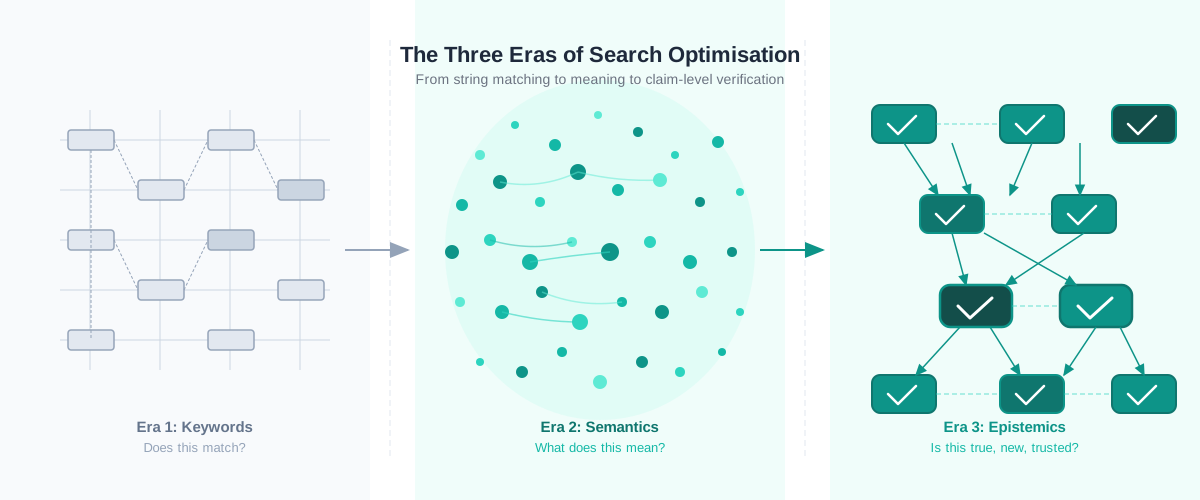
Search engine optimisation has had two eras. The first was about matching words. The second was about matching meaning. The third, which has arrived now, is about something different: whether what you say can be verified, who is saying it, and whether it adds anything to what the machine already knows.
We call this third era epistemic optimisation. This article explains what it is, presents evidence that it is already operating within Google's systems, and provides a detailed, step-by-step process for optimising existing content for it. Where the evidence is documented, we cite it. Where we are interpreting, we say so. That distinction is not a stylistic choice; as you will see, it is itself part of the optimisation method.
Key Insights
Before the detail, here are the five claims this article makes, stated plainly:
- Google holds a granted patent (US11354342B2) describing an "information gain score" that ranks pages by how much new information they add beyond documents a user has already seen.
- Google holds a granted patent (US11769017B1) describing how LLM-generated search summaries are corroborated against source documents, the architecture widely understood to underpin AI Overviews.
- Google sells claim-level verification as a commercial product: the Check Grounding API scores how well each sentence of a text is supported by a set of source documents, returning scores from 0 to 1.
- Google's official guidance states that its generative AI search features are built on retrieval-augmented generation over its core ranking systems.
- Therefore, a probable and practical conclusion: content is increasingly evaluated at the level of individual claims, and the properties that matter are verifiability, provenance, novelty, and consistency. This fifth point is our interpretation of the first four, not something Google has stated.
| Era | Core Question | Optimisation Target | Failure Mode |
|---|---|---|---|
| Era 1: Keywords | Does this match? | String placement, density, anchor text | Strings without meaning could win |
| Era 2: Semantics | What does this mean? | Vector embeddings, topical relevance, intent | Semantic saturation: everyone says the same thing |
| Era 3: Epistemics | Is this true, new, and trusted? | Claim verifiability, provenance, novelty, consistency | Fluent assertions that cannot be corroborated |
The Three Eras of Search Optimisation
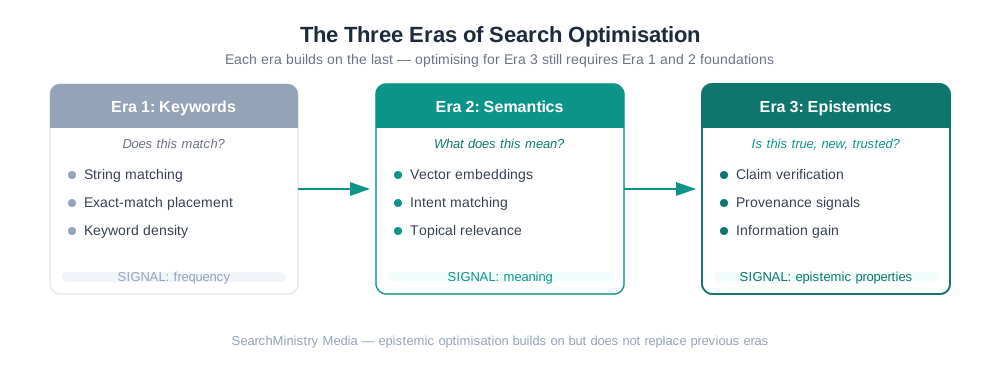
Search optimisation has evolved through three distinct eras, each defined by the core question the system asks. The first era of keywords asked "Does this match?", evaluating whether strings on a page matched strings in a query. The second era of semantics asked "What does this mean?", using embedding models to represent content as meaning so that conceptually similar texts could be matched even without shared words. The third era of epistemics asks "Is this true, is it new, and can I trust the source?" That three-part question is what distinguishes the third era from everything that came before it.
Era One: Keywords
The keyword era solved matching. Does the string on the page match the string in the query? Optimisation meant exact-match placement, density, and anchor text. The failure mode was obvious in hindsight: strings do not have meaning. Content that matched words without answering questions could win, and for years it did.
Era Two: Semantics
The semantic era solved meaning. From Hummingbird through RankBrain, BERT, and the embedding models that power today's retrieval systems, search learned to represent content as meaning rather than strings. The core question shifted from "Does this match?" to "What does this mean?" Two texts with no words in common could be recognised as saying the same thing.
The difference between keyword-based SEO and semantic SEO is this: keyword optimisation targets string-level matches between page text and query text, while semantic SEO targets meaning-level similarity between embedded representations of content and query. In semantic search, relevance is determined by mathematical similarity between vectors, not by literal word overlap.
Large language models are the fullest expression of this era. In modern AI search, retrieval is substantially vector-based: your content is embedded into vectors, the query is embedded into vectors, and similarity between those vectors decides whether you enter the candidate set. OpenAI's published patents confirm how central this remains to their stack. US20240249186A1 covers contrastive pre-training for text embeddings, and US20250103962A1 covers embedding content into vector databases for retrieval.
For a deeper treatment of how vector retrieval works, see our guide on vector embeddings and the twelve retrieval methods covered in our LLM retrieval methods guide.
The Failure Mode of Semantics
The semantic era has a failure mode, and it is now the dominant problem in search: semantic saturation. When everyone optimises for meaning, and when AI writing tools can produce semantically competent coverage of any topic in minutes, the top of every results set converges on content that means the same thing.
Similarity cannot distinguish between ten pages that all say the same true things, and it cannot distinguish a verified claim from a fluent hallucination. Meaning becomes a minimum requirement, not a differentiator. The system needs a new signal.
Era Three: Epistemics
Epistemics is the branch of philosophy concerned with knowledge: what is claimed, on what evidence, by whom, and with what justification. In the context of SEO, epistemics refers to the evaluation of content at the level of individual claims, based on four key properties:
- Verifiability: Can each claim be checked against evidence?
- Provenance: Who is making the claim, and do they have standing?
- Novelty: Does the claim add anything beyond what other sources already establish?
- Consistency: Does the claim hold within the page, across the site, and against topic consensus?
Applied to search, the epistemic questions are:
- What discrete claims does this content make?
- Can each claim be verified against evidence?
- Who is making the claim, and does that entity have standing to make it?
- Does the claim add anything beyond what other sources already establish?
- Is the claim consistent both within the page and with what the same entity says elsewhere?
The Evidence Base
That is the theory. Here is the evidence that machinery of this kind already exists within Google's documented and productised systems.
Evidence 1: The Information Gain Patent
Google's patent US11354342B2, "Contextual estimation of link information gain", was filed in 2018 with a continuation granted in June 2024. It describes assigning documents an information gain score: a measure of how much additional information a document contains beyond documents the user has already viewed on the same topic. Pages with higher scores may be ranked higher. The patent is framed largely in the context of automated assistants, which is one reason it is widely read as applying to AI Overviews behaviour.
Two properties of this score matter for practitioners. First, it is relational: a page cannot be scored in isolation, only against a comparison set. Second, it is claim-sensitive: what counts is the information the page adds, not its length or comprehensiveness. A 3,000-word article that restates the top ten results adds nothing and scores accordingly.
Evidence 2: The Generative Summaries Patent
Google's patent US11769017B1, "Generative summaries for search results", was filed on 20 March 2023, weeks before the public announcement of the Search Generative Experience, and describes using large language models to generate natural-language summaries of search results, with the generated statements corroborated by links to source documents. This is the architecture widely understood to sit behind AI Overviews.
The epistemically significant detail is the corroboration step. Sources are not selected only because they are relevant to the query; they are selected because they can verify the statements the model wants to make. A page can be perfectly relevant and still be useless for corroboration if its assertions are too vague to support anything. Relevance gets you into the candidate set. Groundability determines whether you are cited.
For a deeper understanding of how retrieval-augmented generation works in this context, see our guide on retrieval augmented generation (RAG). For our analysis of how chain of thought reasoning operates within Google's ranking and evaluation systems, see our Google Chain of Thought patent deep dive.
Evidence 3: Verification as a Product
The strongest evidence that claim-level verification is real, rather than a patent abstraction, is that Google sells it. The Check Grounding API, part of Google Cloud's Vertex AI offering, takes a piece of text (an "answer candidate") and a set of source documents ("facts") and returns a support score from 0 to 1 indicating how well the text is supported by the sources, along with citations linking each claim to the facts that support it.
Four documented properties of this API should shape how you write:
| Property | What Google Documents | SEO Implication |
|---|---|---|
| Unit of analysis | A sentence is treated as a single claim | Write one claim per sentence; avoid multi-assertion sentences |
| Partial correctness | One weak detail sinks the whole sentence | Split compound claims into separate, independently verifiable sentences |
| Real-time operation | Latency under 500ms; can filter claims at inference time | Unsupported claims can be excluded before the AI answer is generated |
| Contradicting citations | Experimental feature returns facts that contradict the text | An unacknowledged disagreement with authoritative sources is a liability |
We do not know that Google Search uses this exact API internally. What we know is that Google has productised sentence-level claim verification, that its documentation describes filtering hallucinated claims at answer time, and that its official description of AI Overviews includes validating generated statements against sources. The direction of travel is not ambiguous.
Evidence 4: Official Guidance
Google's own documentation for site owners states that its generative AI features are rooted in its core Search ranking and quality systems and rely on retrieval-augmented generation, also called grounding, to retrieve relevant pages from the Search index. The same guidance warns that producing content for every possible query variation primarily to manipulate AI responses violates the scaled content abuse policy.
Read together with the patents, the official picture is: retrieval remains semantic and rank-driven, and a verification layer sits on top. You need the semantic layer to be retrieved. You need the epistemic layer to be cited.
The Five Layers of Epistemic Optimisation
We audit content against five layers. The first two rest on documented, testable infrastructure. The third rests on a granted patent whose production use is probable but unconfirmed. The fourth and fifth are reasoned inference from converging signals. We state this openly because overclaiming would fail our own framework.
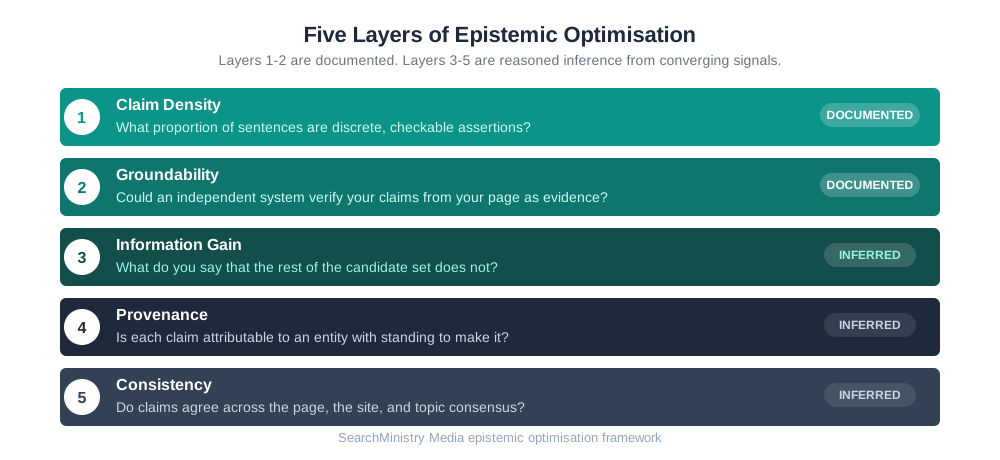
Claim Density
DocumentedGroundability
DocumentedInformation Gain
ProbableProvenance
InferredConsistency
InferredAdapting Your SEO Strategy for the Epistemic Era
To adapt your SEO strategy for the third era of search, you need to shift focus from semantic relevance to verifiability, provenance, novelty, and consistency. In practical terms, this means:
- Ensuring every sentence either carries a discrete, checkable claim or is cut
- Attributing claims to identifiable sources inline rather than in a distant bibliography
- Including genuinely unique information: first-party data, coined terms, or documented experience
- Separating confirmed facts from interpretation, labelling each clearly
- Checking that your claims do not contradict what authoritative sources in your topic area establish
Run this process on pages that already rank in positions 3 to 15 but earn no AI citations. For those pages, retrieval is already solved. The semantic layer is working. Only the epistemic layer is failing. Our AI SEO services include an epistemic content audit for exactly this scenario. To understand how AI agents retrieve and evaluate content before deciding what to cite, see our guide on agentic SEO and AI retrieval pipelines.
The Step-by-Step Optimisation Process
What follows is the process we run at SearchMinistry, in the order we run it. Budget two to four hours per article. Do not run it on everything; run it on pages that already rank in positions 3 to 15 but earn no AI citations, because for those pages retrieval is solved and only the epistemic layer is failing.
Extract and classify every claim
"Split this article into individual sentences. Classify each as FACTUAL CLAIM (a checkable assertion with an entity, a relation, and a value), OPINION, HEDGE/FILLER, or NAVIGATION. For each factual claim, note whether it contains a specific number, date, name, or source. Output as a table."
Put the output in a spreadsheet. This table is your work surface; every subsequent step operates on it, not on the article. Clean the classification manually: retag fragments and headings as navigation, retag quoted source material as sourced claims, and mark illustrative examples as examples to skip.
Triage every row
- KEEP — the claim already carries a source, number, or date.
- SPECIFY — the claim is true but vague and needs a number, date, or named detail.
- ANCHOR — the claim is supported by a source you already have, so attach the attribution inline.
- REFRAME — the sentence asserts something you cannot verify; convert it to explicitly labelled interpretation with probabilistic language.
- CUT — filler that carries no claim and no transition value.
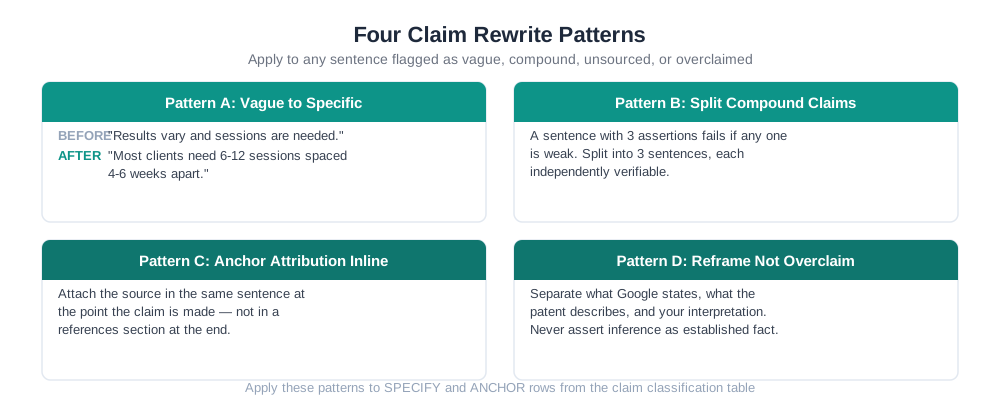
Apply the four rewrite patterns
- Pattern A — vague to specific: For example, "Results vary, and sessions are usually needed" becomes "Most clients need 6 to 12 sessions spaced 4 to 6 weeks apart, because only hairs in the anagen growth phase respond to treatment."
- Pattern B — split compound claims: a sentence carrying three assertions fails if any one is weak; split it into separate sentences.
- Pattern C — anchor attribution inline: attach the source in the same sentence at the point the claim is made, not in a references section three screens away.
- Pattern D — reframe not overclaim: separate what is documented from what is your interpretation, and label each clearly.
Run the information gain delta
- Claims on 5+ competing pages that you are missing — add these briefly to ensure compatibility with the retrieval set.
- Claims that appear nowhere in competing pages — this is your citation inventory.
If your unique claim list is empty, inject first-party data, coin a defined term, document a specific experience with named outcomes, or take an evidenced position on a genuinely disputed point.
For any claim of yours that conflicts with what authoritative sources in the retrieval set say, do not delete the disagreement. Reconcile it explicitly, stating the official position and then your differing interpretation with reasons. An acknowledged, argued disagreement is a feature. An unacknowledged one is a grounding failure waiting to happen.
What a Rewritten Sentence Looks Like
The before/after below shows Pattern D (reframe not overclaim) applied to a claim about how Google evaluates pages:
The rewritten version produces three independently groundable sentences from one ungroundable assertion. Two of the three sentences can be verified directly from Google's own documentation. The third is clearly labelled as interpretation. The original could not ground anything.
Epistemic optimisation quick audit: before you publish
- What percentage of sentences carry a discrete, checkable claim? Aim for at least 40%.
- Does every factual claim include a number, date, named source, or attributed entity?
- Are any compound claims carrying three or more assertions in a single sentence?
- Is inline attribution present at the sentence level, not just in a references section?
- What three claims does this page make that no other page in the top 10 makes?
- Does anything in this page contradict what authoritative sources establish? If so, is the disagreement explicitly acknowledged and argued?
Frequently Asked Questions
What is epistemic SEO?
Epistemic SEO is the practice of optimising content at the level of individual claims, based on four properties: verifiability (can each claim be checked against evidence?), provenance (who is making the claim and do they have standing?), novelty (does the claim add anything beyond what other sources already establish?), and consistency (does the claim agree with itself across the page and site?). It represents the third era of search optimisation, following keyword optimisation and semantic SEO.
What is the difference between semantic SEO and epistemic SEO?
Semantic SEO targets meaning-level similarity between embedded representations of content and query. Two texts with no words in common can be recognised as saying the same thing. Epistemic SEO goes further: it evaluates whether the claims within content are verifiable, attributed to credible sources, novel relative to the candidate set, and internally consistent. Semantic SEO solves retrieval into the candidate set. Epistemic SEO determines whether a page is cited once retrieved.
What is the information gain score and does Google use it?
The information gain score is described in Google's granted patent US11354342B2, filed in 2018 with a continuation granted in June 2024. It measures how much additional information a document contains beyond documents a user has already viewed on the same topic. Google has not publicly confirmed whether or how this patent operates in production. It should be treated as a probable direction based on documented capability, not a confirmed production mechanism.
What is the Check Grounding API and why does it matter for SEO?
The Check Grounding API is a Google Cloud Vertex AI product that takes a piece of text and a set of source documents and returns a support score from 0 to 1 indicating how well each sentence is supported by the sources. Four properties matter for SEO: the unit of verification is the sentence (not the page), partial correctness fails entirely, it operates in real time under 500 milliseconds, and an experimental feature returns contradicting citations. The API demonstrates that sentence-level claim verification is productised, not experimental.
Which pages should I prioritise for epistemic optimisation?
Prioritise pages that already rank in positions 3 to 15 but earn no AI citations. For those pages, retrieval is already solved because the semantic layer is working. Only the epistemic layer is failing. Improving claim specificity, inline source attribution, and cross-page consistency on those pages will have the greatest measurable impact. Running the full process on every page is not efficient; target the pages where retrieval is confirmed and citation is the remaining gap.
What does 'partial correctness fails entirely' mean in practice?
Google's Check Grounding API documentation gives the example: 'Google was founded by Larry Page and Sergey Brin in 1975.' The founders are correct, the year is wrong, and the entire claim is treated as ungrounded. One weak detail sinks the sentence. In practice this means compound claims should be split into separate sentences, each independently verifiable. A sentence claiming three things fails if any one is inaccurate or unsupported, even if the other two are correct.

Tharindu Gunawardana
Founder & Director, SearchMinistry Media
Tharindu Gunawardana is the Founder of SearchMinistry Media and a search strategist with 17 years of experience across Sri Lanka, Singapore, and Australia. A former Agency SEO Director, he specialises in helping brands transition from traditional SEO to AI-driven discovery.