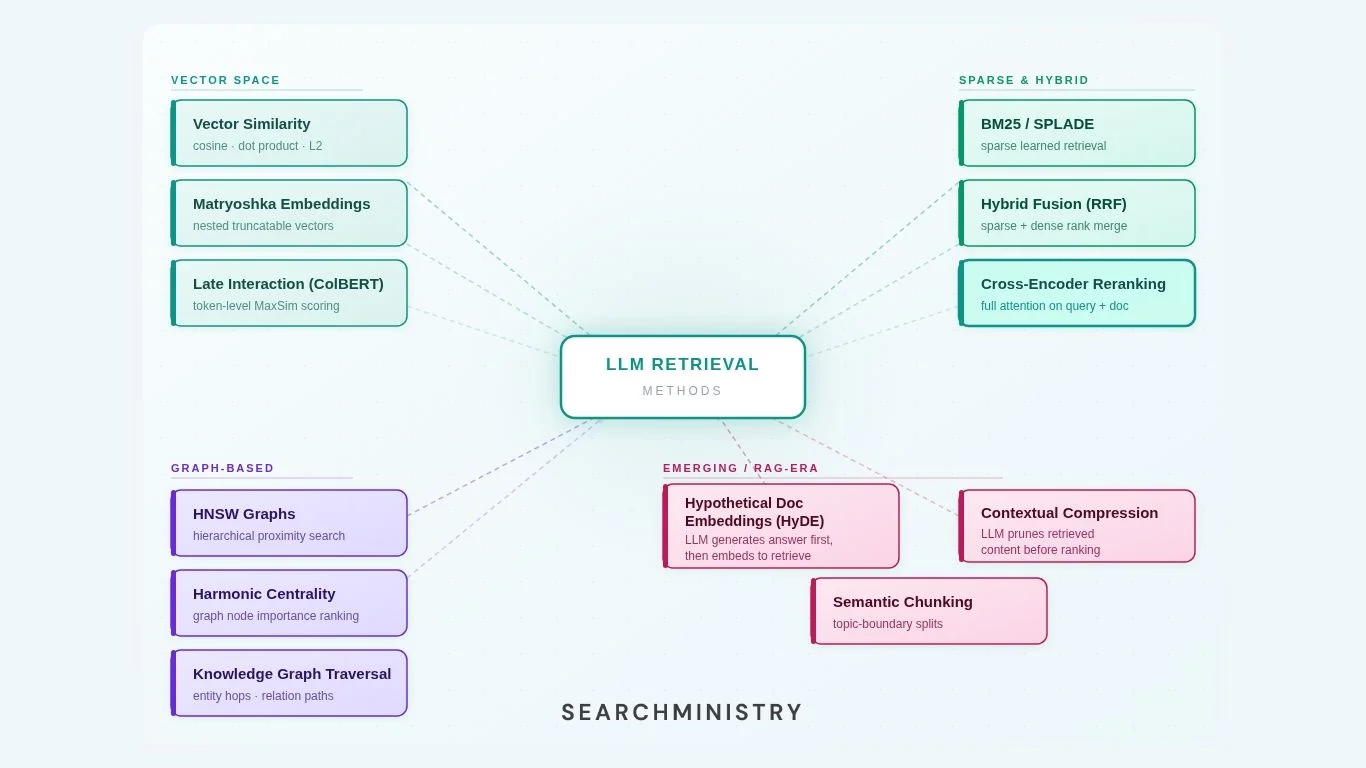
Why Retrieval Is the New Ranking
Traditional SEO optimised for ranking. You structured your page, earned backlinks, matched keywords, and watched your position on a results page. AI search works differently. It does not rank pages and present a list. Instead, it retrieves specific passages from specific documents, then generates a synthesised, grounded answer with inline citations.
The 12 methods in this guide represent the technical architecture used by platforms like Google AI Overviews, Perplexity, and ChatGPT Search. It is important to note that a system like Google is not limited to a single approach. Depending on the specific query requirement, Google deploys a combination of all these retrieval methods simultaneously to ensure the most relevant response.
Understanding these retrieval methods moves SEO from guesswork to engineering. It clarifies exactly how engines process your content:
- You will see why keywords in titles still matter for initial "lexical" retrieval, while semantic wordings are required for the "vector" retrieval that follows.
- You will learn where to place semantic terms and verification points so LLMs can easily extract and cite your data accurately.
- These methods explain why traditional keyword optimisation still works in some contexts, while deep semantic SEO is necessary for others.
Optimisation for retrieval is ineffective without E-E-A-T. AI systems prioritise human-verified authority to filter out low-trust sources. Each section below provides a clear explanation, SEO examples, and actionable optimisation steps, followed by a 7-step execution framework.
12 retrieval methods govern whether AI search cites your content
Across 4 categories: vector space, sparse and hybrid, graph-based, and RAG-era. Each method can independently surface or exclude your content.
Quick Reference: All 12 Methods
The table below gives you a strategic snapshot of each method before we go into depth. Impact ratings reflect how directly each method affects whether your content reaches the final AI answer context window.
| Method | Category | What It Measures | SEO Impact | Adoption | Primary Lever |
|---|---|---|---|---|---|
| Vector Similarity | Vector Space | Cosine/dot product angle between embeddings | High | Universal | Focused, single-topic sections |
| Matryoshka Embeddings | Vector Space | Nested truncatable vectors for 2-pass retrieval | High | Growing | Clear titles, dense semantic content |
| Late Interaction ColBERT | Vector Space | Token-level MaxSim scoring | High | Selective | Vocabulary breadth and depth |
| BM25 / SPLADE | Sparse + Hybrid | Term frequency + learned sparse expansion | High | Universal | Exact terminology the audience uses |
| Hybrid Fusion (RRF) | Sparse + Hybrid | Rank merging across sparse + dense lists | Very High | Common | Presence in both retrieval lists |
| Cross-Encoder Reranking | Sparse + Hybrid | Joint query-doc attention for final scoring | Very High | Common | Answer-first structure, no preamble |
| HNSW Graphs | Graph-Based | Hierarchical ANN index navigation | Medium | Universal | Specific, precise content that clusters well |
| Harmonic Centrality | Graph-Based | Graph reachability as crawl + citation signal | High | Common | Flat internal link architecture |
| Knowledge Graph Traversal | Graph-Based | Multi-hop entity relation following | High | Common | Schema.org markup + sameAs links |
| Contextual Compression | RAG-Era | Post-retrieval sentence extraction | Very High | Common | Key fact in first sentence of every section |
| Semantic Chunking | RAG-Era | Topic-boundary document splitting | Very High | Common | One H2 section per topic, clear headings |
| HyDE | RAG-Era | Hypothetical answer embedding for retrieval | Medium | Emerging | Expert-register, authoritative writing |
Part 1: Vector Space Methods
Vector space methods convert text into numerical coordinates in high-dimensional space, then measure geometric relationships between coordinates to determine relevance. These methods underpin the dense retrieval component of nearly every AI search system in production.
1. Vector Similarity (Cosine, Dot Product, L2)
Vector similarity measures the angle or distance between two embedding vectors. Cosine similarity is the most common measure: a score of 1.0 means the vectors point in exactly the same semantic direction; 0 means no relationship. The retrieval system embeds the query and every candidate chunk, then surfaces the chunks with the highest similarity scores.
Poor cosine score (0.52): A product category page mixing espresso machines, filter coffee, pod coffee, and cold brew equipment in the same section. The embedding vector is pulled in four semantic directions. Weak match for any specific query.
Strong cosine score (0.91): A section dedicated to espresso machines under $500 in 2026, covering grind quality, boiler type, pressure bar rating, and milk frothing capability. One topic, one semantic direction. Retrieved reliably for "best coffee machine 2026" and related queries.
Does not retrieve: A homepage that mentions "AI SEO" in the hero and "Melbourne" in the footer contact address. Two separate concepts with no semantic connection in any single passage. Low cosine similarity to the combined query.
Retrieves reliably: A service page section that covers "AI SEO for Melbourne businesses", explaining how local intent signals interact with AI Overviews, citing Melbourne-specific search patterns and local entity coverage. The embedding carries all three concepts together.
Optimise for vector similarity: Write one topic per H2 section. Avoid mixing concepts within a paragraph. Use the natural vocabulary of your subject domain rather than repeating the same keyword phrase. Dense, varied semantic coverage produces a tighter embedding that matches a broader set of related queries.
2. Matryoshka Embeddings
Matryoshka Representation Learning (MRL) trains embedding models so that lower-dimension truncations of a full embedding vector are already a meaningful, independently usable representation of the content. In a model producing 1536-dimensional vectors, the first 128 dimensions are sufficient for a useful first-pass retrieval, though the exact dimension thresholds vary by model and deployment. AI search systems exploit this by running a cheap low-dimension pass to shortlist thousands of candidates, then re-ranking the shortlist at full precision. Content that fails the low-dimension filter never reaches the expensive reranking stage.
Filtered out at 128d: A chunk mixing page speed, server hosting, image optimisation, and JavaScript execution in one section. The 128-dimension vector cannot resolve the dominant topic clearly. Score: 0.48 at 128d. Filtered before re-ranking runs.
Passes filter, wins at 1536d: A section titled "How to Reduce Largest Contentful Paint (LCP)" covering only LCP root causes and fixes. Clear semantic focus at 128d scores 0.79. At 1536d precision: 0.94. Selected for the AI answer context window.
Fails first pass: A blog post introduction that spends 300 words discussing the history of e-commerce, the importance of product pages generally, and then briefly mentions writing descriptions. At 128d the signal is diluted. Score: 0.41. Dropped before precision re-ranking.
Passes and wins: A section opening with "An SEO-friendly product description covers the product's primary benefit in the first sentence, includes the target keyword within the first 50 words, and uses bullet points for technical specifications." Dense signal from the first sentence. Passes 128d filter at 0.82.
Optimise for Matryoshka embeddings: Put your section's most important semantic signal into the first two sentences, not buried later. Use clear, descriptive H2 and H3 headings that state the topic directly. Single-topic sections produce clean embeddings at every dimension size.
3. Late Interaction ColBERT
ColBERT's late interaction model stores a contextualised embedding vector for every individual token in a document. At query time, each query token finds its best-matching document token via MaxSim scoring and the scores are summed. A document that contains the concepts from a query spread across multiple sentences will score higher than one that mentions them only briefly. Token breadth and coverage are the scoring mechanism.
Low MaxSim score: "Optimise your Google Business Profile for SEO. This is important for local SEO. Google Business Profile optimisation helps local SEO." Repetition without variation. Query tokens for "how", "Google", "local", and "optimise" all match the same tokens repeatedly. MaxSim ceiling is low.
High MaxSim score: "Add your primary service category and three secondary categories to your Business Profile. Collect reviews with location-specific keywords in the response text. Post weekly updates using suburb names from your service area. Verify your NAP details match all external directory listings." Every query token finds a distinct, high-quality match. MaxSim score is substantially higher.
Shallow coverage: A page that lists "URL parameters, HTTP/HTTPS versions, trailing slashes" as causes with no further explanation. Three token matches, minimal depth. ColBERT score is moderate at best.
Deep coverage: A section covering each cause with a mechanism explanation: why URL parameters create duplicates (crawler sees each parameter combination as a new URL), how to diagnose them with a site: operator search, and which canonical or robots.txt approach resolves each type. Diverse token coverage from technical vocabulary throughout. ColBERT rewards the depth.
Optimise for ColBERT: Use synonyms and related terms rather than repeating the same phrase. Cover each concept from multiple angles. Comprehensive treatment of a topic produces more diverse, high-value token vectors than surface-level coverage.
Part 2: Sparse and Hybrid Methods
Sparse retrieval methods match documents based on specific terms rather than semantic direction. Hybrid methods combine sparse and dense signals. These methods are not legacy technology. BM25 remains a first-stage retriever in most production AI search systems because of its speed and precision on exact queries.
4. BM25 and SPLADE
BM25 scores documents by how frequently a query term appears, with diminishing returns as frequency increases (TF saturation) and a correction for document length. Keyword stuffing produces a worse BM25 score than natural integration of terms in a comprehensive document. SPLADE extends BM25 with a learned sparse expansion that adds implicit related terms to both query and document at indexing time, giving sparse retrieval some of the semantic reach of dense retrieval.
BM25 scores zero: A page titled "Top Espresso Equipment for Home Baristas 2026" that covers all the same products but uses "espresso machine", "home barista equipment", and "bean-to-cup setup" throughout without using the phrase "coffee machine under $500". Exact BM25 term match fails. SPLADE recovers this partially through expansion, but the BM25 component contributes nothing to RRF.
BM25 scores high: The same page, with an H2 added: "Best Coffee Machines Under $500: Our Top Picks for 2026". BM25 now finds exact matches for "best", "coffee machine", "under" and "500" in the heading. SPLADE further expands to "espresso", "home barista", and "affordable". Both sparse signals active.
Fails BM25: An article about "organic growth strategy" and "non-paid channel optimisation" that never uses "website traffic" or "paid ads" as exact terms. Semantically correct, but BM25 scores zero. In a hybrid system, this page wins the dense signal but misses the sparse signal entirely, halving its effective RRF score.
Wins both signals: The same article with a section explicitly titled "How to Increase Website Traffic Without Paid Ads", using the exact terms the audience searches. Then building out the section with semantic vocabulary: "organic channels", "SEO", "content marketing", "social referral". Covers BM25 with the heading and dense retrieval with the body text.
Optimise for BM25/SPLADE: Use the exact phrases your audience searches in at least one heading per section. Do not replace them with elegant synonyms in the heading. Use the synonyms in the body text where they sound natural. This pattern covers both sparse and dense signals without forcing awkward repetition.
5. Hybrid Fusion (RRF)
Reciprocal Rank Fusion (RRF) combines the ranked output lists from BM25 (or SPLADE) and dense vector retrieval into one unified ranking. The formula is: RRF score = 1/(k + rank_sparse) + 1/(k + rank_dense), where k defaults to 60. The critical insight: a document ranking 5th in both lists scores approximately 0.031. A document ranking 1st in only one list scores approximately 0.016. Appearing in both lists roughly doubles your effective retrieval score.
| Page | BM25 rank | Dense rank | RRF score | Outcome |
|---|---|---|---|---|
| Page A: covers both signals | 5 | 5 | 0.031 | Selected |
| Page B: only keyword match | 1 | absent | 0.016 | Loses to A |
| Page C: only semantic match | absent | 1 | 0.016 | Loses to A |
Single-signal page: A technical SEO guide that discusses meta descriptions extensively using terms like "SERP snippets", "click-through rate optimisation", and "search result preview text" but never uses the exact phrase "how to write a meta description". Dense signal: strong. BM25 signal: zero. RRF score: 0.016.
Dual-signal page: The same guide, with an H2 heading "How to Write a Meta Description That Gets Clicked" and a first paragraph using "meta description" three times naturally. BM25 signal: strong. Dense signal: still strong. RRF score: 0.031. Cited in AI answers for this query; the other page is not.
Optimise for RRF: Audit your top pages to confirm they hold both a sparse signal (exact keyword in heading or first paragraph) and a dense signal (semantic vocabulary variation in body text). Pages missing either signal are operating at half their potential RRF score regardless of quality.
6. Cross-Encoder Reranking
Cross-encoder reranking is the final precision filtering stage before content reaches the LLM context window. Unlike bi-encoders (which embed query and document separately), a cross-encoder processes the full query and the full document chunk together in a single forward pass. This joint attention allows it to identify fine-grained token-level matches between the specific words in a query and the specific sentences in your content. It is slower than first-stage retrieval but far more accurate. Pages that win at first-stage retrieval but fail here never appear in AI answers.
Cross-encoder score: 0.39: "Bounce rate is an important metric. Many factors affect bounce rate including page load time, content quality, design, user experience, and relevance. Product pages are particularly important for e-commerce conversion. There are various techniques that can help address these issues on product pages." The direct answer is absent. The cross-encoder finds no high-similarity token pair between the query and the document.
Cross-encoder score: 0.93: "Reduce product page bounce rate by loading hero images in under 1.5 seconds, placing the primary CTA above the fold, and matching the exact search query that brought the visitor to the page in the first heading. Rich visual formats such as 360-degree product images consistently reduce bounce rate compared to single static images." Direct answer in the first sentence. Every token in the query finds a high-similarity match.
Preamble structure (fails reranker): "In the world of technical SEO, there are many tools available to webmasters. One of these tools, which has been important since it was introduced by Google in 2009, is the canonical tag. This tag, which appears in the head section of HTML..." The answer is 40 words into the paragraph. The reranker sees the definition buried; score is moderate.
Definition-first structure (wins reranker): "A canonical tag is an HTML element that tells search engines which version of a duplicate or near-duplicate URL is the primary one to index. Use it when the same content is accessible at multiple URLs, when URL parameters create duplicate pages, or when you syndicate content to third-party sites." Definition in the first sentence. Query token "canonical tag", "when", and "use" all find immediate high-similarity matches.
Optimise for the cross-encoder: Write every section opening as if someone asked the heading as a question and you are providing a direct answer. No preamble, no context-setting paragraphs. The answer first. The supporting detail after. This structure is called inverted pyramid writing and it is the single most effective change you can make for AI answer inclusion.
Part 3: Graph-Based Methods
Graph-based methods use structural relationships between nodes in various types of graphs to determine retrieval probability and factual accuracy. Two distinct graph types matter for SEO: the vector index graph (HNSW) and the knowledge graph (entity relations). Harmonic centrality bridges both.
7. HNSW Graphs
Hierarchical Navigable Small World (HNSW) graphs are the data structure that makes fast approximate nearest-neighbour search possible at scale. When your content is embedded and indexed, its chunk vectors become nodes in a layered graph. During retrieval, the system enters the top layer at a fixed entry point, greedily moves toward the nearest neighbour at each layer, then descends. Chunks with tight, focused embeddings that cluster near many related documents will be well-connected in the graph and retrieved reliably. Generic or mixed-topic chunks sit in sparse areas with few connections.
Sparse graph position: A page covering "kitchen appliances" broadly: dishwashers, coffee machines, blenders, toasters. The coffee machine content produces a diffuse embedding that sits at the edge of multiple clusters (kitchen appliances, small appliances, home goods) without belonging firmly to any. Few HNSW neighbours. Retrieved inconsistently for coffee-specific queries.
Dense graph position: A coffee machine buyer's guide covering espresso machines, bean-to-cup machines, pod machines, and French press. All content clusters tightly in the "coffee equipment" semantic neighbourhood of the HNSW graph. Many neighbours (other coffee content). Retrieved reliably for all coffee machine query variants.
Isolated chunk: A generic "What is Technical SEO?" section that mentions audits in one sentence alongside crawlability, page speed, structured data, and international SEO. The chunk embedding sits in a diffuse zone. Low HNSW connectivity for the specific query "technical SEO audit".
Connected chunk: A dedicated "Technical SEO Audit: Step-by-Step Process" section covering crawl report analysis, Core Web Vitals thresholds, canonical tag verification, and 404 resolution. The embedding clusters tightly with other audit-specific content across the web. High HNSW connectivity. Retrieved consistently.
Optimise for HNSW: Build topical depth rather than topical breadth. A site with 10 comprehensive guides on SEO audits will have better HNSW connectivity for audit queries than a site with 50 superficial pages across 50 different topics. Depth creates clustering; clustering creates HNSW connectivity.
8. Harmonic Centrality
Harmonic centrality measures how close a page is to every other page in the site's internal link graph. Pages with high harmonic centrality are crawled more frequently, accumulate more link equity, and have higher AI citation probability. The practical metric to watch is click depth from your homepage: a page at 2 clicks scores dramatically higher than one at 5 clicks, even with identical content.
5-click depth: Homepage → Services → AI SEO → Guides → AI Retrieval Guides → "What Is Semantic Chunking". Link equity diluted across 5 hops. Crawled infrequently. Low AI citation probability despite excellent content.
2-click depth: Homepage → AI SEO Service Page → "What Is Semantic Chunking" (linked directly from the service page). Link equity arrives with minimal dilution. Crawled regularly. AI citation probability is substantially higher for the same content.
Low centrality setup: The "AI SEO Melbourne" city page is only linked from the "Melbourne" section of a locations index, which is only linked from the footer. Path: Homepage → Footer → Locations → Melbourne → AI SEO Melbourne. Crawled monthly. Receives almost no link equity.
High centrality setup: The AI SEO service page (1 click from homepage) contains a direct link to the "AI SEO Melbourne" page in a "Serving Melbourne businesses" section. Path: Homepage → AI SEO Service → AI SEO Melbourne. 2 clicks. Crawled weekly. Receives strong link equity. AI citation probability is high.
Optimise for harmonic centrality: Audit your highest-value AI SEO content for click depth. For every page at depth 4 or deeper, add one link from a service page or homepage hub. That single structural change improves crawl frequency, link equity, and AI citation probability simultaneously without any content changes.
For sites built with JavaScript frameworks, this structural challenge starts earlier: if the server is not delivering fully rendered HTML, no depth optimisation will help because Googlebot never sees the content to index. Our guide on ranking Vibe-coded sites for search covers the SSR, routing, and meta tag fixes that make JavaScript-rendered content accessible to AI crawlers before retrieval optimisation begins.
9. Knowledge Graph Traversal
Knowledge graph traversal is how AI search systems answer factual questions about entities. When a query involves a named entity (a brand, person, location, or product), the system traverses relation edges in the knowledge graph to find and verify facts. If your brand, product, or person is not represented as an entity with traversable relations, it cannot appear in traversal-based AI answers, regardless of how good your content is.
No traversal possible: A product page listing the Breville Bambino Plus for $399 with milk frother included, but using only plain text descriptions. Google can read the text but cannot traverse the entity graph to verify the price, confirm the milk frother feature as a product attribute, or connect the product to Breville as a manufacturer. Factual AI answers about this product cannot cite this page confidently.
Traversal enabled: The same page with Product schema including name, brand (with sameAs linking to Breville's Wikipedia entry), offers (price: 399, priceCurrency: AUD), and additionalProperty for "milk frother: included". AI search can traverse from the product to the brand to the price to the feature. Factual answers about this product can now cite this page with high confidence.
Text-only entity: "SearchMinistry Media is an AI SEO agency in Melbourne." Google extracts the entity via NER but cannot traverse: who founded it, what services it offers, which locations it serves. The entity is a dead end in the knowledge graph. Traversal from "Melbourne + AI SEO agencies" cannot reliably reach this entity.
Structured entity: Organisation schema with name, foundingDate, founder (Person with sameAs), areaServed (Melbourne, sameAs geo entity), serviceType, and sameAs linking to a LinkedIn company page and an industry directory. Traversal from "Melbourne" reaches the brand; traversal from the brand reaches the service type; traversal from the founder reaches the brand. Multi-hop reachability from multiple entry points.
Optimise for knowledge graph traversal: Add Organisation, Person, Product, and LocalBusiness schema to every relevant page. Use sameAs properties to link your entities to authoritative external profiles. Each sameAs link is an additional graph edge that increases your entity's reachability from multiple traversal entry points.
Part 4: RAG-Era Methods
RAG-era methods operate after first-stage retrieval, shaping what content the LLM actually receives and processes. These methods have the highest direct impact on whether your content appears in a generated answer because they control the final context window that the LLM reads before generating its response.
10. Contextual Compression
Contextual compression is a post-retrieval filter that extracts only the sentences from a retrieved chunk that are relevant to the query. A 600-token chunk containing the answer to the query plus 400 tokens of surrounding context will be compressed to the 200 most relevant tokens before being passed to the LLM. Content that buries its key answers in the middle or end of long paragraphs loses its most citable sentences to compression before the LLM ever sees them.
Compressed out: A 600-word section about Google Business Profile management that spends 450 words covering reviews, Q+A, category selection, and photos, and then mentions in the second-to-last paragraph: "Posting weekly is generally recommended for most businesses." That sentence is buried. The compressor extracts it, but surrounded by irrelevant context it scores lower against the query than a direct answer.
Compression-proof: A dedicated section: "How Often to Post on Google Business Profile". Opening sentence: "Post to your Google Business Profile at least once per week for most businesses, or twice weekly if you operate in a competitive service category." The compressor selects this sentence immediately. It is the highest-scoring sentence in the chunk for this specific query.
Fails compression: An intro section: "When Googlebot crawls the web, it reads a variety of files on your server. One of these files, which has been a part of the web for decades, is the robots.txt file. This file, which sits at the root of your domain, communicates with crawlers." The definition is implied, not stated. The compressor extracts fragments. The LLM cannot cite a clear answer from the compressed output.
Survives compression: "A robots.txt file is a plain text file stored at the root of your domain that instructs search engine crawlers which pages or directories they are permitted or not permitted to access." Direct definition in the first sentence. The compressor extracts this sentence in full. The LLM cites it verbatim.
Optimise for contextual compression: Open every H2 section with a direct answer to the implied question in the heading. Test by covering everything except the first two sentences of each section: does a reader get the core answer? If not, rewrite the opening until they do.
11. Semantic Chunking
Semantic chunking is the process AI systems use to split documents into retrieval-ready segments. Instead of cutting at a fixed token count, semantic chunkers measure cosine similarity between consecutive sentence embeddings and split where similarity drops sharply, indicating a topic change. A page with clean heading structure and single-topic sections will be chunked at natural boundaries, producing focused, high-quality embeddings. Mixed-topic sections get split arbitrarily or produce noisy embeddings.
Poor chunking (no section structure): A 4,000-word buying guide written as continuous prose covering espresso machines, pod machines, and filter coffee equipment without heading separators. A fixed-size chunker splits at 512 tokens, producing 8 chunks each mixing multiple product categories. Each chunk retrieves weakly for any specific sub-query. The guide is present in the index but rarely cited.
Excellent chunking (structured guide): The same guide with H2 sections for "Best Espresso Machines Under $500", "Best Pod Coffee Machines 2026", "Best Filter Coffee Machines for Home Use". Semantic chunking splits at each H2 boundary, producing 3 focused chunks. Each chunk retrieves independently: the espresso section retrieves for espresso queries, the pod section for pod queries. The guide is cited multiple times across different sub-queries from the same AI answer session.
Mixed-topic chunk: A section covering "301 redirect setup, crawl budget during migration, and URL structure changes" in the same 400 words. Semantic chunker splits this at the highest-similarity-drop point but the resulting chunks still mix concepts. Neither chunk retrieves reliably for a specific sub-query.
Clean chunks: Three separate H2 sections: "How to Set Up 301 Redirects for a Site Migration", "Managing Crawl Budget During a Website Migration", "URL Structure Changes: What to Change and What to Keep". Each section is its own chunk. Each retrieves independently for its specific query. The article is cited three times across an AI answer covering the full migration topic.
Optimise for semantic chunking: Create a new H2 heading for every distinct topic. Never mix two separate concepts in a single section. A long-form piece with 12 well-separated sections will be chunked into 12 independently citable passages. The same content as one continuous essay produces as few as 3 usable chunks.
12. Hypothetical Document Embeddings (HyDE)
HyDE is an emerging retrieval technique where the system uses an LLM to generate a hypothetical ideal answer to the query, embeds that hypothetical answer, and then retrieves real documents most similar to it. Rather than matching a short query embedding against long document embeddings (a dimension mismatch problem), HyDE matches a full hypothetical document against real documents in the same embedding space. Content that reads like an expert's direct response to the query will retrieve well under HyDE, because its embedding closely resembles the hypothetical ideal answer.
Important Caveat
HyDE performs poorly for time-sensitive or rapidly evolving topics because the LLM generates hypotheticals based on training data, which is outdated by definition. For queries like "best coffee machine 2026" or "latest Google algorithm updates", HyDE-generated hypotheticals embed outdated information, reducing retrieval accuracy. Pair HyDE with freshness filters when deploying in production for current-events queries.
Does not match HyDE hypothetical: "Title tags are an important part of on-page SEO. They appear in search results and browser tabs. There are various best practices to follow." Vague, hedging, no specific guidance. The embedding does not match a hypothetical written by a knowledgeable SEO practitioner providing direct guidance.
Matches HyDE hypothetical well: "A well-written title tag places the primary keyword within the first 30 characters, stays under 60 characters total to avoid truncation in search results, and includes a clear benefit or action (e.g., Guide, Calculator, Checklist) to improve click-through rate. Avoid duplicating titles across pages: each URL needs a unique title that accurately describes only that page's content." Expert-register, specific, direct. The embedding resembles what a knowledgeable practitioner would write as the ideal answer.
Thin content (fails HyDE matching): "Crawl budget is the number of pages Google crawls on your site. It depends on your site authority. You can optimise it by removing low-quality pages." Generic. The hypothetical answer generated by the LLM for this query will be far more specific than this. The embedding similarity is low.
Expert-register content (matches HyDE): "Crawl budget is the product of crawl rate limit (how fast Googlebot can crawl without overloading your server) and crawl demand (how often Google wants to recrawl your URLs based on freshness and popularity signals). To optimise it: block low-value URLs via robots.txt (parameter pages, internal search results, admin paths), consolidate near-duplicate pages with canonical tags, and improve server response time to increase crawl rate limit." The specificity and completeness of this answer closely resembles what a HyDE hypothetical would look like. High embedding similarity. Retrieved and cited.
Optimise for HyDE: Write with the authority and specificity of a published expert. Avoid hedging language like "can", "may", "generally", "some might say". Provide named techniques, specific numbers, and direct recommendations. This register produces embeddings that align with the confident, detailed hypotheticals HyDE systems generate. Link to the RAG guide for deeper context on how these retrieval methods fit together in a full pipeline.
7-Step AI Retrieval Optimisation Framework
The methods above operate in parallel, not in sequence. A single piece of content passes (or fails) all 12 simultaneously. The framework below gives you a prioritised sequence for improving your content's performance across the full retrieval stack. Start with the highest-impact steps and confirm each one before moving to the next.
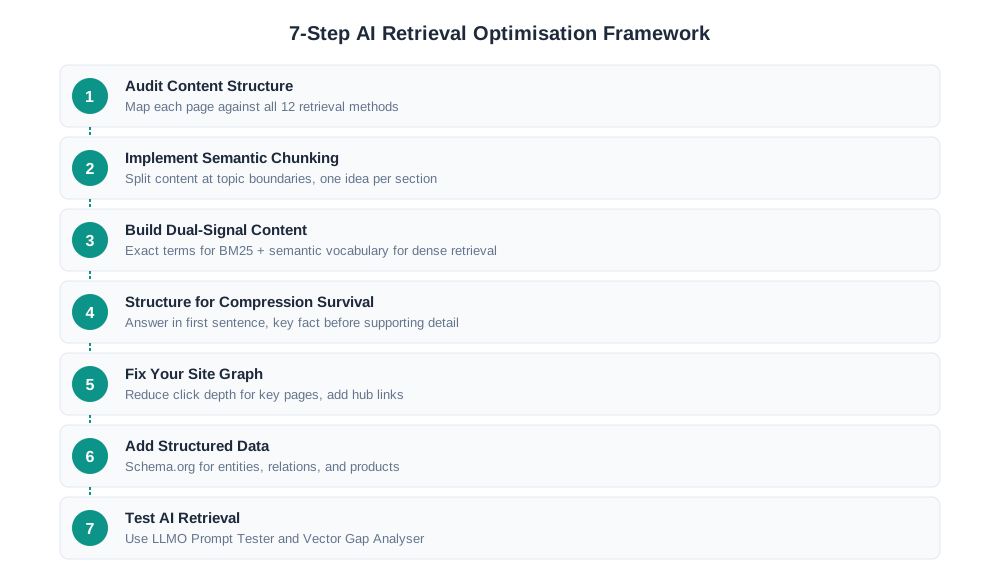
Audit your content structure against the 12-method checklist
For each key page, run through the 12 methods and ask: does this page perform well here? Single-topic sections score well for vector similarity and semantic chunking. Exact terminology helps BM25. Structured data helps graph traversal. Identify the two or three methods where your content is weakest and fix those first.
Implement semantic chunking at the content creation stage
Every H2 section should cover exactly one topic. Every paragraph should develop one idea from introduction to conclusion. A 3,000-word guide with clean heading structure will be chunked into 8-12 focused, high-quality chunks by AI retrieval systems. The same length written as continuous prose will be split arbitrarily, producing poor embeddings for every method in Part 1.
Build dual-signal content for hybrid retrieval dominance
Hybrid Fusion RRF rewards pages that appear in both the BM25 sparse list and the dense semantic list. A page ranking 5th in both lists scores better than a page ranking 1st in only one. Practical approach: use the exact terminology your audience searches ("best coffee machine under $500", "AI SEO Melbourne") in your headings and first paragraphs. Then build out surrounding sentences with semantic vocabulary variation. This covers both signals without any conflict.
Structure every section for compression survival
Contextual compression extracts the most relevant sentences from a retrieved chunk. If your answer is buried in paragraph 4, it is compressed out before reaching the LLM context window. Apply inverted pyramid structure to every H2 section: the key fact or direct answer in the first sentence, supporting detail in the sentences that follow. Test this by asking: if someone read only the first two sentences of this section, would they get the core answer? If not, rewrite.
Fix your site graph with harmonic centrality principles
Key pages buried more than 3 clicks from your homepage are crawled infrequently, accumulate less link equity, and have lower AI citation probability. The fix is structural: identify pages at depth 4 or deeper, then add one link to each from a hub page (your homepage or a service page). A guide added to a hub page drops from depth 4 to depth 2 immediately. Run a crawl to confirm depth before and after. Use this specifically for your highest-value AI SEO content.
Add structured data for entity and knowledge graph visibility
Knowledge graph traversal only works if your entities have machine-readable relation data. Add Organisation schema with founder, location, and sameAs properties linking to authoritative external profiles. Add Product schema with Offer and AggregateRating for any product content. Add FAQPage schema for Q+A sections. Add Article or BlogPosting schema with author and datePublished. Each schema property added is a new traversal edge that AI search systems can follow to find and verify your content.
Test AI retrieval directly and iterate
Use the LLMO Prompt Tester to see how AI systems currently answer questions relevant to your business, and whether your content appears. Use the SEO Vector Gap Analyser to identify semantic gaps between your content and the queries you want to rank for. Re-audit every 90 days: retrieval pipelines evolve quickly and a method given less weight six months ago carries more weight today.
Which methods to prioritise first
If you have limited time and need to prioritise, apply this order:
| Priority | Fix | Methods addressed | Effort |
|---|---|---|---|
| P1 | Answer-first structure for every section | Cross-encoder, compression, HyDE | Low |
| P2 | One H2 section per topic, clear headings | Semantic chunking, vector similarity, Matryoshka | Low |
| P3 | Exact keywords in headings + semantic vocab in body | BM25/SPLADE, Hybrid RRF | Low |
| P4 | Fix click depth for key pages (add hub links) | Harmonic centrality | Medium |
| P5 | Add Organisation/Product/Article schema | Knowledge graph traversal | Medium |
| P6 | Build topical depth within each subject area | HNSW, ColBERT, vector similarity | High |
Test how AI systems retrieve your content now
Use our free LLMO Prompt Tester to see which AI search answers currently cite your content, and our SEO Vector Gap Analyser to find semantic gaps between your pages and the queries you want to win.
For a full technical review of how your site performs across all 12 retrieval methods, including internal link graph analysis, entity footprint mapping, and chunk quality scoring, our AI SEO service covers the complete stack from indexing through to answer generation.
Frequently Asked Questions
Which of the 12 LLM retrieval methods is most important for SEO?
In most hybrid RAG-based AI search pipelines, cross-encoder reranking and contextual compression have the highest direct impact on whether your content appears in AI answers, because they operate closest to the final output. However, a page that fails at the first-stage retrieval layer (vector similarity or BM25) never reaches the reranker. Hybrid Fusion RRF is the most strategically important method to optimise for because it governs first-stage selection across both sparse and dense signals simultaneously.
Does keyword optimisation still matter with LLM retrieval?
Yes, but the reason has changed. BM25 and SPLADE are still first-stage retrievers in most hybrid AI search systems. Exact-match keywords matter for sparse retrieval coverage. The difference from traditional SEO is that keyword density is penalised by BM25's TF saturation formula, and keyword stuffing actively degrades dense retrieval quality by producing noisy embeddings. Use exact terminology once, then build semantic depth around it.
How is AI retrieval different from Google's standard ranking algorithm?
Traditional Google ranking scores pages holistically across hundreds of signals and returns a ranked list of URLs. AI retrieval retrieves specific passages or chunks, not pages, and the retrieved content is used as the raw material for a generated answer. This means a single page can contribute multiple independent chunks to an AI answer, and ranking position is less relevant than passage-level relevance. A page at position 7 with a perfectly structured answer passage will be cited more often than a page at position 1 with a buried, mixed-topic answer.
What is HyDE and how does it change content strategy?
HyDE (Hypothetical Document Embeddings) has the system generate a hypothetical ideal answer to a query, embed it, and then retrieve real documents most similar to that hypothetical. The practical implication: your content should read like an expert's direct answer to the question. Content that hedges, uses excessive qualifications, or buries the key point performs poorly against HyDE-generated hypotheticals. Write with the confidence and directness of an authoritative source.
Can I optimise for all 12 methods at once?
Most of the optimisations reinforce each other. Semantic chunking improves vector similarity, contextual compression survival, and Matryoshka first-pass scores simultaneously. Answer-first structure improves cross-encoder reranking and compression survival at the same time. The only areas requiring separate attention are sparse retrieval (exact terminology) and graph-based methods (internal links and schema markup), which do not follow automatically from content writing improvements.
How many hops can AI knowledge graph traversal follow reliably?
Current AI systems handle 2-3 hops reliably. At 4+ hops, accuracy degrades significantly due to error compounding at each traversal step. For SEO purposes, the practical goal is to be 1-2 hops from well-known entities. If your brand is connected to a known industry body, a widely-cited person, or a recognised location entity via schema.org markup, traversal from those anchor entities can reach you in 1-2 hops.
How does semantic chunking affect long-form content?
Positively, provided the content has clear heading structure. A 5,000-word guide with 12 distinct H2 sections will be chunked into 12 focused, independently retrievable passages. Each passage can be cited independently for its specific sub-topic. Without structure, the same 5,000 words will be split by a fixed-size chunker at arbitrary boundaries, often cutting paragraphs mid-argument. The result is chunks that are either incomplete or mixed-topic, both of which produce weaker embeddings and lower retrieval scores.
Does HNSW graph connectivity affect every page equally?
No. Pages that produce embeddings clustering tightly with many related documents in vector space have strong HNSW graph connectivity and are retrieved reliably. Generic, broad content produces diffuse embeddings that sit in sparse areas of the index with few connections. Specific, focused content about well-established topics (not obscure niche topics) clusters near existing knowledge and connects well in the HNSW graph. This is one of the reasons deep topical coverage of a subject outperforms shallow coverage across many subjects.

Tharindu Gunawardana
Founder & Director, SearchMinistry Media
Tharindu Gunawardana is the Founder of SearchMinistry Media and a search strategist with 17 years of experience across Sri Lanka, Singapore, and Australia. A former Agency SEO Director, he specialises in helping brands transition from traditional SEO to AI-driven discovery.