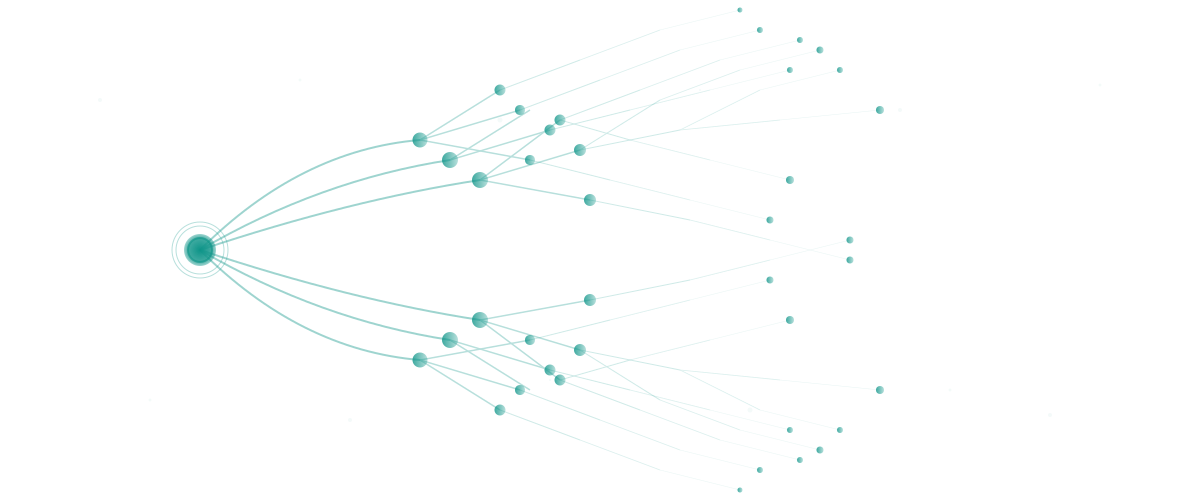
Query fan-out is the process by which AI search engines decompose a single user query into multiple specialised sub-queries before retrieving content and generating an answer. Instead of matching one query against a document index, the system runs several parallel or sequential searches, each targeting a different facet of what the user asked. The results are then merged and synthesised into a single coherent response. Understanding query fan-out is fundamental to optimising content for AI Overviews, Perplexity, ChatGPT Search, and any other system built on retrieval augmented generation (RAG).
What Is Query Fan-Out?
The term "fan-out" describes the shape of the process. One query enters the system and fans outward into many sub-queries, like a hand of cards being spread or a river delta branching into channels. Each branch handles a different informational angle of the original request.
Take the query "how do I improve my local SEO rankings?" A naive search engine treats this as one request. An AI search engine with fan-out breaks it into components: What are the Google Business Profile ranking factors? What role do local citations play? How does NAP consistency affect local search? What on-page signals matter for local queries? What do review signals contribute to the Local Pack? Each sub-query retrieves different content, and the final AI answer synthesises across all of them.
This is why comprehensive content outperforms narrow content in AI-generated answers. A page that addresses only one aspect of a topic is retrieved for one sub-query. A page that covers a topic deeply across its sub-components is retrieved multiple times across multiple sub-queries, making it significantly more likely to be cited.
How Query Fan-Out Works
The query fan-out process runs in several distinct phases inside an AI search pipeline:
- Intent classification: The system first determines what type of query it is. Factual, procedural, comparative, and exploratory queries each trigger different fan-out patterns. A "how to" query fans out differently from a "what is" query.
- Sub-query generation: The AI model generates a set of rewritten or decomposed queries. These are often produced by the same underlying language model via a planning step, where the model reasons about what information it needs before retrieving anything.
- Parallel retrieval: Each sub-query is executed against the retrieval index simultaneously. In RAG-based systems, this means each sub-query is embedded as a vector and used to find the nearest matching document chunks using vector similarity search.
- Re-ranking and deduplication: Retrieved chunks from all sub-queries are scored, and duplicate or near-duplicate passages are merged. Chunks that answer the most sub-queries are weighted more heavily.
- Answer synthesis: The language model generates a final response using all retrieved chunks as context, citing or referencing the sources that contributed most to the answer.
The sub-query generation step is where contextual vector representations play a critical role. The model's ability to understand what sub-questions are implied by the original query depends on its contextual understanding of language, not just keyword matching.
Types of Sub-Queries Generated
AI search systems generate several distinct types of sub-queries depending on the complexity and nature of the original request:
- Decomposition sub-queries: Break a complex question into its component parts. "How do I start an online store?" becomes sub-queries about platform selection, product sourcing, payment processing, and marketing separately.
- Clarification sub-queries: Resolve ambiguous terms in the original query. A query about "Python" might spawn sub-queries clarifying whether the context is programming or the snake, resolved by surrounding context signals.
- Perspective sub-queries: Retrieve content representing different viewpoints or use cases. A question about an SEO tactic might fan out into sub-queries for small businesses, enterprise sites, and specific industries.
- Temporal sub-queries: Separate evergreen information from recent updates. "What is the best CMS for SEO?" might generate a sub-query specifically targeting 2024 and 2025 comparisons alongside foundational sub-queries.
- Entity-based sub-queries: Resolve specific named entities mentioned or implied in the query. A question about a company's SEO strategy might spawn sub-queries about each product line or service the company offers.
- Verification sub-queries: Some systems generate sub-queries specifically to fact-check or cross-reference information retrieved in earlier rounds, particularly for factual claims.
How Different AI Engines Implement Fan-Out
Query fan-out is not a single standard. Each major AI search system implements it differently, and the differences matter for how you structure content:
- Google AI Overviews: Google refers to its approach as "multi-step reasoning." For complex queries, Google generates multiple search requests internally before composing the AI Overview. The underlying sub-queries often map closely to the sub-headings and structured sections in top-ranking documents.
- Perplexity: Perplexity's query decomposition is visible in its interface, where it displays the searches it runs. It typically generates three to six sub-queries per complex question and retrieves the top-three results for each. This makes Perplexity a useful tool for reverse-engineering what sub-queries your topic triggers.
- ChatGPT Search (SearchGPT): OpenAI's web search mode uses tool calls to execute multiple searches in parallel. The model decides which sub-queries to run based on reasoning traces that users can sometimes view in the response.
- Claude with web search: Anthropic's system uses a similar tool-call pattern, with the model generating sub-queries as structured function calls before synthesising retrieved content into its response.
Across all of these systems, the pattern is consistent: semantic search retrieval executes on each sub-query independently, and content that satisfies the most sub-queries wins the most citations.
Content Coverage and Fan-Out Retrieval
The most important practical insight from query fan-out is that content coverage is the primary retrieval signal in AI search. A page is retrieved for a sub-query if and only if it contains content that is semantically similar to that sub-query. The number of sub-queries a page satisfies determines how often it appears across AI-generated answers.
This changes how content strategy should be approached:
- Topic depth over keyword density: Optimising for keyword frequency matters less than covering the full breadth of what a topic encompasses. Each sub-topic covered adds another sub-query the page can satisfy.
- Sub-heading structure as sub-query mapping: H2 and H3 headings that reflect natural sub-questions are directly retrieved as answer candidates. A guide with an H2 for each major sub-question the AI would generate is more likely to surface across fan-out retrievals.
- Internal entity coverage: Pages that name, define, and contextualise the entities related to their primary topic perform better. A local SEO guide that explicitly covers GBP, citations, NAP, and Local Pack signals satisfies more sub-queries than one that covers only citations.
- FAQ sections as sub-query targets: Structured FAQ content is particularly effective because each question-answer pair maps directly to a sub-query pattern the AI system commonly generates.
- Freshness signals on temporal sub-queries: For topics where recency matters, keeping content updated and including the current year in appropriate contexts helps satisfy temporal sub-queries that specifically seek recent information.
Exploring Fan-Out With a Dedicated Tool
Visualising the sub-queries that a topic actually generates is one of the most practical ways to audit content coverage gaps. SearchMinistry's partner platform Brandonomy AI has built a dedicated Query Fan-Out Generator that takes a topic or query and surfaces the sub-queries an AI engine is likely to generate. This makes it possible to compare your existing content against the actual sub-query surface area for a topic and identify which angles are missing.
For LLMO (Large Language Model Optimisation) testing, you can also use our own LLMO Prompt Tester to evaluate how well your content answers specific AI-generated sub-queries and where your coverage falls short.
How Query Fan-Out Affects AI Search Coverage
Query fan-out fundamentally shifts the competitive landscape for AI search visibility. The pages that appear most often in AI-generated answers are not necessarily those with the highest traditional rankings. They are the ones that cover the most sub-queries on a topic comprehensively. In agentic AI systems that take actions on behalf of users, this retrieval pattern extends beyond search to autonomous task completion, where sub-query coverage directly determines whether your business is selected or bypassed.
Example: One Query, Five Sub-Queries
User query: "How do I improve my Google Business Profile ranking?"
What factors affect Google Business Profile ranking?
How do reviews impact local search ranking?
What is proximity and relevance in local SEO?
How often should I post on Google Business Profile?
What categories should I choose for my Google Business Profile?
A page that covers all five sub-queries is retrieved five times across the fan-out. A page covering only one is retrieved once. Coverage determines citation frequency, not just ranking position.
- Audit your content against likely sub-queries: For each key topic you want to rank for, manually list the sub-questions an AI system would generate. Then check whether your content addresses each one. Gaps in coverage are gaps in retrieval.
- Restructure content around sub-topic coverage: If a page currently covers only one angle of a topic, expand it to address the full range of sub-questions. Each new sub-topic added is another potential retrieval match across AI answers.
- Use structured headings that mirror sub-queries: H2 headings that are phrased as questions or clear topic statements are retrieved more reliably because they directly match sub-query patterns. "How does query fan-out affect content strategy?" is a stronger heading than "Content Strategy."
- Build topic clusters with cross-coverage: When multiple pages in a cluster each cover different sub-topics, they collectively satisfy a wider fan-out. Our AI SEO services use topic cluster architecture to systematically map content against the sub-queries AI systems generate for your industry.
- Prioritise comprehensive guides over thin posts: A single comprehensive guide that covers a topic's full sub-question surface typically outperforms a collection of thin posts in AI retrieval, because the guide is retrieved across more sub-queries in a single pass.
- Include explicit definitions of related entities: AI systems generate entity-resolution sub-queries for ambiguous or specialist terms. Defining the key entities in your content explicitly helps the system match your page to those sub-queries.
Frequently Asked Questions
What is the difference between query fan-out and query expansion?
Query expansion is a technique that adds synonyms or related terms to a single query before retrieval, keeping it as one search. Query fan-out decomposes the original query into multiple distinct sub-queries that are each executed separately. Fan-out is a broader and more powerful technique because each sub-query can target a completely different aspect of the topic, whereas expansion only widens the match criteria for a single query.
How many sub-queries does an AI search engine typically generate?
The number varies by system and query complexity. Simple factual queries may generate two or three sub-queries. Complex procedural or comparative queries can generate five to ten or more. Perplexity's interface makes this visible: a query like "how to start an e-commerce business" typically produces six to eight distinct sub-queries covering platform choice, legal setup, product sourcing, payment processing, and marketing channels separately.
Does query fan-out affect traditional Google search rankings?
Query fan-out primarily affects AI Overview and AI search engine retrieval, not traditional blue-link rankings. However, there is an indirect relationship: comprehensive content that satisfies multiple sub-queries tends to perform well in traditional search too because it covers more semantic territory and satisfies more co-occurring query patterns. Optimising for fan-out retrieval and optimising for topical authority are complementary, not competing, strategies.
How can I find out what sub-queries my topic generates?
The most direct method is to use Perplexity, which displays the sub-queries it runs for each question. You can also use the Brandonomy AI Query Fan-Out Generator, which is purpose-built for this analysis. Another approach is to examine "People Also Ask" boxes and related searches on Google, which surface the sub-questions a topic commonly generates. Keyword clustering tools that group queries by semantic similarity also reveal the sub-topic structure of a topic.
Is query fan-out the same as multi-hop reasoning?
They are related but distinct. Query fan-out refers specifically to the parallel or sequential decomposition of a query into sub-queries for retrieval purposes. Multi-hop reasoning is a broader cognitive process in which the AI system uses the output of one retrieval step as the input for a subsequent reasoning step. Multi-hop reasoning often involves fan-out, but also includes synthesis, evaluation, and inference steps that go beyond simple sub-query generation.
What type of content is most likely to be retrieved across many fan-out sub-queries?
Comprehensive topic guides with clear sub-section headings, explicit entity definitions, and FAQ sections perform best across fan-out sub-queries. Each sub-section of a well-structured guide acts as an independent retrieval candidate for a different sub-query. Pages that also include process steps, comparisons, examples, and definitions cover more of the sub-query patterns that AI systems generate for informational topics.

Tharindu Gunawardana
Founder and Director of SearchMinistry
Tharindu Gunawardana is the Founder of SearchMinistry Media and a search strategist with 17 years of experience across Sri Lanka, Singapore, and Australia. A former Agency SEO Director, he specialises in helping brands transition from traditional SEO to AI-driven discovery.