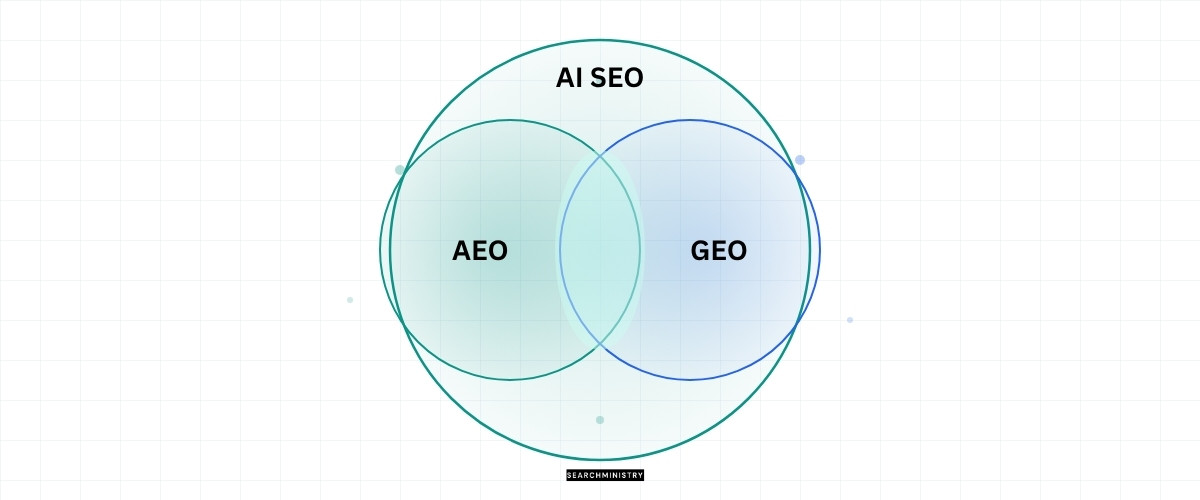
The easiest way to understand the difference is to look at the scope and emphasis of each term:
| Term | What It Means | Main Emphasis |
|---|---|---|
| AI SEO | The broader discipline of optimising for AI-powered search and discovery | Overall AI search visibility across all surfaces, including Google AI Mode, AI Overviews, ChatGPT, Claude and other AI-powered discovery systems. |
| AEO | Answer Engine Optimisation | Answer-first content, information structure and retrieval |
| GEO | Generative Engine Optimisation | Discovery, retrieval and selection within generative systems, including citations, mentions and recommendations |
These are not hard boundaries. AEO and GEO overlap because both depend on AI systems being able to understand and retrieve relevant information. Content optimised for AEO may also improve generative search visibility, while successful GEO depends on many of the same information-retrieval principles used in AEO.
What Is AI SEO?
AI SEO is the broader discipline of improving the visibility of a website, brand, product, person or other entity across Google AI Mode, AI Overviews, ChatGPT, Claude and other AI-powered discovery systems.
Traditional SEO primarily considers how search engines crawl, understand, index and rank web content. AI SEO extends optimisation into search experiences where systems may retrieve information from multiple sources, synthesise that information and generate an answer directly for the user.
These environments include Google AI Overviews and AI Mode, ChatGPT, Gemini, Perplexity and other AI-powered search and discovery experiences.
AI SEO can incorporate practices from:
- Traditional and technical SEO
- Semantic SEO
- Entity optimisation
- Content architecture
- Answer Engine Optimisation
- Generative Engine Optimisation
- Digital PR and brand authority
- Third-party mentions and corroboration
- AI search visibility measurement
For a platform-specific approach to improving visibility, mentions and citations, explore our ChatGPT SEO Service.
Get your brand cited in ChatGPT, Google AI Overviews, and AI Systems
What Is Answer Engine Optimisation (AEO)?
Answer Engine Optimisation is the process of structuring and improving information so search and AI systems can understand, retrieve and use it when answering a user's question.
AEO places particular emphasis on the relationship between a query and the information required to answer it. That means making important information clear, explicit and easy to retrieve rather than requiring a system to infer the answer from several loosely related paragraphs.
How AEO Works in Practice
A simplified AEO process can be represented as:
Question → Relevant information → Retrieval → Answer
Consider the query: What is an SEO migration?
AEO places emphasis on factors including:
- Query-answer alignment
- Answer-first content structure
- Clear definitions and factual claims
- Information structure and hierarchy
- Passage-level retrievability
- Entity and attribute clarity
What Is Generative Engine Optimisation (GEO)?
Generative Engine Optimisation is the process of improving how a brand, entity or piece of content is discovered, retrieved, selected and represented within generative AI search systems.
While AEO focuses tightly on the relationship between a question and its answer, GEO broadens the scope to consider how information, sources and entities participate in the wider generative search process. This includes not just whether your content answers a question, but whether your brand is the entity an AI system chooses to cite, mention or recommend.
GEO places emphasis on factors including:
- Brand entity clarity and semantic associations
- Third-party corroboration and independent mentions
- Source authority and trustworthiness signals
- Digital PR and citation acquisition
- Structured entity data and knowledge graph presence
- Consistent brand information across the web
Do You Need Separate AEO, GEO and AI SEO Strategies?
No. You do not need separate AEO, GEO and AI SEO strategies. AEO and GEO are overlapping optimisation approaches within the broader discipline of AI SEO, and AI SEO itself builds on the foundations of traditional SEO. Technical accessibility, crawlability, content quality, internal linking, authority and other established SEO practices remain important, while semantic SEO strengthens how search and AI systems understand entities, attributes, relationships and context. A practical AI SEO strategy brings these foundations together with AEO and GEO techniques to support the full visibility journey from discovery and understanding through retrieval, selection, citation, mention and recommendation.
Which Term Should You Use?
The terminology around AI search optimisation is still developing. These terms are best treated as useful working definitions rather than rigid technical categories.
The important distinction is not which acronym wins. It is understanding which part of the AI search process you are trying to optimise and applying the right techniques at the right stage.
You can test how AI systems currently represent your brand using the LLMO Prompt Tester, which queries multiple AI models and shows how your brand appears in AI-generated responses.
Frequently Asked Questions
Is AEO part of AI SEO?
Yes. AEO can be considered an optimisation approach within the broader discipline of AI SEO. It focuses particularly on making information understandable, retrievable and suitable for answering user questions. A comprehensive AI SEO strategy incorporates AEO techniques alongside GEO and traditional technical SEO practices.
Is GEO part of AI SEO?
Yes. GEO sits within the broader AI SEO discipline and focuses on improving visibility across generative search processes, including discovery, retrieval, source selection, citations, mentions and recommendations. Like AEO, it is an emphasis within AI SEO rather than a replacement for it.
Is AEO the same as GEO?
No, but they overlap considerably. AEO places greater emphasis on answer-first information structure and passage-level retrieval. GEO considers the wider generative process involving information and entities, from discovery and retrieval through to synthesis, citations, mentions and recommendations. In practice, the same content improvements often benefit both.
Is AI SEO the same as using AI tools for SEO?
No. AI SEO means optimising for visibility within AI-powered search and discovery systems such as Google AI Overviews, ChatGPT, Gemini and Perplexity. Using AI tools to perform SEO tasks, such as using ChatGPT to write meta descriptions or cluster keywords, is better described as AI-assisted SEO.
How do I know if my business appears in AI search results?
Currently, Google Search Console and Bing Webmaster Tools provide some query- and page-level data that can help you understand how your website appears in AI-powered search experiences. However, these reporting capabilities are still developing and provide limited visibility into AI search performance. Third-party AI visibility tools, typically paid, can also track brand mentions, citations, and visibility across different AI search platforms.

Tharindu Gunawardana
Founder & Director, SearchMinistry Media
Tharindu Gunawardana is the Founder of SearchMinistry Media and a search strategist with 17 years of experience across Sri Lanka, Singapore, and Australia. A former Agency SEO Director, he specialises in helping brands transition from traditional SEO to AI-driven discovery.