Choosing an SEO agency used to be relatively straightforward. You looked at whether the agency could improve Google rankings, increase organic traffic, fix technical SEO issues and create content that attracted potential customers.
Those capabilities still matter.
But the way people search has changed.
Customers can now discover businesses through traditional Google search results, Google AI Overviews and AI Mode, as well as conversational AI platforms such as ChatGPT. Search is increasingly becoming a process of asking, comparing, refining and receiving recommendations, rather than simply typing a keyword and choosing from ten blue links.
That means businesses choosing an SEO agency in 2026 should ask a new question:
Can this agency improve our visibility not only in traditional Google Search, but also across AI-powered search and recommendation experiences?
AI search capability should not replace the traditional criteria used to evaluate an SEO agency. It should become an additional part of that evaluation.
This guide explains what businesses should look for when choosing an SEO agency in 2026, why AI search capability now matters, and the questions you should ask before hiring an agency.
Search Has Changed, but SEO Hasn't Disappeared
The rise of AI search does not mean traditional SEO is dead.
Technical accessibility, crawlability, site architecture, content quality, relevance, authority, links, brand signals and user experience remain fundamental.
What has changed is the number of places where search discovery can happen.
A potential customer might:
Search Google → see an AI Overview → research several companies → ask ChatGPT to compare them → visit two websites → return to Google → make a decision.
The customer journey is no longer necessarily:
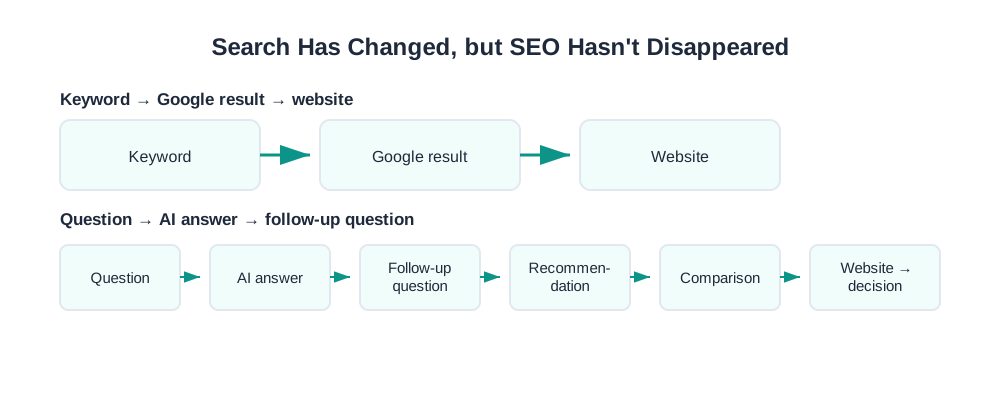
Keyword → Google result → website.
It can now look more like:
Question → AI answer → follow-up question → recommendation → comparison → website → decision.
This creates a broader visibility challenge for businesses.
Your SEO strategy therefore needs to consider both traditional search visibility and AI search visibility.
What Should You Look for When Choosing an SEO Agency?
There is no single metric that identifies a good SEO agency.
A strong agency should be able to demonstrate a combination of technical capability, strategic thinking, content expertise, authority building, measurement and commercial understanding.
In 2026, we believe AI search capability should be added to that list.
Here are the key areas to evaluate.
1. Proven SEO Experience
Start with the fundamentals.
Ask how long the agency has worked in SEO, what industries it has experience in and whether it has handled websites similar to yours.
An agency working with a small local service business faces very different challenges from one managing a large ecommerce website with tens of thousands of URLs.
Look beyond rankings for a handful of keywords.
Ask for evidence involving:
- Organic traffic and qualified lead growth
- Revenue or conversion improvements
- Technical SEO projects
- Website migrations
- Ecommerce SEO
- Local SEO
- Content and topical growth
- Recovery from organic visibility declines
The important question is not simply:
"Can you rank a keyword?"
It is:
"Can you use organic search to contribute to our business objectives?"
2. Strong Technical SEO Capability
AI search does not remove the need for technical SEO.
Search engines and AI systems still need to discover, access and understand information from your website.
Your SEO agency should therefore understand areas such as crawling, indexing, rendering, internal linking, canonicals, redirects, JavaScript, structured data, site architecture, page speed and website migrations.
Increasingly, technical SEO also needs to consider whether important content can be accessed by the crawlers and systems used by AI platforms.
A website can contain excellent information, but that information has limited search value if systems cannot reliably retrieve and understand it.
3. A Strategy Built Around Topics and User Needs, Not Just Keywords
Keyword research still matters, but modern SEO strategy should go beyond creating one page for every keyword variation.
A good SEO agency should understand:
What is the user actually trying to accomplish?
That requires understanding the questions, entities, attributes, comparisons and decisions surrounding a topic.
For example, someone searching for:
"SEO agency Melbourne"
may subsequently want to know:
- Which agencies specialise in ecommerce?
- How much should SEO cost?
- How do I compare SEO agencies?
- Does the agency understand AI search?
- Can the agency improve visibility in ChatGPT or Google AI?
Modern search optimisation therefore requires understanding the broader information and decision journey surrounding a query, rather than targeting the keyword in isolation.
4. AI Search Capability
This is one of the most important additions to the SEO agency evaluation process in 2026.
Businesses should ask whether their prospective SEO agency understands how brands are discovered, retrieved, cited and recommended within AI-powered search experiences.
This includes platforms and experiences such as:
- Google AI Overviews
- Google AI Mode
- ChatGPT
- Gemini
- Other AI-powered search and recommendation systems
The objective is not simply to "rank in ChatGPT."
AI-generated answers can be assembled differently depending on the query, available sources, context and system being used.
Instead, an AI SEO strategy should increase the likelihood that your business and its information can be discovered, understood, retrieved and supported by credible evidence when relevant questions are asked.
What should an SEO agency understand about AI search?
Look for knowledge and practical capability around:
- Entity optimisation
- Can search and AI systems clearly understand who your organisation is, what it does, where it operates and how it relates to relevant topics?
- Semantic content architecture
- Does the website comprehensively represent the topics, entities, attributes and relationships important to the business?
- Retrieval-oriented content
- Can important facts, claims, comparisons, definitions and answers be easily extracted from your content?
- Citation and authority signals
- Is important information about the business corroborated by credible external sources?
- AI crawler accessibility
- Can relevant AI systems access the content you want available for retrieval?
- Structured information
- Are important business facts represented consistently across the website and, where appropriate, structured data?
- Brand mentions and digital PR
- Does the organisation have a credible presence outside its own website?
These capabilities overlap significantly with good SEO.
That is precisely the point.
AI SEO should not be treated as a replacement for SEO. It is an expansion of search optimisation into new discovery environments.
5. Ask How the Agency Measures AI Visibility
Be cautious if an agency promises to make you "#1 in ChatGPT."
AI-generated answers don't behave exactly like conventional rankings.
Instead, ask how the agency measures changes in visibility.
Possible measurements include:
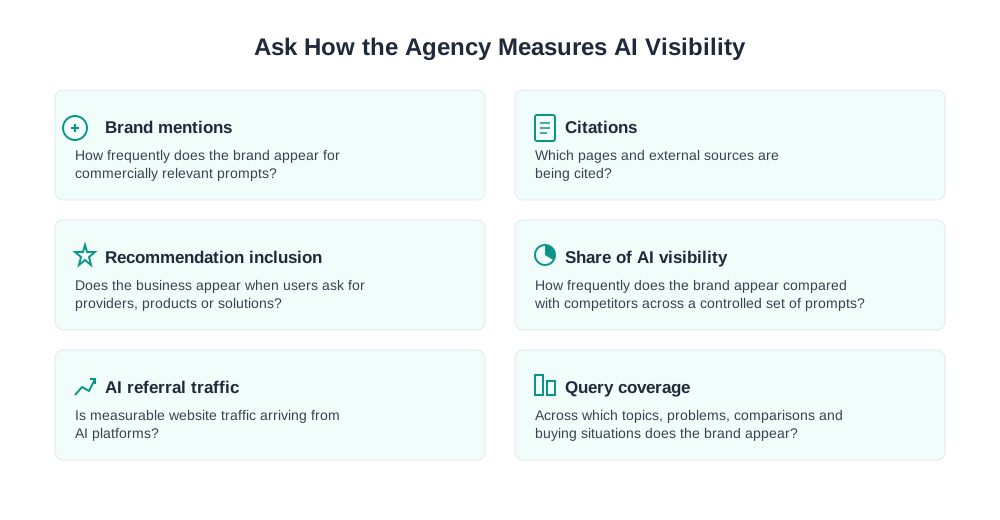
- Brand mentions
- How frequently does the brand appear for commercially relevant prompts?
- Citations
- Which pages and external sources are being cited?
- Recommendation inclusion
- Does the business appear when users ask for providers, products or solutions?
- Share of AI visibility
- How frequently does the brand appear compared with competitors across a controlled set of prompts?
- AI referral traffic
- Is measurable website traffic arriving from AI platforms?
- Query coverage
- Across which topics, problems, comparisons and buying situations does the brand appear?
The agency should also acknowledge the limitations of AI visibility measurement.
AI outputs can vary, and there is no universal equivalent of a traditional Google rank-tracking position.
6. Make Sure They Understand the Relationship Between SEO and AI SEO
This is an important distinction.
You should not necessarily be looking for:
SEO agency OR AI SEO agency.
A better question may be:
Can this agency build one search strategy that supports visibility across traditional search and AI-powered discovery?
Many of the underlying requirements overlap.
A technically accessible website helps search engines and AI systems access information.
Strong topical content helps establish relevance.
Clear entity information helps systems understand the organisation.
Authoritative external mentions provide corroborating evidence.
Digital PR can strengthen both traditional authority and the wider information environment surrounding a brand.
The strongest strategy therefore shouldn't operate SEO and AI SEO as completely separate disciplines.
Think of it as:
Traditional SEO + AI Search Optimisation = Broader Search Visibility
7. Look for Evidence, Not Just an "AI SEO" Service Page
AI SEO has quickly become a marketing term.
Adding "GEO", "AEO" or "AI SEO" to an agency's website does not demonstrate capability.
Ask the agency to show what it actually does.
For example:
- Can they demonstrate brands appearing in AI-generated answers?
- Can they explain why particular sources are being cited?
- Can they show how they analyse AI visibility against competitors?
- Can they demonstrate technical changes made for AI accessibility?
- Can they explain how entity and semantic optimisation changes their content strategy?
- Can they show examples where SEO and AI-search strategies have been integrated?
Most importantly, ask them to explain the process in language you understand.
If the entire strategy consists of terminology such as "GEO", "LLM optimisation" and "AI authority" without explaining what will actually change on your website or elsewhere on the web, ask more questions.
8. Evaluate Their Content Strategy
Content remains central to both traditional and AI search.
However, publishing large volumes of generic AI-generated articles is not an AI SEO strategy.
Look for an agency that focuses on creating information that genuinely contributes something useful.
That could include:
- Original research and data
- Expert commentary
- Detailed comparisons
- First-hand experience
- Case studies
- Unique methodologies
- Tools and calculators
- Clear definitions
- Product or service information
- Answers to specific customer questions
- Evidence supporting important claims
The objective should be to create information worth retrieving and referencing, rather than simply increasing the number of indexed pages.
10. Look for Commercial Understanding, Not Just Traffic Growth
More organic traffic isn't necessarily better SEO.
The agency should understand how search contributes to your business.
Ask how its strategy connects to:
- Leads
- Sales
- Revenue
- Customer acquisition
- Conversion rates
- Qualified traffic
- Market visibility
The same principle should apply to AI search.
Being mentioned by an AI system for hundreds of informational questions may be less valuable than appearing for a small number of high-intent questions such as:
"Which company should I use for..."
or
"What are the best providers of..."
Visibility needs to be connected to commercially meaningful customer journeys.
10 Questions to Ask an SEO Agency Before Hiring Them
When comparing agencies, ask:
- Can you show examples of SEO results for businesses similar to ours?
- How will you measure SEO performance against our business objectives?
- How do you approach technical SEO, content, authority and digital PR?
- How has your SEO strategy changed because of AI-powered search?
- Do you actively optimise for Google AI Overviews, AI Mode and platforms such as ChatGPT?
- How do you measure our visibility across AI search platforms?
- Can you show examples of businesses you've helped appear in AI-generated answers or citations?
- How do you improve entity understanding and semantic relevance?
- How do you build credible third-party signals about our business?
- How will traditional SEO and AI SEO work together rather than becoming two separate campaigns?
A capable agency should be able to provide clear answers without relying on buzzwords.
Should AI SEO Capability Be a Requirement When Choosing an SEO Agency?
For many businesses in 2026, yes, it should at least be part of the evaluation process.
That does not mean abandoning traditional SEO.
Quite the opposite.
The fundamentals of SEO remain essential.
But customers are increasingly able to discover and evaluate businesses through search experiences that generate answers, compare alternatives and recommend providers.
Businesses therefore need to think beyond:
"Where do we rank in Google?"
and increasingly consider:
"Where and how are we represented when people use search and AI to research, compare and choose businesses like ours?"
Your SEO agency should be capable of helping answer both questions.
SEO Agency Selection Checklist for 2026
Before appointing an agency, evaluate whether it can demonstrate:
| Capability | What to look for |
|---|---|
| Traditional SEO | Rankings, qualified organic traffic and commercial results |
| Technical SEO | Crawling, indexing, rendering, architecture and migrations |
| Content Strategy | User intent, topical depth and useful original information |
| Authority | Digital PR, links, mentions and third-party validation |
| Entity Optimisation | Clear understanding of the brand, services and relationships |
| AI Search Optimisation | Strategy for AI Overviews, AI Mode and conversational search |
| AI Visibility Measurement | Mentions, citations, recommendation inclusion and competitor visibility |
| Analytics | Leads, revenue, conversions and attribution |
| Experience | Relevant industries, websites and technical environments |
| Transparency | Clear strategy, reporting and explanation of what is being implemented |
The goal is no longer to find an agency that understands Google rankings OR AI search.
The stronger question is whether the agency understands the entire modern search ecosystem.
Choosing an SEO Agency in Melbourne?
If you're comparing SEO agencies in Melbourne, consider both their traditional SEO track record and their ability to adapt to the changing search environment.
At SearchMinistry Media, we work across traditional SEO, technical SEO, semantic SEO and AI search optimisation, helping businesses improve how they are discovered across Google Search and AI-powered search experiences.
Our approach is based on a simple principle:
Good AI SEO starts with good SEO, but modern search visibility now extends beyond traditional rankings.
Before choosing SearchMinistry, or any other SEO agency, ask for evidence of both.
That will tell you considerably more than an "AI SEO Agency" label on a website.

Tharindu Gunawardana
Founder & Director, SearchMinistry Media
Tharindu Gunawardana is the Founder of SearchMinistry Media and a search strategist with 17 years of experience across Sri Lanka, Singapore, and Australia. A former Agency SEO Director, he specialises in helping brands transition from traditional SEO to AI-driven discovery.