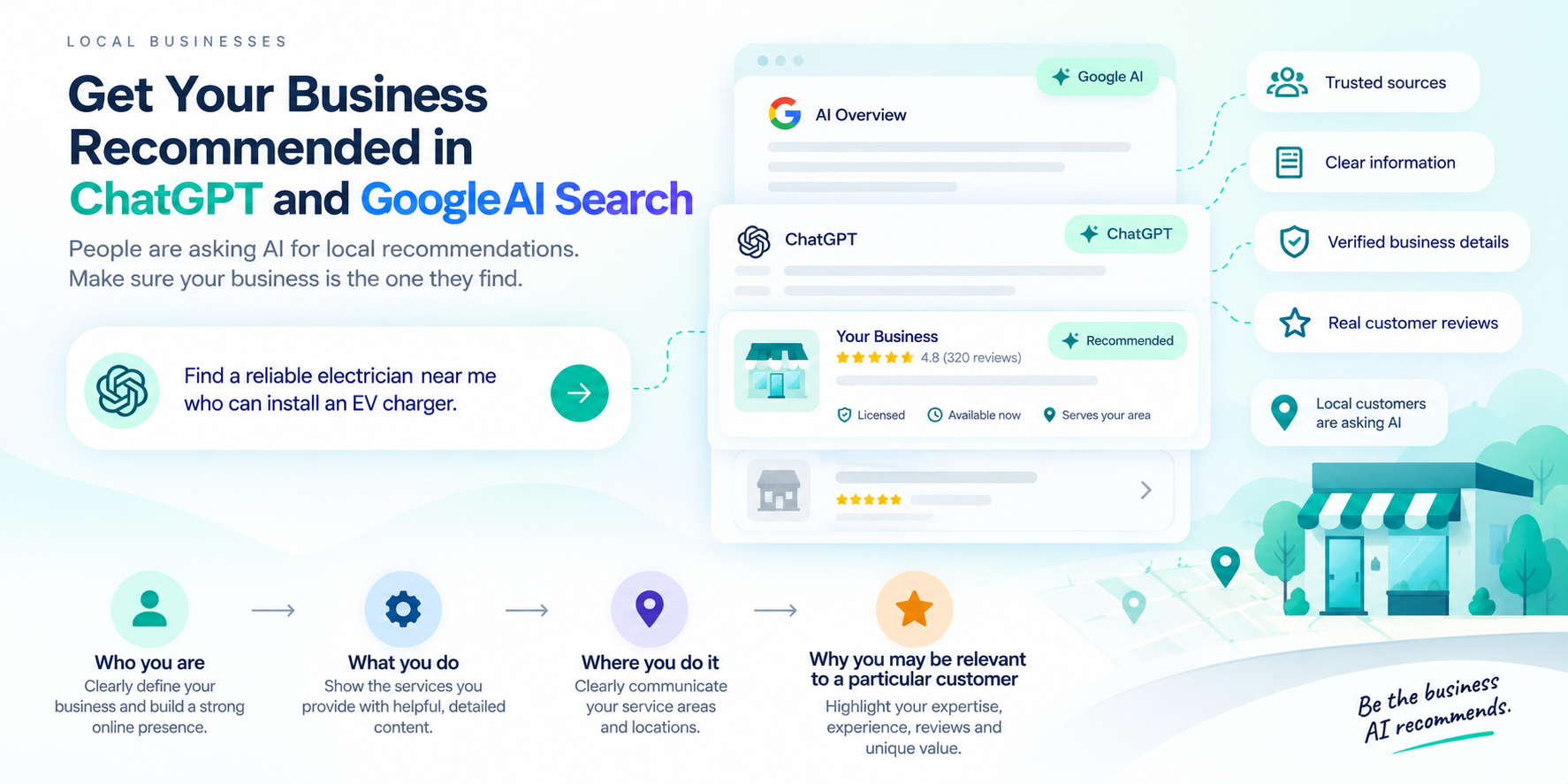
People are changing how they search for local businesses.
Instead of only searching Google for:
“plumber near me”
or:
“electrician Melbourne”
potential customers can now ask much more specific questions:
- “Who is a reliable emergency plumber near me?”
- “Find an electrician who can install an EV charger at my home.”
- “Which plumbers in my area offer same-day blocked drain repairs?”
- “Who can fix a burst pipe tonight?”
- “Recommend a local electrician with experience upgrading old switchboards.”
Google AI Overviews, Google’s AI search experiences and ChatGPT can provide direct answers to questions like these, sometimes mentioning, recommending or citing businesses as part of the response.
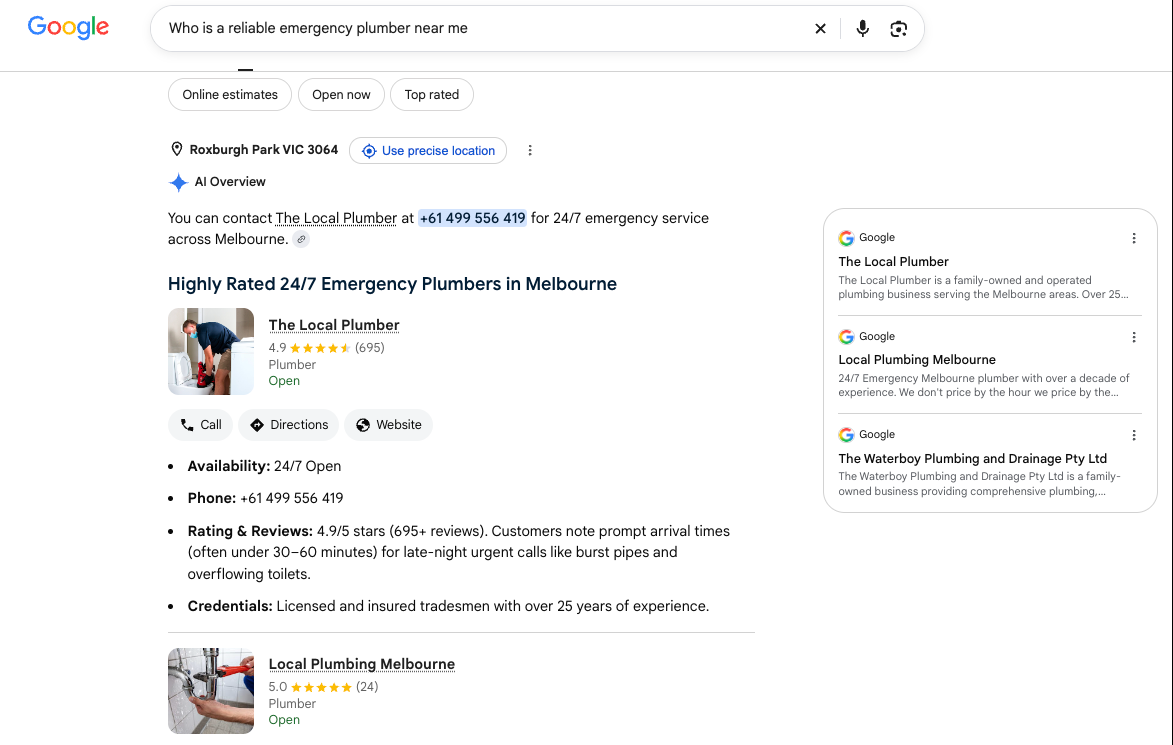
This creates a new challenge for local service businesses.
It is no longer only:
How do I rank my website on Google?
There is now another important question:
How do I make sure AI search engines understand my business well enough to consider it when someone asks for the services I provide?
For plumbers, electricians, cleaners, builders, roofers, landscapers and other local service businesses, this is becoming an important part of search visibility.
What Is AI Search Optimisation for Local Businesses?
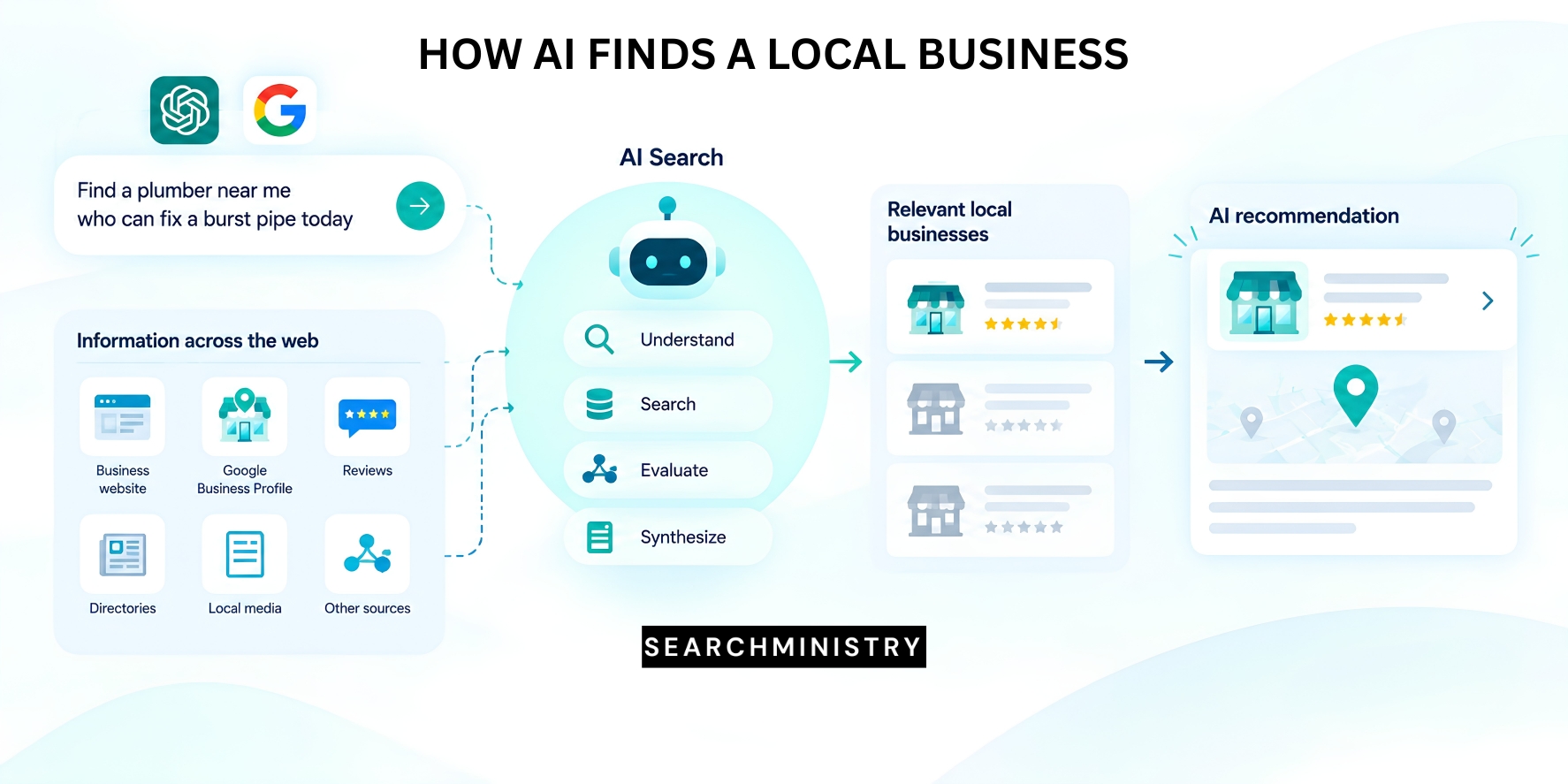
AI search optimisation is the process of making your business, services, expertise and supporting evidence easier for AI-powered search systems to discover, understand and retrieve.
Traditional local SEO often focuses on searches such as:
Plumber Melbourne
Electrician near me
Commercial cleaner Melbourne
These searches are still extremely important.
But AI allows customers to express much more detailed needs.
Someone might ask:
“I have no hot water and the system is leaking. Who is a plumber near me who can repair it today?”
Another person might ask:
“Find an electrician in the northern suburbs of Melbourne who installs home EV chargers.”
These queries contain several pieces of information.
The AI system needs to understand:
- what service is required;
- where it is required;
- what type of business can provide it;
- whether the business actually offers that service;
- whether it services that location;
- whether there is evidence supporting those claims;
- and potentially other attributes such as availability, experience, reviews or specialisation.
This means AI search visibility starts with making your business extremely clear and well supported across the web.
AI Search Does Not Replace Local SEO
One of the biggest misconceptions is that businesses now need to choose between SEO and AI optimisation.
They don't.
For local businesses, strong traditional SEO provides much of the foundation required for AI search visibility.
Google says local results are primarily influenced by relevance, distance and prominence. Complete business information helps Google understand relevance, while links, reviews and information about the business from across the web can contribute to prominence.
Google also explains that its understanding of businesses can come from several sources, including official websites, third-party data, Business Profiles and information contributed by users such as reviews and photos.
So if you are trying to become more visible in AI search, don't abandon your existing SEO strategy.
Strengthen it.
But start thinking beyond rankings.
The objective is to create enough clear, consistent and trustworthy information for search and AI systems to understand:
Who you are → What you do → Where you do it → Why you may be relevant to a particular customer.
1. Make It Extremely Clear What Your Business Is
Start with your primary business entity.
Imagine you operate a plumbing company called ABC Plumbing.
Search engines should be able to establish relationships such as:
ABC Plumbing → is a → Plumbing Company
ABC Plumbing → provides → Emergency Plumbing
ABC Plumbing → provides → Blocked Drain Services
ABC Plumbing → provides → Hot Water Repairs
ABC Plumbing → serves → Melbourne
ABC Plumbing → employs → Licensed Plumbers
These relationships may sound obvious to a human.
But businesses frequently make them surprisingly difficult to establish online.
A website might simply say:
“Quality solutions you can trust.”
That may sound good from a branding perspective, but it communicates very little about the actual business.
Compare it with:
“Licensed Melbourne plumbers providing emergency plumbing, blocked drain repairs, hot water repairs and general plumbing services across Melbourne's northern suburbs.”
The second version establishes much clearer relationships between the business, services and locations.
Your homepage, About page, service pages, contact information and Google Business Profile should reinforce a consistent understanding of the business.
2. Build Dedicated Pages for Your Important Services
Don't expect one generic services page to establish expertise across every service you provide.
A plumbing company might need dedicated pages covering services such as:
- Emergency Plumbing
- Blocked Drains
- Hot Water Repairs
- Burst Pipe Repairs
- Leak Detection
- Gas Plumbing
- Toilet Repairs
- CCTV Drain Inspections
An electrical company might instead have:
- Emergency Electrician
- Switchboard Upgrades
- EV Charger Installation
- Safety Switch Installation
- Electrical Fault Finding
- Lighting Installation
- Power Point Installation
These pages should not exist simply because an SEO tool found a keyword.
Each page should comprehensively explain the service.
For example, a blocked drain page could explain:
What is a blocked drain?
What causes blocked drains?
What are the warning signs?
How are blocked drains diagnosed?
What equipment does the company use?
How are they repaired?
How much might the service cost?
Is emergency service available?
Which locations are serviced?
What relevant experience does the company have?
Now the page isn't simply targeting “blocked drain plumber”.
It is building a much richer understanding of the company's relationship with that service.
3. Clearly Define Where You Provide Each Service
Location remains fundamental to local search.
If someone asks:
“Who can repair a blocked drain in Bundoora?”
it isn't enough for an AI system to understand that you repair blocked drains.
It also needs sufficient information to associate your business with that service area.
Your website should therefore clearly communicate your genuine service coverage.
Depending on the business, this could include:
- service-area information;
- location pages;
- projects completed in different areas;
- customer reviews;
- case studies;
- contact information;
- Google Business Profile information.
However, avoid creating hundreds of almost identical suburb pages where only the suburb name changes.
A page saying:
“Looking for a plumber in SUBURB? We are the best plumber in SUBURB…”
repeated across 150 URLs adds very little useful information.
Instead, create location content when you have something meaningful to communicate about servicing that area.
4. Think Beyond Keywords: Optimise for Attributes
This is where AI search optimisation becomes particularly interesting.
Suppose somebody asks:
“Recommend an emergency plumber near me who is available after hours and can fix a burst pipe.”
The query isn't simply about the entity plumber.
It contains attributes.
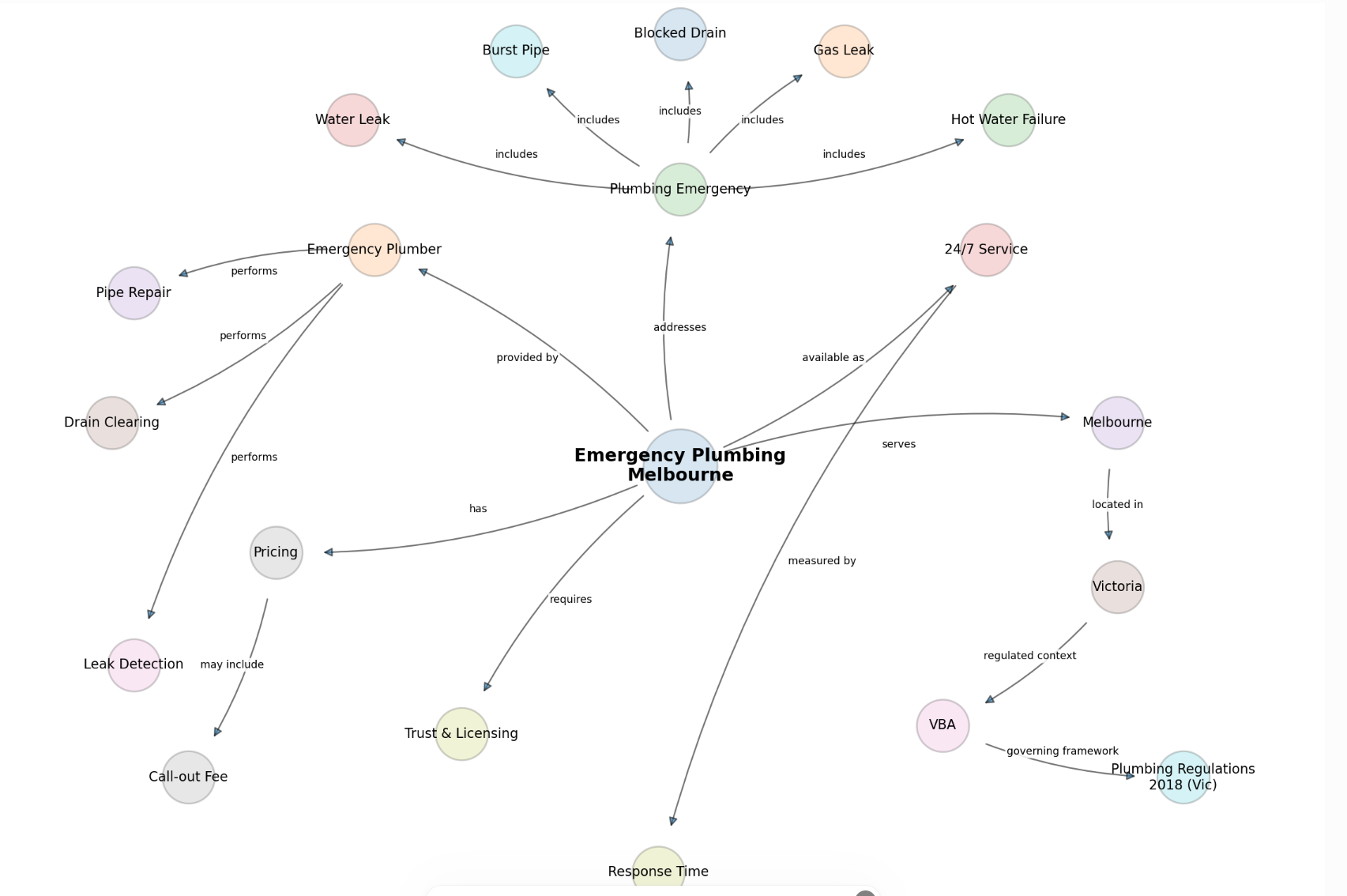
The customer potentially cares about:
Service: Burst pipe repair
Location: Near the customer
Availability: After hours
Urgency: Emergency
Business type: Plumber
Other local searches might involve attributes such as:
- licensed;
- insured;
- same-day service;
- 24-hour availability;
- years of experience;
- specific equipment;
- particular brands serviced;
- residential or commercial specialisation;
- guarantees;
- pricing;
- response time.
Identify the attributes customers commonly use when choosing your type of business.
Then make sure accurate information about those attributes actually exists on your website.
Don't add attributes simply because you want to rank for them. They need to reflect what the business genuinely provides.
5. Don't Just Make Claims. Provide Evidence.
This is one of the biggest opportunities for local businesses.
Most websites are full of unsupported marketing claims:
“Melbourne's trusted plumbers.”
“The leading electricians in Melbourne.”
“Experts you can rely on.”
“The best service at affordable prices.”
AI search creates a good reason to move towards something stronger:
evidence.
Instead of only saying that you have experience repairing blocked drains, demonstrate it.
For example:
Blocked Drain Repair in Preston
Problem: Customer reported recurring drainage problems and overflowing outside drains.
Diagnosis: CCTV inspection identified tree-root intrusion within the drainage line.
Solution: The affected section was cleared and repaired.
Location: Preston, Victoria.
Service: Blocked drain repair.
Add genuine photographs of the job where appropriate.
Now you have created evidence connecting:
Business → Service → Problem → Solution → Location
This is significantly more informative than another paragraph saying you are an “experienced plumbing company”.
6. Turn Completed Jobs Into Case Studies
Local service businesses have an advantage that many online businesses don't have.
Every week they generate real-world evidence.
A plumber may complete:
- emergency plumbing jobs;
- blocked drain repairs;
- hot water installations;
- burst pipe repairs.
An electrician may complete:
- switchboard upgrades;
- EV charger installations;
- rewiring;
- lighting installations;
- electrical fault repairs.
Don't let all that information disappear once the invoice has been paid.
Turn appropriate jobs into useful website content.
For example:
Switchboard Upgrade in Reservoir
Include:
- what the customer needed;
- what problem was discovered;
- what work was completed;
- relevant equipment or products;
- photographs;
- approximate project scope;
- location;
- outcome.
Over time, these projects create a strong body of evidence around what the business actually does.
7. Treat Customer Reviews as More Than Star Ratings
Reviews are important for traditional local SEO.
Google states that review count and positive ratings can contribute to local prominence.
But reviews can communicate far more than:
★★★★★
Compare these two genuine-style examples.
Review A
“Great company. Highly recommended.”
Review B
“Our hot water system stopped working on Sunday morning. The plumber arrived that afternoon, identified the problem and had the system running again the same day.”
The second review contains much richer information about the customer's experience.
It potentially describes:
Service → Hot water repair
Availability → Weekend
Response → Same day
Outcome → Problem resolved
Businesses should never manufacture reviews or dictate what customers should write.
But you can encourage customers to describe their actual experience, such as what service was performed and what they found helpful.
8. Strengthen Your Google Business Profile
Your Google Business Profile remains critical.
Keep information accurate and complete, including relevant categories, services, business hours, contact information and other applicable attributes.
Add genuine photos and continue earning authentic customer reviews.
Google says complete and accurate information makes businesses more likely to appear for relevant local searches, and specifically encourages businesses to keep details current, respond to reviews and add photos and videos.
Your website and Google Business Profile should also tell a consistent story.
If your website says you specialise in emergency plumbing but your Business Profile provides very little information about that service, there is an opportunity to strengthen the relationship.
9. Build Your Business Presence Beyond Your Own Website
Your website isn't the only source an AI system can potentially use to understand your company.
Google explains that business information can be assembled from public web content, licensed third-party data, user contributions and information businesses provide through their profiles.
This makes your broader digital footprint important.
Depending on your industry, useful sources may include:
- relevant business directories;
- professional associations;
- licensing or registration sources;
- suppliers and manufacturers;
- local publications;
- industry websites;
- review platforms;
- community organisations;
- local sponsorships;
- credible media coverage.
The objective isn't to submit your business to hundreds of low-quality directories.
Think about corroboration.
If your website says:
“ABC Plumbing provides emergency plumbing across Melbourne's northern suburbs.”
what other trustworthy sources across the web help establish that ABC Plumbing is a genuine plumbing company operating in that market?
This is where digital PR, citations, reviews, links and entity consistency can work together.
10. Make Your Website Accessible to AI Search Crawlers
There is also a technical component.
For ChatGPT Search, OpenAI says public websites can appear in search and recommends allowing OAI-SearchBot so content can be discovered, surfaced, cited and linked. Placement is not guaranteed.
Check that your:
- robots.txt isn't unintentionally blocking important crawlers;
- CDN or firewall isn't blocking legitimate bots;
- important pages are indexable;
- internal links allow important content to be discovered;
- pages return the correct HTTP status;
- important information isn't hidden behind inaccessible interfaces;
- website performs properly on mobile devices.
You can have excellent content, but if systems cannot reliably access it, your visibility opportunities become limited.
11. Use Structured Data to Reinforce Business Information
Where appropriate, implement structured data that accurately represents the information already visible on the website.
For a local service business, this may include relevant business, organisation, service and breadcrumb information.
But schema markup isn't a magic AI ranking switch.
Think of structured data as another way of making existing relationships explicit.
If the underlying website contains weak service information, no evidence, poor location coverage and an unclear business identity, adding schema isn't going to solve the fundamental problem.
Start with the information architecture and content.
Then reinforce it technically.
12. Create Content Around the Questions Customers Actually Ask
Your content strategy should also expand beyond traditional high-volume keywords.
A plumber might create genuinely useful resources answering:
How much does an emergency plumber cost?
Why does my drain keep blocking?
Can a plumber fix a hot water system the same day?
What should I do if a pipe bursts at night?
When does a blocked drain require CCTV inspection?
An electrician could answer:
How much does a switchboard upgrade cost?
Do I need to upgrade my switchboard before installing an EV charger?
Why does my safety switch keep tripping?
Can an electrician install an EV charger in any home?
These questions help establish relationships between your business's expertise and the problems potential customers are trying to solve.
They also support your main commercial service pages.
13. Connect Your Content Together
Don't create a collection of isolated pages.
Build a connected information network.
For example:
Emergency Plumber
connects to:
Burst Pipe Repair
which connects to:
What to Do When a Pipe Bursts
which connects to:
Emergency Burst Pipe Repair in Preston
which connects to:
Preston Plumbing Services
The same entities and relationships are being reinforced through different types of useful information.
This helps users navigate the website and makes the overall structure easier for search systems to understand.
A Simple Framework for Local AI Search Optimisation
We use a simple way of thinking about local AI search visibility:
Entity
Who are you?
Clearly establish the business and what type of company it is.
Services
What do you do?
Build comprehensive information around the actual services you provide.
Locations
Where do you provide those services?
Clearly communicate genuine service areas.
Attributes
What makes your offering relevant to a particular search?
Availability, expertise, qualifications, equipment, pricing information, specialisation and other meaningful characteristics.
Evidence
Can you prove what you say?
Projects, case studies, photographs, team expertise, licences and genuine customer experiences.
Corroboration
Does the wider web support your business information?
Business profiles, reviews, associations, directories, links, mentions and other credible third-party sources.
Retrieval
Can search and AI systems actually discover the information?
Technical accessibility, crawling, indexing, internal linking and clear information architecture all matter.
Put together:
Entity → Services → Locations → Attributes → Evidence → Corroboration → Retrieval
This is a much stronger way to approach AI search than simply adding the words “AI optimised” to your existing SEO strategy.
Can You Guarantee That ChatGPT or Google AI Will Recommend Your Business?
No.
Nobody can legitimately guarantee that a particular business will be recommended for every relevant AI query.
ChatGPT states that search ranking uses multiple factors and that placement isn't guaranteed.
The objective of AI search optimisation is therefore not to manipulate an AI system into recommending your company.
The objective is to improve the quality, clarity, accessibility and corroboration of information about your business so that search systems have stronger information available when determining what is relevant to a user's query.
SEO Is Moving Beyond the Blue Links
Local businesses shouldn't stop trying to rank in traditional Google Search or Google Maps.
Those channels remain extremely valuable.
But customer discovery is expanding.
Your potential customer may search Google.
They may look at Google Maps.
They may see an AI-generated answer.
Or they may simply ask ChatGPT:
“Can you recommend a plumber near me who can fix this today?”
The businesses that adapt will think beyond a single keyword ranking.
They will build a digital presence that clearly communicates:
Who they are.
What they do.
Where they operate.
What they specialise in.
And what evidence exists to support those claims.
That is the foundation of local AI search optimisation.
Is Your Business Visible in ChatGPT and Google AI Search?
If your business performs well in traditional Google Search but rarely appears when potential customers ask ChatGPT or Google AI for your services, there may be gaps in how AI search systems discover, understand or validate your business.
At SearchMinistry, we combine traditional SEO, local search optimisation and AI search optimisation to improve visibility across Google Search, Google AI experiences and ChatGPT.
We analyse your business entity, services, location signals, website architecture, content, third-party presence and AI search visibility to identify where those gaps exist.
Want to understand how visible your business is in AI search?
Talk to SearchMinistry about an AI Search Visibility Audit for your local business.

Tharindu Gunawardana
Founder & Director, SearchMinistry Media
Tharindu Gunawardana is the Founder of SearchMinistry Media and a search strategist with 17 years of experience across Sri Lanka, Singapore, and Australia. A former Agency SEO Director, he specialises in helping brands transition from traditional SEO to AI-driven discovery.