AI Visibility Audit
Google AI Overviews, ChatGPT Search, and Perplexity generate answers from a small set of trusted sources. An AI visibility audit identifies why your business is not among them.
SearchMinistry Media's AI visibility audit tests your site against 20 to 30 representative queries across Google AI Overviews, ChatGPT Search, Perplexity, and Claude. We measure entity clarity, structured data implementation, answer-first formatting compliance, and knowledge graph presence. The output is a GEO (Generative Engine Optimisation) remediation roadmap that identifies the exact changes needed for your pages to appear in AI-generated answers.
Request Your AI Visibility Audit
Google AI Overviews, ChatGPT Search and Perplexity presence measured and improved.
Request Your AI Visibility Audit
Google AI Overviews, ChatGPT Search and Perplexity presence measured and improved.
What Your AI Visibility Audit Reveals
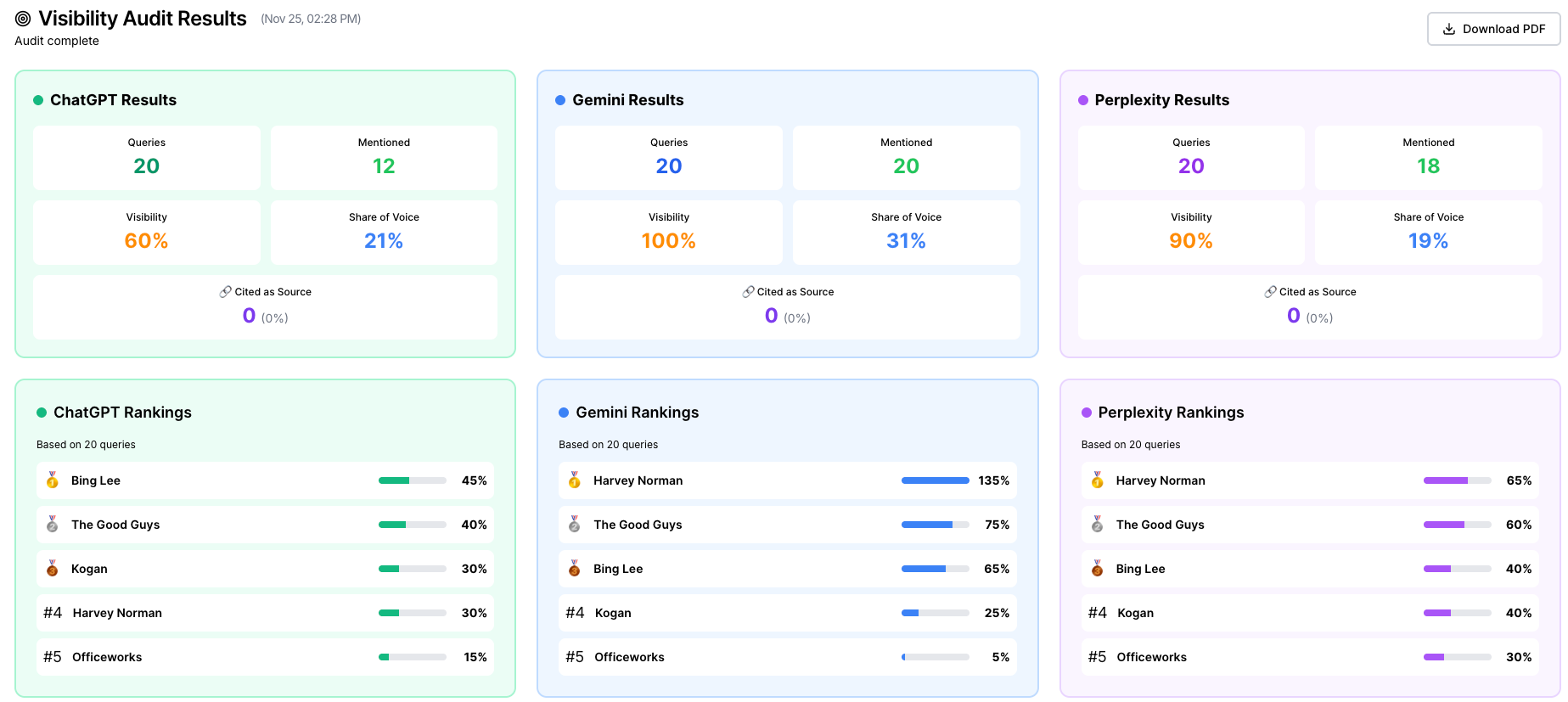
Every audit runs your target queries across ChatGPT, Gemini, and Perplexity separately. Each platform receives 20 queries and is scored on mentions, visibility rate, and share of voice. Competitive rankings show which brands dominate each AI platform and by how much.
The report pinpoints gaps between platforms. A brand with 100% Gemini visibility and 60% ChatGPT visibility has a structured data or entity clarity gap specific to the ChatGPT retrieval pipeline. The audit isolates the cause and provides a platform-specific remediation plan.
- Per-platform visibility rate and share of voice
- Competitive share of voice rankings per AI platform
- Citation rate: how often your brand is linked as a source
- Platform-specific remediation steps
How AI Search Systems Decide Which Pages to Cite
AI search systems including Google AI Overviews use retrieval-augmented generation (RAG) to produce answers. A RAG pipeline retrieves candidate passages from its index, ranks them by relevance to the query, and synthesises the highest-ranked passages into a generated response. Only pages that establish named entities clearly, state facts in extractable form, and structure content answer-first score above the retrieval threshold consistently and appear in AI-generated answers.
Structured data accelerates AI citation because it provides machine-readable facts that AI systems can extract without parsing prose. An Organisation schema block with name, address, founding date, and service area gives an AI system five extractable facts in three lines of JSON-LD. A page with the same information buried in a paragraph requires semantic parsing that introduces ambiguity and reduces citation probability.
68%
Zero-click searches
AI-generated answers that satisfy the query without the user clicking through to any website
12
Retrieval methods
Distinct LLM retrieval methods that determine which pages appear in AI-generated answers
4-8w
Visibility uplift
Typical timeline for measurable AI citation increases after entity and schema improvements
Six AI Discovery Signals the Audit Measures
SearchMinistry's AI visibility audit scores each page against the same six discovery signals defined in our agentic SEO guide, measuring which signals are present, which are absent, and which fall below the threshold required for consistent AI citation.
Entity Clarity
Your primary entity must be named and typed in the opening paragraph. Related entities chain across sections to reinforce the subject consistently. Ambiguous pronoun references prevent clean entity extraction and reduce the probability that AI systems will cite the page.
Structured Data
JSON-LD schema must cover all relevant Schema.org types with property completeness against Google's Rich Results requirements. Dynamic values for time-sensitive fields like availability and pricing ensure the schema stays accurate at crawl time.
Answer-First Formatting
Every H2 section must open with a direct answer before supporting evidence. Preamble constructions delay the key fact and lower retrieval scores. FAQ sections require FAQPage microdata schema to appear in AI-generated question answers.
Machine-Readable Data
Tables, structured lists, and specification data must be formatted for direct extraction. Numerical facts require explicit units. Statistical claims require source citations that AI systems can verify against known authority sources.
Authority Signals
E-E-A-T signals must be present: author credentials, publication dates, review dates, and source citations from Google-approved authorities. Anonymous authorship on decision-stage pages reduces citation probability and E-E-A-T scores.
AI Citation Readiness
Content chunked at semantic boundaries produces distinct embedding vectors per section. Keyword density distributed across headings and body copy supports hybrid retrieval by both sparse and dense systems. Heading repetition flattens embedding diversity and reduces the range of queries a page can answer.
Frequently Asked Questions
Test Your AI Search Visibility Now
Run our free LLMO Prompt Tester to see how AI systems currently respond to queries about your business, or request a full AI visibility audit below.