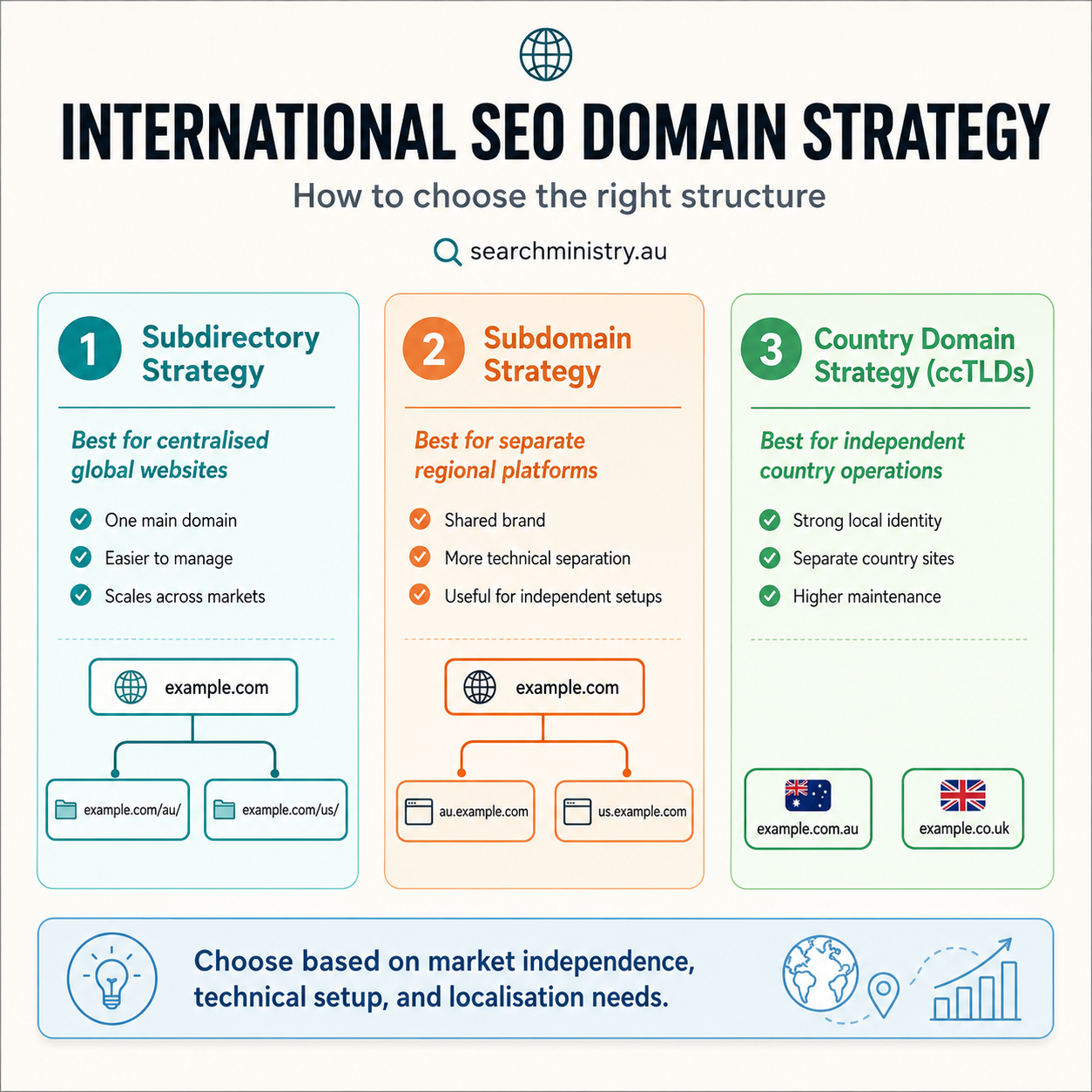
The right international SEO domain strategy depends on how independently each country or regional market operates. Subdirectories are generally the most practical choice for businesses using one global brand, platform and marketing structure. Subdomains are better suited to markets that require separate technical infrastructure while remaining connected to the main brand. Country-code top-level domains, or ccTLDs, are most appropriate when each country functions as a distinct business with its own products, regulations, fulfilment and marketing resources.
No domain structure is universally better for SEO. The correct choice depends on market independence, local identity, platform requirements, localisation needs and the organisation's ability to maintain each regional website. A poorly supported ccTLD will not outperform a well-maintained subdirectory. A subdirectory cannot replace a ccTLD when the business genuinely operates as separate local entities.
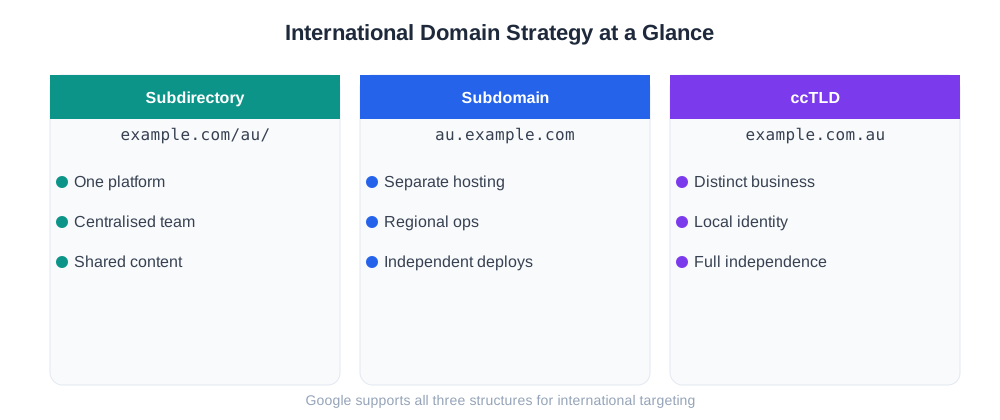
International Domain Strategies at a Glance
Google recognises country-specific domains, subdomains and subdirectories as valid locale-specific URL structures. It describes ccTLDs as offering clear country targeting, subdomains as providing easier site separation, and subdirectories as comparatively easy to establish and maintain. Google does not recommend URL parameters for this purpose because they make URL-based segmentation harder to interpret.
| Domain strategy | Example | Usually best suited to |
|---|---|---|
| Subdirectory | example.com/au/ | Centralised international businesses using one global platform |
| Subdomain | au.example.com | Regional operations requiring separate hosting, platforms or technical management |
| Country-code domain (ccTLD) | example.com.au | Independent country operations requiring a strong local identity |
| URL parameter | example.com/?country=au | Not recommended for international targeting |
Are You Targeting Countries, Languages or Both?
Before choosing a domain structure, determine what the website is actually targeting. This distinction affects URL naming conventions, hreflang implementation, content localisation, product availability, currency and pricing, legal information, shipping and fulfilment, and market-specific search intent.
A multilingual website provides content in more than one language. A Canadian business might provide separate English and French versions of its website. A multi-regional website targets users in different countries, even when each version is written in the same language. A website can also be both multilingual and multi-regional.
Google makes this distinction because language targeting and country targeting solve different problems. Consider these URL examples:
# Language targeting only
example.com/fr/ # French-language content
# Country targeting only
example.com/ca/ # Content targeting Canada
# Language + country combinations
example.com/fr-ca/ # French content for Canada
example.com/en-ca/ # English content for Canada
A business should define its complete country and language model before deciding whether to use subdirectories, subdomains or separate domains. Retrofitting the naming convention after launch is significantly more disruptive than planning it correctly upfront.
What Is the Subdirectory Approach?
A subdirectory strategy places each country, language or locale within a folder under one primary domain. The domain remains the same; the directory path identifies the relevant regional or language experience.
# Country targeting
example.com/au/
example.com/us/
example.com/ca/
# Language + country combinations
example.com/en-au/
example.com/en-gb/
example.com/fr-ca/
When Are Subdirectories the Right Choice?
Subdirectories are usually appropriate when the international website operates as one centralised digital property. This often means the business has one global brand, one content management system, one development team, a shared product catalogue, centralised analytics and reporting, and a shared design system with limited regional autonomy.
For example, an Australian software company expanding into the UK and US may offer the same platform in each market. Pricing, terminology and case studies may differ, but the core product and technical infrastructure remain the same. A suitable structure would be:
example.com/en-au/
example.com/en-gb/
example.com/en-us/
Advantages of Subdirectories
The main advantage is operational efficiency. All international content remains within one domain and can usually be managed through the same CMS, hosting environment and development process. Global technical changes can be applied across markets without separately updating several websites.
Subdirectories can also simplify internal linking, XML sitemap management, analytics implementation, conversion tracking, template maintenance, content governance, security management and sitewide technical audits. Google describes subdirectories on a generic top-level domain as relatively easy to establish and low maintenance when they use the same hosting environment.
There is also a meaningful SEO advantage in how link equity flows. Backlinks pointing to the root domain pass their value through to every subdirectory beneath it. A strong link profile built for example.com directly benefits example.com/en-au/ and every other regional folder. Subdomains do not automatically share this benefit. Google has acknowledged that it can associate subdomains with the root domain, but in practice subdomains are often treated as separate websites for crawling, indexation, link equity and authority purposes. For international websites that have invested in building domain authority, subdirectories typically make better use of that existing investment.
Limitations of Subdirectories
A subdirectory does not create complete technical or commercial separation between markets. Regional teams may find it harder to use different platforms, hosting configurations or development schedules. A major technical problem affecting the primary domain can also affect every country section.
Users may not immediately recognise whether a folder represents a country or language. For example, /de/ could mean German-language content or content targeting Germany. This ambiguity requires clear navigation cues and consistent hreflang implementation.
Subdirectories may also become restrictive when regional operations require independent ecommerce platforms, country-specific data hosting, separate legal ownership, different checkout systems, substantially different products, or independent regional development teams.
Important Clarification
It is too simplistic to say that subdirectories automatically receive all the SEO authority of the root domain. Each regional section still needs useful content, relevant internal links, appropriate localisation and external recognition. A weak Australian section does not become locally relevant merely because it sits under a strong international domain. The practical advantage of subdirectories is centralisation, not guaranteed rankings.
What Is the Subdomain Approach?
A subdomain strategy gives each country, language or region a separate hostname while retaining the same root domain. Each subdomain can operate as a technically separate website with its own hosting, server configuration and release schedule.
# Country subdomains
au.example.com
us.example.com
ca.example.com
# Multilingual implementation
en-ca.example.com
fr-ca.example.com
When Are Subdomains the Right Choice?
Subdomains are usually appropriate when regional websites need infrastructure independence but should remain visibly connected to the same global brand. This can occur when regional markets use different CMS platforms, each market has separate hosting requirements, regional teams deploy website changes independently, data must be stored in specific regions, country operations have separate release schedules, or a company cannot technically implement subdirectories on its current platform.
For example, a global software platform might host its Australian service in an Australian cloud environment while its US service uses separate infrastructure. The subdomains retain the global brand while supporting the technical separation required by data sovereignty rules or infrastructure contracts.
Advantages of Subdomains
Subdomains provide more technical separation than subdirectories. Each regional website can have independent hosting, separate server configurations, different software platforms, market-specific security settings, independent release schedules and separate development ownership. Google notes that subdomains are relatively easy to establish, permit different server locations and make it easier to separate regional sites.
Limitations of Subdomains
Subdomains can introduce unnecessary complexity when the business does not need genuine technical separation. Separate subdomains may require independent management of crawling controls, XML sitemaps, analytics properties, monitoring systems, redirect rules, canonical tags, hreflang implementation, content templates and internal links.
Regional subdomains can also become inconsistent when different teams make decisions without central governance. One country might use different navigation, page templates, product naming or structured data from another. Over time, the international website can become a collection of loosely connected platforms rather than one coherent brand experience.
When Subdomains Go Wrong
Subdomains chosen purely for cosmetic separation, rather than genuine infrastructure requirements, create governance overhead without a corresponding operational benefit. When one platform can support all markets effectively, subdirectories are generally easier to govern and audit. The key question is not "do we want to look separate?" but "do we genuinely need to be separate technically?"
What Is the ccTLD Approach?
A country-code top-level domain uses a separate country-specific domain for each target market. Each domain represents a separate website rather than a folder or hostname beneath one global domain.
example.com.au
example.ca
example.co.uk
example.de
Google considers most ccTLDs to be a strong signal that a website is intended for users in a particular country. It also notes that ccTLD availability may be limited, some registries impose eligibility requirements, and a country domain can generally target only one country. Australian registrars, for example, require evidence of an Australian business presence for .com.au registration.
When Are ccTLDs the Right Choice?
A ccTLD strategy is most appropriate when the country website functions as a distinct commercial operation rather than a lightly localised copy of a global website. This may involve a separate legal entity, independent regional management, country-specific inventory, different pricing structures, local fulfilment centres, separate customer support, market-specific regulations, independent marketing budgets and a strong need for domestic brand identity.
For example, a retailer may operate separate businesses in Australia and Canada. Each country might have different products, warehouses, currencies, returns policies, promotions and legal obligations under the Australian Consumer Law and Canadian consumer protection legislation respectively.
Advantages of ccTLDs
The greatest advantage is clear country identity. A country domain can immediately communicate to users that the website serves their local market. This can be commercially valuable when customers prefer domestic businesses or expect local payment, support and delivery options.
Separate domains also provide substantial operational independence. Each market can have its own hosting environment, product catalogue, content strategy, development roadmap, analytics configuration, legal content, marketing campaigns and conversion experience. Google identifies clear geotargeting and easy site separation as advantages of ccTLDs.
Limitations of ccTLDs
Every domain requires investment. A business must register, secure, maintain and monitor each website. Content cannot simply be launched and forgotten. Each country site needs sufficient local relevance, technical maintenance and commercial support.
A ccTLD strategy can increase the cost of website development, content localisation, link acquisition, digital PR, monitoring, reporting, security management, domain renewals, technical audits and website migrations. Google specifically lists expense, infrastructure requirements, availability restrictions and single-country targeting among the limitations of ccTLDs.
The ccTLD Trap
A ccTLD is a clear country-targeting signal, but it does not guarantee strong local rankings. A poorly maintained country domain will not necessarily outperform a well-localised subdirectory on an established global website. The ccTLD should be chosen because it supports the business model, not because the domain extension is expected to solve every international SEO problem on its own.
Why URL Parameters Are Not Recommended
A parameter-based international structure might look like this:
example.com/?country=au
example.com/?country=ca
example.com/?language=fr
example.com/en-au/
example.com/en-ca/
example.com/fr/
Google does not recommend URL parameters as the primary method of segmenting international website versions. Parameter-based structures make geographic segmentation harder to recognise and can create less understandable URLs for users. They also waste crawl budget on near-identical locale variants, complicate indexation, internal linking, canonicalisation, analytics reporting, cache management and hreflang implementation.
The International Domain Strategy Framework
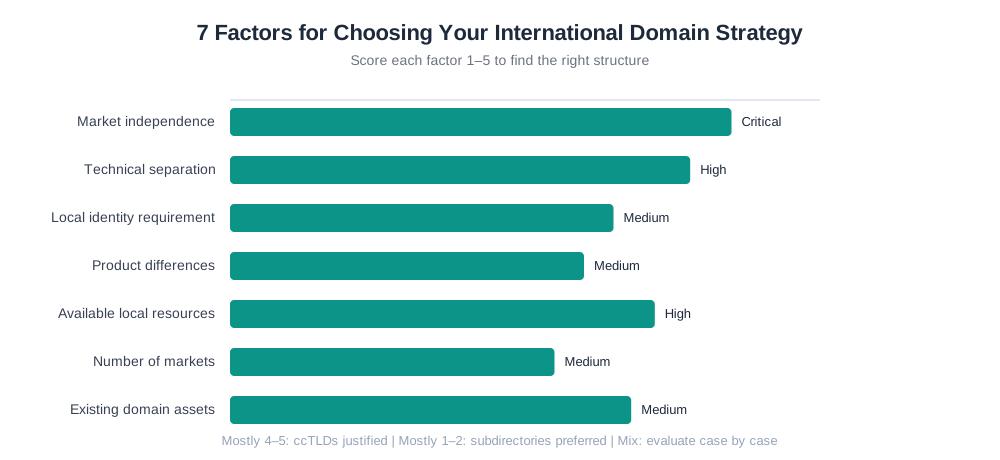
Rather than choosing a structure based on a generic list of SEO advantages, evaluate the business across seven dimensions. The decision is primarily a business architecture choice, not an SEO ranking play.
How independently does each country operate?
Market independence is one of the strongest decision factors. Ask: does each country have its own leadership? Are commercial decisions made centrally or locally? Does each region control its own marketing? Can one global team approve website changes? The more independently each market operates, the stronger the case for domain separation.
Does each market require separate technology?
Consider whether each market needs a different CMS, separate ecommerce software, country-specific hosting, independent customer databases, different payment systems, separate inventory platforms, regional privacy or consent systems, or independent deployment processes. A shared platform favours subdirectories. Separate platforms may favour subdomains or ccTLDs.
How important is local identity?
Some markets are comfortable purchasing from a global .com domain. Others respond more positively to a recognisably local website. Evaluate customer expectations, competitor domain conventions, local trust requirements and whether the brand is already recognised internationally. A ccTLD may support local identity, but the domain must be backed by genuine local substance, not just a local URL.
How different are the products and services?
Consider differences in product availability, specifications, service eligibility, pricing, currency, tax, shipping, warranties, promotions, legal restrictions, measurement systems and terminology. When most products and content are shared, subdirectories are usually easier to manage. When each country has a substantially different commercial offering, subdomains or ccTLDs may provide greater flexibility.
How many markets will the business enter?
Scalability changes the economics of the decision. Maintaining three country domains may be manageable. Maintaining 30 requires considerably more governance, security, content and technical support. A company planning broad international expansion may prefer a centralised subdirectory structure. A company entering only two strategically important countries, each with an established local operation, may justify separate domains.
What resources are available in each region?
A separate website requires more than a domain registration. Assess whether each market has the resources to support local keyword research, content production, translation, technical maintenance, digital PR, link acquisition, customer support, legal review and performance reporting. When local resources are limited, creating separate country domains can spread the organisation too thinly.
What international assets already exist?
Review existing rankings, backlinks, brand recognition, domain age, indexed pages, local search visibility, customer familiarity and existing technology. A company with successful country domains should not consolidate them merely because subdirectories appear easier to manage. A company with an established global domain should not create new country domains without a clear commercial reason.
International Domain Strategy Scorecard
Score each factor from one to five. Use the totals to guide the decision, not replace it. This is a business and technical decision framework, not a Google ranking score.
| Decision factor | Score of 1 | Score of 5 |
|---|---|---|
| Market independence | Fully centralised | Fully independent |
| Technical separation | One shared platform | Separate regional platforms |
| Local identity requirement | Global identity is sufficient | Domestic identity is essential |
| Product differences | Nearly identical across markets | Substantially different |
| Regulatory differences | Minimal | Extensive |
| Local resources | No dedicated local team | Fully resourced regional team |
| Number of markets | Large-scale global expansion | Small number of strategic markets |
How to interpret the score
Mostly 1–2: Subdirectories are likely the most manageable option. Centralised management and shared infrastructure will serve the organisation better than maintaining separate regional domains.
Mostly 3: Subdomains, ccTLDs or a hybrid strategy may be appropriate. Investigate which specific factors are creating the need for separation and whether that need is genuinely technical or organisational.
Mostly 4–5: Country-specific domains may be justified, provided each market has sufficient resources to operate independently and the commercial case supports the investment.
Domain Strategy by Business Model
Abstract scoring frameworks are useful, but real decisions involve trade-offs between competing factors. These worked examples show how the framework applies across common Australian business scenarios.
| Business type | Conditions | Likely recommendation |
|---|---|---|
| International SaaS | Same platform and product across AU, UK, CA, US. One central dev and marketing team. Pricing and case studies differ. | Subdirectories — example.com/en-au/, /en-gb/, /en-ca/, /en-us/ |
| International ecommerce retailer | Separate AU and CA warehouses. Different inventory, pricing, tax, returns and local support teams. | ccTLDs — example.com.au and example.ca |
| Global platform with regional data requirements | Shared brand but separate infrastructure and databases per region. Separate release schedules. | Subdomains — au.example.com, eu.example.com, us.example.com |
| Canadian multilingual business | One country (Canada), two language markets (English and French). | Language subdirectories within ccTLD — example.ca/en/ and example.ca/fr/ |
| Professional services firm (AU, SG, UK) | Different regulations and qualifications per market. Same platform and global brand. Depends on autonomy. | Subdirectories if centrally managed. ccTLDs if each office is a distinct regulated entity. |
A hybrid architecture can also be valid when it reflects genuine business or technical differences. A company might maintain example.com as a global corporate website, example.com.au as an established Australian ecommerce site, uk.example.com for a UK application on separate infrastructure, and example.com/fr/ for French-language global content. The key test: a hybrid structure should be explainable as a coherent architecture, not as a collection of exceptions accumulated over years of inconsistent website launches.
Technical SEO Requirements for International Websites
Choosing a domain structure is only the first stage. Regional pages must also be implemented correctly to signal their intended audience to search engines. Domain structure determines the container. The following technical elements determine whether that container works.
Every indexable country or language version needs a stable, dedicated URL. Google recommends using different URLs for different language versions rather than changing the content of one URL based on cookies or browser language settings. IP-based content switching prevents crawlers from accessing all versions and can lead to incomplete indexation. For a structured audit of crawlability signals across your site, our crawlability and indexability checklist covers the most common causes of incomplete indexation and how to fix them.
Implementing Hreflang
Hreflang connects alternate language and regional versions of the same page. For example, an Australian product page might reference equivalent UK and US versions:
<!-- Self-reference always required -->
<link rel="alternate" hreflang="en-au"
href="https://example.com/en-au/product/" />
<link rel="alternate" hreflang="en-gb"
href="https://example.com/en-gb/product/" />
<link rel="alternate" hreflang="en-us"
href="https://example.com/en-us/product/" />
<!-- International fallback -->
<link rel="alternate" hreflang="x-default"
href="https://example.com/" />
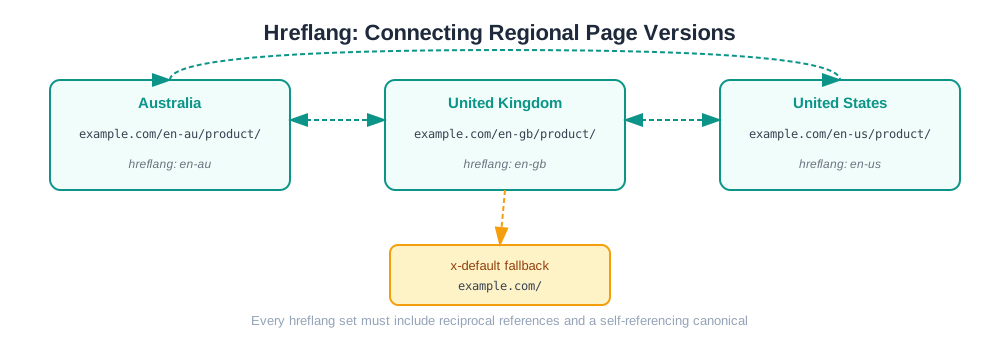
Google supports hreflang through HTML, HTTP headers and XML sitemaps. The methods are considered equivalent, so businesses should select the one they can implement and maintain most reliably. Each hreflang set must include a self-reference, reciprocal references from every alternate page, fully qualified URLs, valid language and country codes, and links connecting genuinely equivalent pages. Google states that alternate pages must reference one another and that one-way hreflang relationships may be ignored.
The x-default hreflang value identifies the page intended for users who do not match a specific language or country version. It is particularly useful for global homepages, country selector pages, language selector pages and international fallback pages.
Hreflang and Canonical Tags
Hreflang and canonical tags perform different functions. Hreflang identifies an alternative page for a particular language or region. A canonical tag identifies the preferred URL among duplicate or substantially similar pages.
An Australian page should not canonicalise to its US equivalent when both are intended to remain indexable. Instead, each regional page should normally have a self-referencing canonical:
<!-- Correct: self-referencing canonical on each regional page -->
<link rel="canonical" href="https://example.com/en-au/product/" />
<!-- Wrong: canonicalising AU page to US equivalent -->
<link rel="canonical" href="https://example.com/en-us/product/" />
Google advises international websites with duplicate or similar same-language pages to select appropriate canonical URLs and use hreflang to serve the correct regional version. Canonicalising all regional pages to the global page collapses the regional index, defeating the purpose of maintaining separate locale URLs.
Localising More Than Language
Translation changes words. Localisation changes the entire market experience. Two pages can both be written in English while serving substantially different customer needs.
An Australian customer may expect prices including GST, metric measurements, domestic shipping and a reference to the Australian Consumer Law. A US customer may expect different tax treatment, imperial measurements, US-specific product certifications and US return policy terminology. International pages may need localised currency, pricing, tax information, measurements, product names and availability, images, case studies, reviews, phone numbers, addresses, delivery information, returns policies, legal terms, calls to action and seasonal references.
Country selector best practice
The country and language selector should use crawlable HTML links, not JavaScript events, forms or cookies. Where possible, link users to the equivalent page rather than always sending them back to the homepage when they change country. A clear selector also helps people who arrive on the wrong regional page through search, shared links or travel.
Do not depend on IP location to determine which content search engines and users can access. Google warns that locale-adaptive pages may not have all variations crawled or indexed. The better approach is to allow users to access the requested page, display a regional suggestion such as "It looks like you are visiting from Australia. Would you prefer the Australian website?", let the user choose whether to switch, and remember the preference without blocking access to other versions.
Should You Change Your Existing International Domain Structure?
Do not migrate an established international website solely because another structure appears theoretically cleaner. A domain migration can affect rankings, indexation, backlinks, referral traffic, analytics continuity, user recognition, internal links, hreflang, canonical tags, XML sitemaps, paid campaigns, email links and product feeds.
Before changing the structure, compare the expected commercial benefit with the migration risk. If you are considering a migration, our SEO migration services cover full redirect mapping, hreflang reconfiguration and crawl validation for international restructures. Before beginning, work through a detailed SEO migration checklist to ensure redirect mapping, canonical reconfiguration and analytics continuity are planned before the cutover date.
| Consider migrating when | Retain the current structure when |
|---|---|
| Existing domains are no longer supported | Country domains already rank strongly in local SERPs |
| Regional websites cannot be maintained | Each market has valuable local backlinks and brand recognition |
| The business has centralised its operations | Regional websites produce significant revenue |
| Several country sites contain thin or duplicated content | Local teams maintain the websites effectively |
| The existing platform prevents international growth | The new structure offers limited commercial benefit |
| Technical inconsistencies are causing serious crawl problems | Migration resources are insufficient for proper redirect mapping |
Theoretically simpler architecture does not automatically justify the disruption of a successful international website. Existing rankings, links, customer trust and local brand recognition may outweigh the operational benefits of consolidation.
Common International Domain Strategy Mistakes
Most international SEO problems are architectural decisions made without sufficient operational planning. These mistakes appear consistently across AU businesses entering global markets.
| Mistake | Effect | Correct approach |
|---|---|---|
| Choosing ccTLDs without sufficient resources | Underdeveloped country domains dilute resources and create poor user experiences | Launch markets only when genuine local content, technical and marketing support is available |
| Assuming subdirectories automatically rank better | Regional sections underperform due to missing local relevance signals | Each market still requires useful content, internal linking and a competitive user experience |
| Using /fr/ for France specifically | Ambiguous targeting; hreflang may conflict with intent | Use /fr-fr/ for France. Use /fr/ only when targeting all French speakers globally |
| Using /en-uk/ instead of /en-gb/ | Invalid hreflang language-region combination; Google may ignore it | UK locale code is en-gb not en-uk. Always use ISO 639-1 language + ISO 3166-1 country codes |
| Copying identical content across every market | Thin localisation reduces relevance in local search and AI retrieval | Address real differences in search behaviour, terminology, regulations and customer expectations |
| Canonicalising regional pages to the global page | Regional versions are deindexed; country-specific rankings collapse to one URL | Use self-referencing canonicals on each regional page and connect them with hreflang |
| One-way hreflang without return links | Hreflang relationships may be ignored; search engines cannot validate consistency | Every page in a hreflang set must reference all other pages and include a self-reference |
| Forcing IP-based redirects for all visitors | Crawlers cannot access all locale versions; some market pages remain unindexed | Suggest a regional preference. Never block access to the requested URL based on IP |
| Treating domain structure as the entire strategy | Domain architecture without local content, technical quality and authority does not rank | The domain is only the container. Content, links, performance and localisation determine outcomes |
Final Recommendation
Most businesses should choose an international domain structure according to operational independence, not an assumed SEO advantage. No structure automatically outperforms the others when implementation quality and content depth are held constant.
Choose Subdirectories
- ✓One global brand and platform
- ✓Centralised dev and marketing
- ✓Broadly similar products
- ✓Planning many markets
- ✓Operational simplicity required
Choose Subdomains
- ✓Separate technical environments
- ✓Regional independent deploys
- ✓Different hosting locations needed
- ✓Global brand must stay visible
- ✓Technical benefits justify overhead
Choose ccTLDs
- ✓Each country is a distinct business
- ✓Local identity is commercially important
- ✓Products, pricing, fulfilment differ
- ✓Regulations vary significantly
- ✓Regional teams have full resources
The best option is the one the organisation can support consistently, not merely the one that appears strongest in a comparison chart. A well-maintained subdirectory will outperform a neglected ccTLD. A poorly governed subdomain will underperform a tightly managed centralised directory.
Successful international SEO requires each regional website to provide a crawlable, technically consistent and genuinely localised experience. Connect equivalent pages correctly through hreflang, allow users to select their preferred market, and invest sufficient resources to maintain every country or language version launched. A technical SEO audit covering crawl behaviour, hreflang consistency and canonical configuration is a useful starting point before either launching new regional sections or migrating an existing international structure. You can also run our On-Site SEO Analyser to check technical foundations before engaging in a full audit.
Audit Your International SEO Architecture
Not sure whether your current domain structure is holding back your international rankings? Our SEO audit covers hreflang consistency, canonical configuration, crawlability signals and regional page quality, with a prioritised plan to fix what matters most.
Request an SEO AuditFrequently Asked Questions
What is the best domain structure for international SEO?
There is no universally best structure. Subdirectories are usually the most practical option for centralised international businesses sharing one platform, brand and development team. Subdomains are suitable when regional markets require separate technical environments. ccTLDs are appropriate when each country operates as a distinct commercial entity with independent management, resources and a need for strong local identity. The choice depends on operational independence, not on a general ranking advantage.
Can a .com website rank in Australia without a .com.au domain?
Yes. A generic .com domain can target Australia using a subdirectory such as example.com/en-au/ or a subdomain such as au.example.com, supported by correct hreflang, localised content, Australian pricing and contact details, and local link signals. Many successful Australian-market websites operate from a .com domain. The .com.au extension provides a clearer country signal and may increase user trust, but it is not a prerequisite for ranking in Australian search results.
Are subdomains treated differently from subdirectories by Google?
Google has stated that it can associate subdomains with their root domain and treat them appropriately for international targeting. The practical difference is governance complexity. Subdirectories share one canonical domain and can be managed through one Search Console property, one sitemap and one analytics account. Subdomains require separate management of each of these elements. Neither structure is inherently penalised, but subdomains introduce overhead that is only justified when genuine infrastructure separation is required.
Does hreflang improve international rankings?
Hreflang helps Google understand the relationships between regional and language versions of the same content and serve the appropriate URL to users in each market. It should not be described as a direct ranking signal. Its purpose is locale matching: ensuring Australian users see the Australian version rather than the US or UK version when multiple equivalents exist. Incorrectly implemented hreflang, such as missing reciprocal references or mismatched language codes, can prevent Google from serving the correct regional URL and can cause indexation confusion between alternate pages.
What is the x-default hreflang value?
The x-default value identifies the page that should be shown to users who do not match any specific language or country in the hreflang set. It is most useful for global homepages, country selector pages and international fallback pages. For example, if a website has an Australian, UK and US version, x-default can point to the global homepage or a language selector page for users in countries not covered by any of the three specific versions. It is not required but is recommended by Google for sites with an explicit international selector page.
Should each country have a separate Google Search Console property?
For ccTLDs and subdomain structures, yes. Each domain or subdomain should be verified as a separate Search Console property to allow country-specific performance monitoring, crawl error tracking and hreflang validation. For subdirectory structures, a domain-level property covers the entire website. Adding separate URL-prefix properties for each regional subdirectory provides closer monitoring of individual market performance. The reporting structure should reflect how the organisation manages each market.
Is .eu a country-specific domain for European targeting?
Google treats .eu as a generic regional top-level domain rather than a domain targeting one specific European country. A .eu website may communicate a European identity to users, but it cannot be used to target individual European countries and should not be treated as a substitute for targeting specific markets with country-appropriate hreflang, localised content and ccTLDs where relevant. Similarly, extensions such as .ai, .io, .me and .tv are also treated as generic by Google despite being country-code extensions originally assigned to Anguilla, British Indian Ocean Territory, Montenegro and Tuvalu respectively.
Should an established ccTLD be migrated to a subdirectory structure?
Not automatically. Existing rankings, local backlinks, customer trust and brand recognition built around a country domain may substantially outweigh the operational simplicity of consolidation. A migration should be supported by a clear business case, a complete redirect mapping plan covering every current URL, a reconfigured hreflang implementation, and updated canonical tags. Budget at least three to six months of active monitoring after any major domain migration before expecting full ranking recovery, and avoid migrating close to seasonal peaks for revenue-critical markets.
Can the same English content appear on several country pages?
Yes, but each page should exist for a genuine regional purpose. Australian, UK and US pages may share much of the same English content while differing in pricing, shipping information, product availability, currency, terminology, regulatory disclosures and calls to action. When regional pages are substantially similar in text, hreflang and self-referencing canonical tags must be implemented carefully. Google advises international websites with duplicate or similar same-language pages to select appropriate canonical URLs and use hreflang to serve the correct regional version to each market.

Tharindu Gunawardana
Founder & Director, SearchMinistry Media
Tharindu Gunawardana is the Founder of SearchMinistry Media and a search strategist with 17 years of experience across Sri Lanka, Singapore, and Australia. A former Agency SEO Director, he specialises in helping brands build technically sound international SEO architectures that scale without requiring a full domain migration.