What Is Entity Gravity?
Entity gravity is the cumulative strength of a brand's presence in semantic space, and the AI-search equivalent of domain authority. Where domain authority measures link equity, entity gravity measures the density, diversity, and distribution of semantic associations in training data: precisely what governs whether an AI system reaches for your brand when generating a response. It is not a single score stored in a model's weights. It is the emergent result of how frequently and how diversely a brand appeared alongside other concepts in the documents the model was trained on. A brand with high entity gravity has built dense, varied associations across many related contexts.
A brand with low entity gravity has thin or narrow associations, often limited to its own name or a single product category.
When a language model generates a response about "the best accounting software for small businesses", it draws on learned associations built during training. Some brands appear reliably across that response and dozens of related queries. Others surface only when their exact name is included in the search. The difference between these two outcomes is entity gravity.
The concept matters because AI search systems, including Google's AI Mode, Perplexity, and ChatGPT, surface information based on semantic association patterns rather than keyword matching. A brand that has only ever appeared in documents about itself has near-zero entity gravity. A brand that appears consistently across industry discussions, client case studies, methodology references, competitor comparisons, and third-party reviews has built the kind of gravitational pull that causes models to reach for it across a wide range of query contexts.
Key Takeaway
- In physics, a body with high mass exerts gravitational pull on objects around it. Those objects orbit it, are drawn toward it, and their own trajectories are influenced by its presence.
- In semantic space, a brand with high entity gravity pulls nearby concepts into its orbit. When a model processes a query about property settlement law in Melbourne, a family law firm with high entity gravity surfaces because the semantic neighbourhood of "property settlement" and "Melbourne family law" contains enough associations pointing toward that firm.
- Domain authority is relatively stable once built because the link graph changes slowly. Entity gravity can shift more rapidly because new training data continuously reshapes the semantic associations models rely on.
Why Gravity Is the Right Metaphor
Low entity gravity brands are the equivalent of small asteroids in that space. They have minimal pull on surrounding concepts. They appear in AI-generated responses only when the query is precise enough to intersect their narrow band of associations, typically an exact-match search on their own business name.
Three properties determine gravitational strength.
Mass
The volume of meaningful associations present in training data.
Diversity
The number of different semantic neighbourhoods a brand occupies across the training data.
Density
How frequently those co-citations appear in sources the model treats as authoritative.
A brand can have high volume but low diversity, appearing thousands of times in one narrow context.
It can have high diversity but low density, appearing occasionally across many contexts with no concentrated signal.
The ideal combination is density across diverse contexts in high-authority sources.
The Three Components of Entity Gravity
| Component | What It Measures | How It Is Built | Effect on AI Visibility |
|---|---|---|---|
| Semantic Proximity | Closeness to related concepts in embedding space | Deep, repeated vocabulary co-occurrence across documents | Brand surfaces when related queries activate those concepts |
| Co-citation Density | Frequency of appearance alongside authoritative entities in third-party content | Earned media, speaking appearances, industry listings | Model places brand in the same semantic cluster as high-authority peers |
| Relation Type Diversity | Variety of roles the brand occupies in training data | Creator, educator, researcher, practitioner, partner content | Opens separate entry points from multiple query class types |
Semantic Proximity
Semantic proximity describes how close a brand sits to related concepts in the model's embedding space. Brands that appear consistently alongside industry-defining terms, recognised experts, and established methodologies develop tight proximity to those concepts. When a query activates those concepts, the brand is nearby in the model's representation and surfaces as a related entity.
A Melbourne-based AI SEO agency that publishes detailed analyses of Google's AI infrastructure patents develops semantic proximity to "Google patents", "AI search infrastructure", and "LLM ranking signals". A query about any of those topics now has a shorter semantic path to that agency than to a competitor that has never written about them. Proximity is built through content that uses the vocabulary of a topic, covers it with genuine depth, and earns citations from sources already close to that part of the semantic space.
Semantic proximity is not built by mentioning a term once. It is built through consistent, repeated co-occurrence across multiple documents and sources. A single blog post that mentions "AI search infrastructure" creates minimal proximity. A series of deeply researched pieces on that topic, cited by other practitioners and publications, creates measurable proximity that persists across training cycles.
The second passage places the brand in five distinct semantic neighbourhoods simultaneously: technology companies, IP licensing, fintech compliance, ASIC, and the Victorian Law Foundation. Each co-occurrence is a step toward semantic proximity with those concepts.
Co-citation Density
Co-citation density measures how often a brand appears alongside other authoritative entities in third-party content. When a brand is consistently mentioned in the same sentence or paragraph as recognised industry authorities, the model learns they belong in the same semantic neighbourhood.
This mechanism explains why some brands appear in AI-generated recommendation lists even without being the most searched entity in a category. They have been co-cited with respected brands in enough authoritative third-party content that the model places them in the relevant semantic cluster. A family law firm mentioned alongside the Law Institute of Victoria, major Melbourne legal publications, and other respected practitioners builds co-citation density that positions it near high-authority nodes in the legal knowledge graph.
The key distinction from traditional backlinks is that co-citation does not require a hyperlink. A magazine article that names three accounting firms in the same paragraph builds co-citation density for all three, regardless of whether any link is present. A podcast transcript, an industry report, or a professional association's published commentary can all contribute to co-citation density without a single link being exchanged. This is why earned media, speaking appearances, and industry panel inclusion build entity gravity through a mechanism that traditional SEO link analysis does not fully capture.
Relation Type Diversity
Relation type diversity is the most underappreciated component of entity gravity. A brand can have high volume and strong co-citations but remain gravitationally weak because it appears in only one type of relationship with other concepts in training data.
The relation types that build gravity each activate from a different class of query:
The entity that originated a methodology, tool, or concept.
The entity that trains practitioners in a discipline.
The entity that analyses and publishes findings on a topic.
The entity that applies a methodology in documented client work.
The entity that collaborates with recognised authorities.
A brand that appears only as a service provider has one relation type. When a query invokes service-provider language, it surfaces. When a query asks who created a methodology, who trains practitioners, or who has published original research, it does not surface because those relation types are empty in its training data record.
A brand that appears as the creator of a methodology, as the educator of practitioners, as the researcher who published patent analyses, and as the practitioner with documented client outcomes occupies four distinct semantic positions simultaneously. A model processing a query from any of those angles has a path to that brand. The interaction effect is significant: relation type diversity amplifies both semantic proximity and co-citation density because each new relation type creates a separate class of query contexts from which the brand is reachable.
Entity Gravity vs Domain Authority
Domain authority is a proxy metric built on backlink data. It measures how much link equity a domain has accumulated from other domains. Entity gravity describes the actual mechanism that determines AI search visibility: the density, diversity, and distribution of semantic associations in training data.
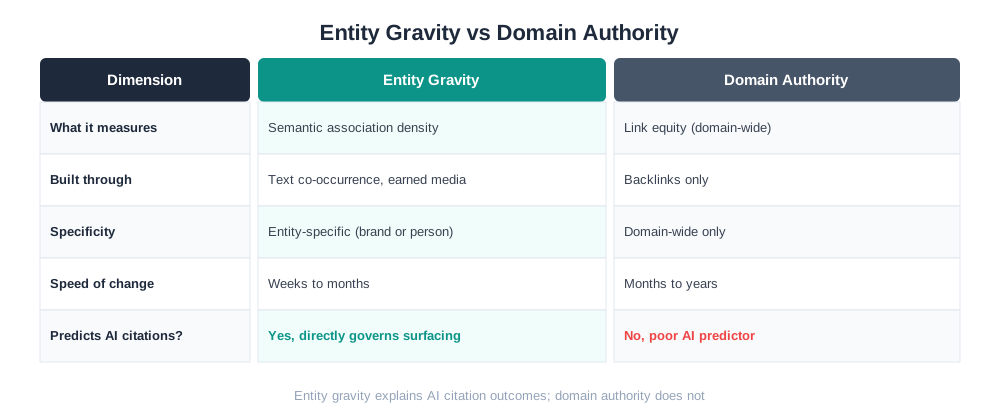
Domain authority is accumulated at the domain level. Entity gravity is specific to an entity, which may be a person, a brand, a product, or a methodology. A single domain can host multiple entities with vastly different gravity levels.
A law firm's domain might have high domain authority, while the individual partners have near-zero entity gravity in AI systems because they have never been cited individually in third-party content.
Domain authority is built primarily through links. Entity gravity is built through co-occurrence patterns in text, regardless of whether links exist. A brand mentioned in an indexed podcast transcript, a speaker listing on a conference website, or a quoted comment in an industry newsletter contributes to entity gravity through pathways that traditional link analysis ignores.
Domain authority is relatively stable once built because the link graph changes slowly. Entity gravity can shift more rapidly because new training data continuously reshapes the semantic associations models rely on. A brand that publishes three significant methodology pieces and earns coverage in three major industry publications can see measurable entity gravity improvement within a single training cycle. That responsiveness makes entity gravity a more actionable target for brands investing in AI search visibility.
Important distinction
A brand with a domain authority of 60 may be completely absent from AI-generated answers about its own category if its training data record is thin. A brand with a domain authority of 30 may be cited consistently if it has built dense, diverse associations in authoritative sources. Entity gravity explains the outcome. Domain authority does not.
How to Measure Entity Gravity
Entity gravity cannot be measured directly from a model's weights, which are not publicly accessible. Its effects are observable through proxy measurements that, taken together, give a reliable picture of where a brand sits in semantic space.
AI citation frequency testing
Test a set of relevant queries across AI systems (Google AI Mode, Perplexity, ChatGPT, Gemini) without including your brand name in the query. Track how often your brand appears in responses. A high citation rate across diverse query types indicates strong entity gravity. A citation rate of zero across all queries except exact-name searches indicates near-zero entity gravity.
Query range diversity analysis
Note which categories of query surface your brand. A brand cited for a narrow band of exact-match queries has low gravity diversity even if its citation frequency within that band is high. A brand cited across competitor comparisons, methodology discussions, client outcome queries, tool recommendation queries, and educational queries has high gravity diversity. The number of distinct query categories that surface your brand is a meaningful indicator of how many semantic positions you occupy.
Semantic proximity testing
Ask AI systems to describe the entities most closely associated with your brand. Ask which other brands they associate yours with. Ask what topics they associate with your name. The richness and accuracy of those associations reflects the depth of semantic proximity your brand has built. A brand that AI systems associate only with generic category labels has shallow proximity. A brand associated with specific methodologies, named credentials, and a clear geographic and industry context has developed meaningful semantic depth.
Co-citation auditing
Search for your brand name across third-party publications, industry directories, conference programmes, and media coverage. Map which other entities consistently appear alongside it. The authority and diversity of those co-cited entities indicates co-citation density. If your brand appears only alongside itself or alongside very low-authority sources, co-citation density is a priority to address.
Tools for systematic tracking
Tools like Brandonomy.ai are built specifically to systematically track AI citation frequency and query range across multiple AI systems, making entity gravity monitoring repeatable rather than ad hoc.
How to Build Entity Gravity
Building entity gravity is a deliberate process of expanding the semantic neighbourhood your brand occupies in authoritative, indexable sources. The strategies map directly to the three components.
Building Semantic Proximity
Publish content that uses the precise vocabulary of your target query contexts alongside your brand name. This is not keyword stuffing. It is ensuring that the semantic territory you want to occupy is covered with genuine depth so that training data crawlers find your brand name in close proximity to the relevant concepts.
Write analyses, frameworks, and guides that position your brand within established conceptual discussions rather than solely as a service provider. A law firm that publishes a detailed analysis of how Victorian courts have treated cryptocurrency assets in property settlements develops proximity to "cryptocurrency", "property settlement", "Victorian family law", and "digital asset valuation" simultaneously. That one piece builds semantic proximity across four concepts that a generic services page does not touch.
Earn citations in content that uses those same vocabularies. A citation from a legal industry publication discussing cryptocurrency in divorce proceedings, naming your firm as a reference, builds semantic proximity far more effectively than a citation from an unrelated business directory.
Building Co-citation Density
Earn mentions in third-party content alongside recognised authorities in your industry. Appear in comparison articles, industry round-ups, and expert commentaries where your brand is named alongside established entities. Build partnerships with industry bodies and agencies that reference you in their own published content.
Prioritise earned media over self-published content for co-citation density. A single article in a respected industry publication that names your brand alongside three recognised peers does more for co-citation density than ten self-published blog posts. The third-party attribution is what creates the independent signal the model registers as evidence of category membership.
Speaker listings, panel appearances, and conference programmes are high-value co-citation sources because they name multiple recognised entities together in a structured, authoritative document. An event programme that lists your founder alongside established industry figures creates co-citation in a document that AI crawlers treat as an authority signal.
Building Relation Type Diversity
Coin terminology that creates the creator relation type for your brand. When you publish the first formal definition of a concept and others adopt and reference that term, you acquire the creator relation type for that concept in training data. That is a non-contestable position. No competitor can become the entity that coined a term that already exists with your name attached.
Publish training programmes or educational content that creates the educator relation type. Conduct and publish original research or data analysis that creates the researcher relation type. Document client outcomes with named, specific case studies that reinforce the practitioner relation type. Each new relation type you establish opens a new class of queries from which your brand is reachable. Four relation types means four distinct entry points into your semantic neighbourhood from four different query contexts.
| Relation Type | How to Acquire It | Query Class It Activates |
|---|---|---|
| Creator | Coin a methodology, framework, or term and have others adopt it | "Who created [methodology]?", "What is [coined term]?" |
| Educator | Publish training programmes, CPD content, or practitioner guides | "Who teaches [skill]?", "[Discipline] training Melbourne" |
| Researcher | Publish original data analyses, patent reviews, or industry studies | "Who published research on [topic]?" |
| Practitioner | Document client case studies with specific named outcomes | "[Service] case study Melbourne", "Proven [methodology] results" |
| Partner | Collaborate with recognised bodies that reference you in their content | "Partners of [industry body]", endorsed [category] providers |
SEO and AI Search Implications
Entity gravity directly shapes which brands AI search systems surface when generating responses to queries that do not contain a brand name. AI systems that use retrieval-augmented generation, such as Google AI Mode and Perplexity, retrieve content based on semantic relevance to the query. Content that sits in semantic proximity to many related concepts is retrieved across more query types. Content that covers a narrow topic in isolation is retrieved only for exact-match queries on that topic. The difference in citation reach between a high-gravity and a low-gravity brand in the same category can be an order of magnitude, even when their traditional SEO performance is similar.
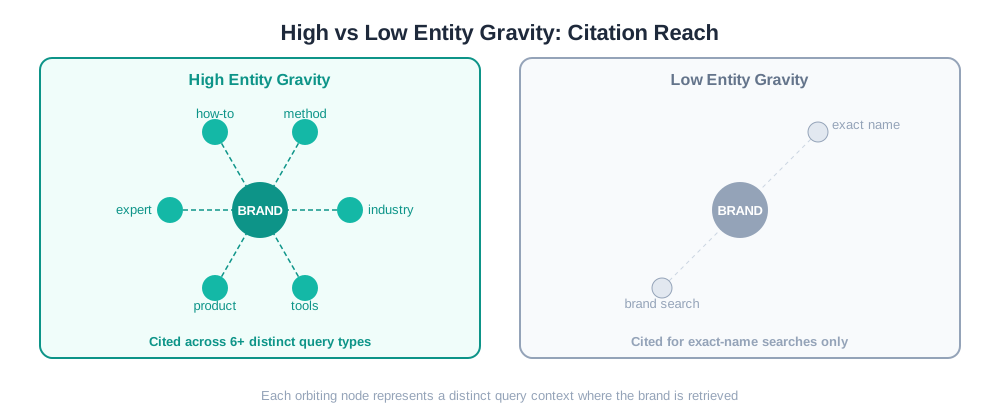
Consider two Melbourne family law firms with similar traditional SEO performance, the same city, the same practice area, and similar domain authority.
Firm A (High Entity Gravity) is cited across six query types: "best family lawyer Melbourne" (category membership plus co-citation with the Law Institute of Victoria), "SMSF divorce Melbourne" (semantic proximity via a published SMSF guide), "family lawyer who understands business valuations" (practitioner relation type), "parenting plan disputes Melbourne" (documented case outcomes), "family law training Melbourne" (educator relation type via CPD content), and "who coined parenting plan architecture" (creator relation type).
Firm B (Low Entity Gravity) is cited for one query type: its own exact business name. All other queries return no citation. The firm has a comparable website and similar domain authority. The difference is entirely in how many semantic positions Firm B occupies in training data relative to Firm A.
Five actionable strategies
- Map your current semantic positions before publishing new content. Test 10 to 15 relevant queries in AI systems without your brand name. The queries you surface for reveal your existing semantic proximity. The queries you do not surface for reveal the gaps. Build content that addresses those gaps directly rather than producing more content in areas where you already have presence.
- Prioritise relation type diversity over volume. Publishing ten more service pages adds volume in one relation type. Publishing one methodology guide that practitioners reference, one data-led research piece that media cites, and one training resource that agencies link to adds three new relation types. The three-piece strategy does more for entity gravity than the ten-page strategy.
- Target co-citation with entities one tier above you in authority. Being mentioned alongside a recognised industry body, a national publication, or an established tool in your category creates co-citation density that places your brand in a higher-authority semantic neighbourhood. Aim for co-citations in sources that AI systems weight heavily, not just sources with large audiences.
- Coin at least one term that describes a gap in your industry's vocabulary. Identify a concept practitioners in your field need to name but currently describe in five different ways. Publish a formal definition, use it consistently in all client-facing materials, and encourage partners to adopt it. The creator relation type for a concept that spreads is one of the most durable forms of entity gravity available because it is structurally non-contestable.
- Track citation range, not just citation frequency. A brand cited 50 times for a single query type has concentrated gravity with limited reach. A brand cited 10 times each across five distinct query types has distributed gravity with broad reach. For commercial outcomes, distributed gravity is more valuable because it intercepts potential clients at more points in their decision-making journey. Our AI SEO services include a citation range audit as part of the initial engagement.
Audit your entity gravity across AI search systems
SearchMinistry's AI SEO service includes a semantic position audit that tests your brand across 15 to 20 query types in Google AI Mode, Perplexity, and ChatGPT. You receive a map of which query contexts currently surface you and a prioritised list of content and outreach actions to expand your semantic neighbourhood.
Explore AI SEO ServicesFrequently Asked Questions
How is entity gravity different from domain authority?
Domain authority is a proxy metric built on backlink data that measures link equity accumulated at the domain level. Entity gravity describes the mechanism that actually determines AI search visibility: the density, diversity, and distribution of semantic associations in training data. The two differ in several important ways. Entity gravity is entity-specific rather than domain-wide, meaning two people or products on the same domain can have very different entity gravity. It is built through co-occurrence patterns in text rather than links, so earned media, podcast appearances, and conference listings contribute to it even without hyperlinks. It is also more responsive to change because new training data continuously updates a model's semantic associations, whereas the link graph shifts slowly.
How long does it take to build entity gravity?
Retrieval-layer improvements, which affect AI systems using RAG such as Google AI Mode and Perplexity, can appear within two to six weeks of new content being indexed and cited. Training weight changes, which affect AI systems that rely on pre-trained model knowledge rather than real-time retrieval, depend on when the next model training run processes the relevant web content. This typically means a six to eighteen month horizon for significant weight changes. The practical approach is to pursue both layers simultaneously: optimise for retrieval to see results now, and build training data associations for lasting impact across future model versions.
Can a small or new brand build entity gravity in a competitive category?
Yes, through a strategy of sub-context specificity rather than direct competition at the broad category level. A new brand cannot quickly displace established entities that have dense training data records in the broad category. But within specific sub-contexts, such as a particular asset type, a niche client situation, or a coined methodology, even a new brand can achieve near-certain citation probability with a single focused content asset. Winning eight to twelve sub-contexts at high specificity creates a pattern the model infers as category authority, which generalises over time toward the broad category query. This is a faster and more reliable path to entity gravity than attempting to match the volume of established competitors.
What weakens or destroys entity gravity?
Several factors reduce entity gravity over time. Brand name changes without redirecting semantic associations can cause a model to treat the old and new names as separate entities with lower individual gravity than the combined record. Inconsistent terminology across content dilutes semantic proximity because the model sees fragmented signals rather than dense co-occurrence. Abandoning a coined term after others begin using it can reduce the creator relation type signal if your own content stops reinforcing the association. Loss of third-party citations, such as publications going offline or removing coverage, reduces co-citation density. And remaining in a single relation type while competitors acquire diverse relation types reduces relative gravity even if absolute volume is maintained.
How does entity gravity relate to topical authority?
Topical authority describes the depth and breadth of coverage a source has within a defined subject domain. It is primarily a content characteristic: a website that has comprehensively covered every aspect of a topic has high topical authority in that domain. Entity gravity describes the strength of a specific named entity's pull across query contexts, which depends on topical authority plus co-citation density and relation type diversity. High topical authority on your own domain contributes to entity gravity but does not guarantee it. A brand with deep topical authority on its own site but no third-party co-citations and no diversity of relation types will have lower entity gravity than a brand with moderate topical authority that is consistently co-cited in authoritative third-party sources.

Tharindu Gunawardana
Founder & Director, SearchMinistry Media
Tharindu Gunawardana is the Founder of SearchMinistry Media and a search strategist with 17 years of experience across Sri Lanka, Singapore, and Australia. A former Agency SEO Director, he specialises in helping brands transition from traditional SEO to AI-driven discovery.