Market Demand
Understand how customers describe their needs, how products and services are represented in search and where meaningful organic opportunities exist.
Plan what your new website needs to rank for before the sitemap, content and design are locked in.
SearchMinistry uses market research, competitor analysis, keyword data and search intent to develop the SEO sitemap, URL structure, page strategy and content opportunities your new website needs for long-term organic growth.
Featured in



Search-led planning
From evidence to build handover
SEO Sitemap / Website Architecture is the centre of the system.
Trusted by growing businesses







A website SEO strategy is a pre-build plan that uses search and market evidence to determine which pages a new or redesigned website needs, what each page should target, how those pages should be structured and what content needs to be created.
Keyword research is one part of that process. The real objective is to convert search demand into decisions that designers, copywriters and developers can actually use.
Instead of completing a redesign and then asking SEO to optimise whatever has already been built, SearchMinistry brings SEO into the planning stage.
Planning checklist
What the strategy needs to answer
The deliverable is not simply a list of keywords. It is a search-led blueprint for the website your team is about to build.
Before recommending a sitemap, we establish the evidence that should shape it.
Understand how customers describe their needs, how products and services are represented in search and where meaningful organic opportunities exist.
Review the pages and topics earning visibility across the search landscape, then identify important gaps without simply copying competitor websites.
Cluster related queries according to the job the user is trying to complete, so one strong page serves one clear search need.
Use Search Console, analytics, current landing pages and the existing structure to protect URLs that already perform a useful search function.
The research is converted into practical outputs your website team can use during planning, design, content production and development.
We identify the commercially relevant search themes the website should be capable of addressing, including services, categories, products, industries, locations, problems, comparison needs and supporting informational topics.
The output shows where the largest structural and content opportunities sit before the new sitemap is finalised.
Keywords are grouped into meaningful query clusters rather than treated as isolated phrases. Each cluster is classified by intent and mapped to the type of page or component most capable of satisfying it.
This identifies whether a query needs a dedicated page, major section, supporting content, FAQ, comparison table or no additional representation.
The approved search opportunities are converted into the proposed website hierarchy. The sitemap defines which pages should exist, how related pages should be grouped and how major entities connect.
Service Hubs
Category Hubs
Resources
Homepage → Hubs → Child pages → Supporting resources
Every important page receives a defined search role, including:
This creates clear page ownership and reduces situations where several pages compete for the same underlying search intent.
The sitemap tells us where pages exist. The content strategy determines what those pages need to communicate, from H1 direction and search intent to important entities, questions, evidence, comparisons and internal links.
Requirements can cover page hierarchy, navigation, breadcrumbs, crawlability, indexation, metadata, structured data, reusable components and content requirements before implementation choices become expensive to change.
The goal is not to recreate every old URL or replace everything with a completely new structure. Existing pages should be evaluated against current performance, future search demand and their role in the proposed architecture.
Retain the existing URL when it already performs the required search job.
Combine pages when several URLs compete for substantially the same user need.
Separate a page when one URL attempts to satisfy materially different intents.
Add a new page when research reveals an important unmet search or customer need.
Once the future architecture is approved, URLs being removed or replaced need to feed into the migration plan. Redirect mapping, staging testing and launch monitoring belong to our SEO Migration Service.
Our process moves from evidence to implementation in a defined sequence.
Establish the products, services, audiences, priority markets and commercial objectives the new website needs to support. For an existing site, identify current organic landing pages and areas of established search visibility.
Analyse keyword demand, search intent, competitors and content opportunities to understand how potential customers search across the market.
Cluster related queries and assign them to proposed destinations. Decide which opportunities deserve dedicated pages and where existing pages should be retained, consolidated or restructured.
Organise approved page opportunities into an information architecture and URL model. Priority pages receive clear search ownership and content requirements.
Turn the strategy into a practical reference for the teams building the website. For an established site, the approved architecture becomes an input to migration planning and launch validation.
A search-led redesign should change what gets built, not simply change the wording on existing pages.
For DIYBlinds, the website structure was expanded in stages. An initial Product Detail Page framework was introduced for selected products and monitored before being rolled out more broadly.
The site was then re-architected to support a larger product range, future expansion and cleaner internal linking. After more than 12 months of staged redesign and restructuring, high-intent keyword visibility more than doubled.
Before launch
523
keywords in top 3
After launch
1,162
keywords in top 3
More than 2x high-intent keyword visibility
View the DIYBlinds case study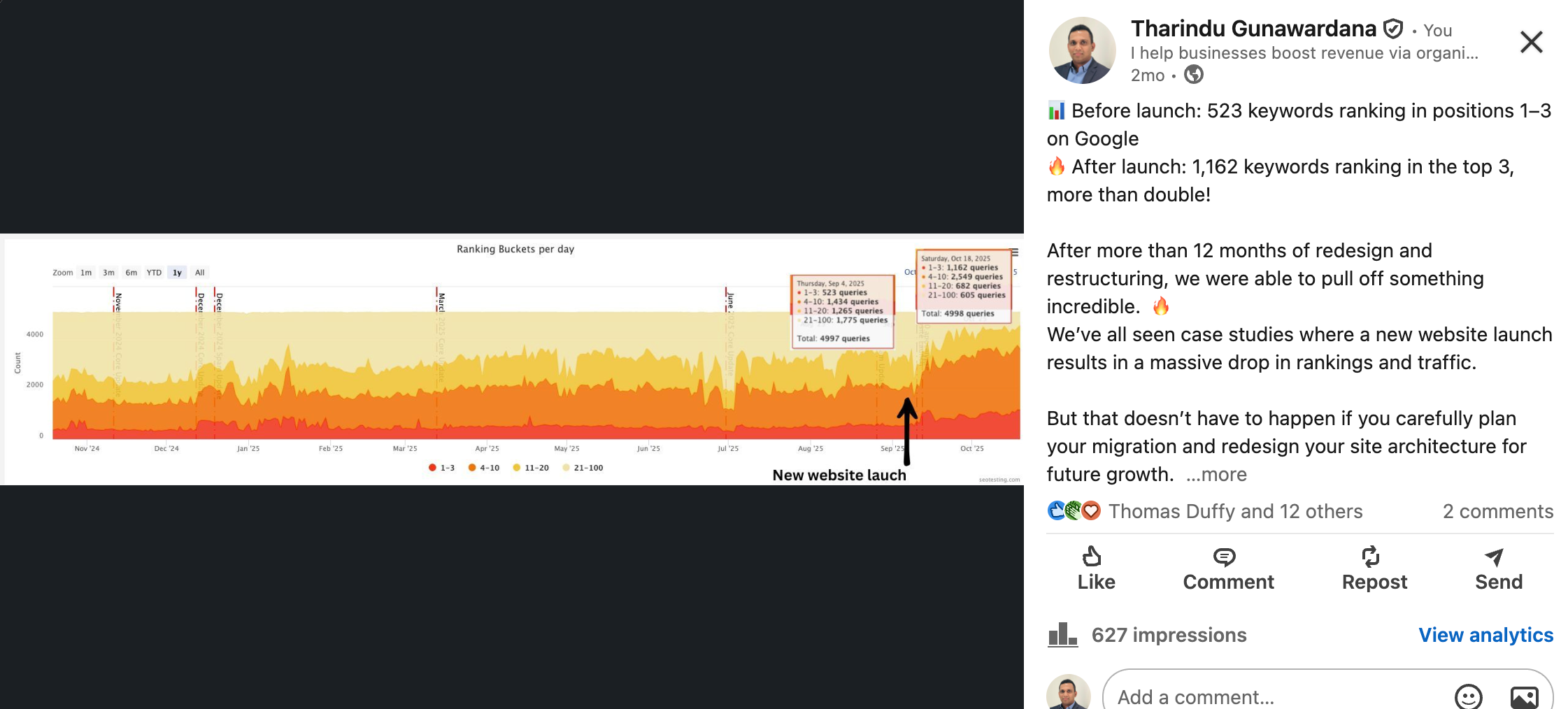
These services solve different stages of the website lifecycle.
| Website SEO Strategy | SEO Audit | SEO Migration | |
|---|---|---|---|
| Primary question | What should the future website contain? | What is limiting the current website? Learn about our SEO Audit. | How do we move to the new website safely? Learn about SEO Migration. |
| Best timing | Before sitemap, wireframes and development | When diagnosing an existing website | Once a redesign, platform move or structural change is being implemented |
| Primary focus | Future search growth and architecture | Existing technical, content and performance issues | Preservation during structural change |
| Typical outputs | Keyword strategy, SEO sitemap, URL structure, page mapping, content opportunities | Audit findings and prioritised recommendations | URL mapping, redirects, staging checks, launch validation and monitoring |
| New website? | Yes | Usually requires an existing site to audit | No existing migration is required for a completely new site |
If the website structure has not yet been decided, start with Website SEO Strategy.
If you need to understand what is wrong with the current site, start with SEO Audit.
If the future website is already planned, move into SEO Migration.
This service is most useful when the structure of the future website is still open to change.
Use case 1
Use search research before approving the new navigation, page hierarchy and templates so the redesign has room to capture existing and new demand.
Use case 2
Use market research, competitor analysis, keyword research and business priorities to establish the initial search architecture when no historical data exists.
Use case 3
Reorganise services, products, locations or content around clearer user and search needs before another layer of pages makes the structure harder to change.
Use case 4
Decide the future architecture before migration mapping begins when a platform change also involves restructuring categories, services, products or content.
Use case 5
Give your existing design and development partners the search research, sitemap, page mapping and SEO requirements they need before implementation.

Website architecture decisions affect technical SEO, content, search intent, UX, internal linking and migration at the same time.
SearchMinistry's SEO strategy is led by Tharindu Gunawardana, Founder and Lead SEO Strategist, with 17 years of search experience across Sri Lanka, Singapore and Australia and previous experience as an Agency SEO Director.
The goal is to turn complex search research into decisions stakeholders can understand and a website team can implement.
Clear answers about planning search architecture before a new website or redesign is built.
Ideally, SEO should be involved before the sitemap, navigation and major page templates are approved. That allows search demand and existing organic performance to influence which pages need to exist and how the new website should be structured rather than trying to retrofit SEO into decisions that have already been made.
No. Keyword research identifies how people search. A website SEO strategy uses that research, alongside search intent, competitors, current performance and business priorities, to decide which pages should exist, how they should relate, what each URL should target and what content needs to be produced. The keyword set is an input. The website architecture is the output.
Yes. An existing sitemap can be compared against search demand, competitor coverage, current organic performance and potential content gaps. Pages that already serve a clear purpose can remain, while missing, overlapping or unnecessary destinations can be identified before development progresses further.
Yes. A new website does not have historical Search Console or landing-page data, so the research places greater emphasis on market demand, competitors, keyword and intent patterns, the business model and the customer journey. The outcome is still an SEO sitemap, page ownership model and content plan designed around the search opportunity available to the business.
Website SEO Strategy and SEO Migration are connected but solve different problems. The strategy determines the future website structure and growth opportunities. SEO Migration manages the transition from the old website to the approved new structure through URL mapping, redirects, staging review, launch validation and post-launch monitoring. Where an existing website is being redesigned, the strategy can feed directly into the migration phase.
Yes. The outputs are designed to give designers, content teams and developers clear requirements before implementation. This can include the approved sitemap, page-purpose mapping, URL recommendations, content requirements, internal-link relationships and technical SEO considerations that need to be reflected in the final build.
The website strategy identifies what content is required and can provide page-level direction and briefs for priority pages. Where full content production or on-page implementation is required, this can be incorporated into the broader SEO engagement.
The scope depends on the size and complexity of the website, the number of services or product categories, the number of markets being researched and whether an existing website also needs to be analysed. After reviewing the project, SearchMinistry provides a defined scope covering the research, architecture and deliverables required before work begins.
With your permission, we use optional marketing cookies through Meta Pixel and Google Ads to measure visits and advertising performance. These trackers stay off unless you accept. You can change your choice anytime in the footer. Privacy policy