What Is Google UCP?
Google UCP, short for Universal Commerce Protocol, is an open standard designed for the future of eCommerce. It enables merchants to connect their store directly to Google's AI surfaces so that AI agents operating in Google Search AI Mode and Gemini can complete purchases on behalf of users, without the user being redirected to the merchant's website to complete checkout.
Google describes UCP as a way to "turn AI interactions into instant sales." For merchants, the practical meaning is that product discovery, cart building, identity linking, and checkout can all happen within Google's environment, while the merchant remains the Merchant of Record and retains full control of customer data, pricing, and fulfilment.
UCP uses a merchant's existing Merchant Center account and product feeds as the discovery layer. Customers who find products through AI Mode in Google Search or Gemini can add them to a cart and purchase directly, without leaving the AI interface. The merchant's backend handles the order on the merchant's own systems.
UCP is an evolving standard. Not all features described in the specification are available on Google's surfaces at the time of writing. Merchants must apply to join Google's waitlist and receive approval before going live. Availability is rolling out progressively, including in Australia.
Introduction to Agentic Commerce
Agentic commerce refers to shopping experiences where AI systems assist, influence, or autonomously participate in the purchasing journey on behalf of a user. Rather than a shopper typing a query, scanning results, clicking through to a product page, and completing a checkout form, an AI agent can handle each of those steps in sequence, or bypass several of them entirely.
The shift matters for eCommerce merchants because the traditional conversion funnel, search to click to product page to cart to checkout, was designed for a human browsing experience. An AI agent operating through a structured protocol like UCP does not browse in that way. It queries structured product data, validates pricing and availability, builds a cart session, and triggers checkout through an API. The quality of your product data and the completeness of your checkout infrastructure determine whether the agent can complete a purchase from your store at all.
Several frameworks and protocols are being developed to govern how AI agents interact with merchants, payment providers, and commerce platforms. These include the Universal Commerce Protocol (UCP), the Agent Payments Protocol (AP2), Agent2Agent (A2A), and the Model Context Protocol (MCP). UCP is Google's primary framework for enabling agentic purchases on its own surfaces. For a broader look at how these protocols layer together, see our guide to ACP, UCP, and MCP in agentic commerce.
For eCommerce businesses, agentic commerce raises a practical question: when a user asks an AI agent "buy me the best standing desk under $800 with same-day delivery in Melbourne," is your store even visible to the agent? And if it is visible, can the agent actually complete the purchase? UCP is Google's answer to the second question. The first question is answered by your Merchant Center feed quality and structured data.
How UCP Enables a Transaction
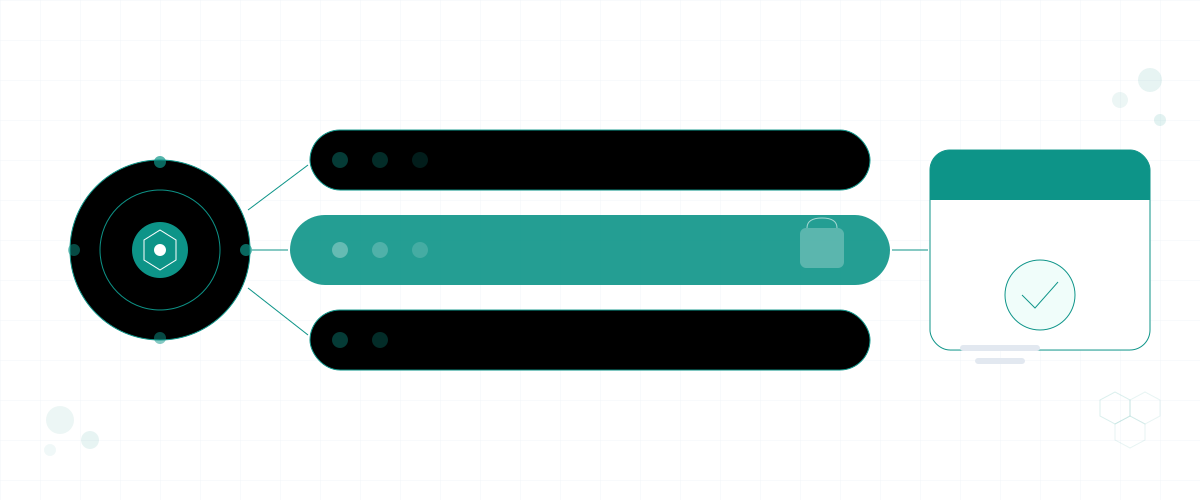
A UCP-enabled transaction flows through five stages. The AI agent in Google Search or Gemini interprets a user's shopping intent and queries Merchant Center feeds to identify relevant products. The UCP protocol then calls the merchant's checkout API to build a cart session. Once the user confirms they want to proceed, control passes to a Google-hosted checkout UI where the user enters sensitive fulfilment and payment details directly. The agent is not involved in this step, which is designed to preserve security and determinism. When payment is complete, a confirmation is shown and the merchant receives the order on their own systems as Merchant of Record.
The key design principle behind UCP is that the merchant never loses ownership of the customer relationship or the transaction. Google provides the interface and the AI layer; the merchant provides the inventory, pricing, fulfilment logic, and post-purchase experience. This is why Google describes UCP as allowing merchants to "maintain full control of your brand."
Native Checkout
Native checkout is the default and recommended UCP integration path. It requires the merchant to build a RESTful API that Google can call to create and manage checkout sessions. Google's documentation describes it as the integration that will "unlock full agentic potential as UCP product offering expands," meaning it is the path that will receive new features first.
The native checkout flow works as follows. The user and optionally an AI agent build up a cart by adding items to a checkout session via the API. Once the user decides to complete the purchase, the agent passes control to a Google-hosted UI, together with the checkout session data. The user then interacts only with Google's interface to enter sensitive details: delivery address, payment method, and any other fulfilment information. The agent is completely excluded from this step. After the user submits, Google shows a confirmation page and the order is passed to the merchant.
What Native Checkout Requires from a Merchant
Technical requirements
- A RESTful API endpoint Google can call to create checkout sessions
- Cart session management including item addition, removal, and pricing
- Real-time inventory and pricing validation
- Order lifecycle management: creation, confirmation, fulfilment status
- Google Pay integration for payment processing
Business requirements
- Active Merchant Center account with complete product feeds
- Shipping and returns configured in Merchant Center
- Published UCP profile at the well-known endpoint
- Google approval before going live on AI Mode and Gemini
- Waitlist application submitted and accepted
The native path is best suited to merchants who have existing API infrastructure or are comfortable building a dedicated checkout API. For platform-based merchants such as Shopify stores, Google is developing UCP integrations through platform partnerships that reduce the custom API work required.
An important detail for merchants to understand is that the native checkout path does not replace your existing website or checkout. It is an additional integration layer that allows your products to be purchased through Google's AI surfaces. Your existing website, product pages, and checkout continue to operate independently.
Embedded Checkout
Embedded checkout is an optional integration path available to specific, approved merchants. It is designed for merchants whose checkout flow is complex enough or bespoke enough that the native API path cannot support it. Typical use cases include highly customised checkout experiences, multi-step configuration tools, or checkout logic that involves product personalisation that cannot be expressed through a standard cart session API.
With embedded checkout, the merchant's existing web-based checkout is embedded inside Google's surfaces using an iframe. Unlike a simple web redirect, the embedded approach enables bi-directional communication between Google's interface (the host) and the merchant's checkout (the iframe content). This means Google can delegate specific tasks to the merchant's checkout, such as selecting a saved delivery address or applying a stored payment credential, to deliver a faster, more native-feeling experience.
The merchant remains the Merchant of Record and handles actual order creation on their own systems. Google's role is as the host that embeds the checkout and manages the outer UI layer. To support embedded checkout, merchants must declare support for the embedded protocol in their UCP profile, implement URL initialisation handling on the frontend, and meet a checklist of implementation requirements across both the UCP API and the frontend checkout application.
Embedded checkout is not the default path and requires a separate approval process. Google's guidance is clear that native checkout should be the starting point for most merchants, with embedded checkout available as a customisation option for those with specific requirements that native cannot meet. Merchants considering embedded checkout should assess whether the additional implementation complexity is justified by genuine checkout requirements that the native path cannot support.
Google Universal Cart
In May 2026, Google announced the Universal Cart as part of its broader AI shopping updates. The Universal Cart allows shoppers to add products from multiple different UCP-enabled merchants into a single cart on Google surfaces, including AI Mode in Google Search and Gemini, and complete a single checkout session that spans those merchants.
Before Universal Cart, a shopper using AI Mode who wanted to buy items from several different retailers would need to visit each merchant's website separately and complete a separate checkout at each store. Universal Cart changes this by aggregating products from multiple UCP-participating merchants into a single Google-managed cart. The shopper pays once through Google Pay, and each merchant receives their portion of the order as a separate Merchant of Record transaction on their own systems.
For merchants, the Universal Cart creates a significant visibility opportunity. A shopper asking Gemini to "put together everything I need to set up a home office under $2,000" could receive a cart that combines a desk from one merchant, a chair from another, and a monitor from a third, all added in a single interaction. Merchants whose products are in Merchant Center with complete, accurate feed data are eligible to appear in these multi-merchant cart sessions. Merchants not participating in UCP are invisible to this behaviour, regardless of how well their products rank in traditional search.
The Universal Cart also has implications for how merchants think about product relationships and bundle opportunities. If a shopper asks for a complete setup rather than a single product, the AI agent will compose a cart from available UCP inventory. Product feeds that include clear compatible-product attributes, accessory relationships, and variant structures are better positioned to appear across these multi-product queries.
Universal Cart is part of Google's broader push to become the primary interface for AI-assisted commerce. Combined with UCP's native and embedded checkout paths, it represents a significant shift in where the conversion moment happens for eCommerce: from the merchant's website to Google's AI surface, with the merchant still owning the fulfilment and customer relationship.
What Merchants Need to Do
Google's implementation documentation outlines a clear sequence for merchants who want to participate in UCP. The steps below reflect the current implementation guidance, though the programme is evolving and specific technical requirements may change as UCP expands.
UCP Implementation Steps for Merchants
- 1
Prepare your Merchant Center account
Configure shipping and returns in Merchant Center. Ensure your product feed is complete, accurate, and up to date. Feed completeness is the primary discovery layer; products not in Merchant Center cannot appear in AI Mode or Universal Cart.
- 2
Set up Google Pay
Integrate the Google Pay payment handler so users can submit payment with Google Wallet credentials during the checkout session. Google Pay is required for both native and embedded checkout paths.
- 3
Publish your UCP profile
Declare your UCP services at the well-known endpoint (/.well-known/ucp). This profile tells Google what commerce capabilities your store supports, including which checkout path you are implementing and what protocol version you are using.
- 4
Build and test your checkout integration
Implement native checkout (RESTful API) or embedded checkout (iframe with bi-directional communication) based on your store's requirements. Use the SDKs and code samples in the UCP GitHub repository to validate your implementation against Google's specifications.
- 5
Apply for the waitlist and get approved
Your UCP integration must be reviewed and approved by Google before going live on AI Mode in Google Search and Gemini. Join the waitlist through Google's UCP programme page to begin the onboarding process.
Merchants who are not yet ready to implement the full UCP checkout API can still prepare by focusing on feed quality and structured data. Products that are well-represented in Merchant Center with complete attributes, accurate pricing, and clear variant structures are better positioned to appear in AI-driven discovery before UCP checkout is even implemented. Discovery and checkout are separate: you can be visible in AI Mode without UCP, but you cannot convert there without it.
For merchants who want a guided assessment of their current agentic commerce readiness, including feed quality, schema, variant architecture, and checkout preparedness, see our Agentic Commerce Optimisation services.
SEO and AI Search Implications
UCP creates a new layer in the eCommerce search and conversion stack. Traditional SEO gets a product page indexed and ranked. UCP gets a product purchased without the shopper ever visiting that page. For merchants, both layers matter, but they require different optimisation work. The SEO implications of UCP are primarily about feed quality and machine-readable product data, not about page content in the traditional sense.
Example: How Feed Quality Affects UCP Discovery
Weak feed (invisible to agentic queries)
"Standing Desk Pro — a quality standing desk for your home or office. Ships within 7 days. Multiple sizes available."
Missing: specific dimensions, weight capacity, motor type, colour variants, delivery estimate, return policy. An AI agent cannot answer "will this fit in a 150cm space?" or "can I return it if it doesn't fit?"
Strong feed (agent-ready)
"UpDesk Pro 1500 — electric height-adjustable desk, 150cm x 75cm surface, 100kg capacity, black or white, same-day dispatch Melbourne warehouse, 30-day free returns."
Specific, structured, complete. An agent can match this to a query like "standing desk that fits 150cm, ships today Melbourne, returnable."
- Treat Merchant Center feeds as your primary AI search ranking signal. For UCP-based discovery, Merchant Center feeds are what AI agents query. Feed completeness, title clarity, attribute specificity, and availability accuracy are more important than your product page's keyword density.
- Add conversational attributes where they answer real pre-purchase questions. Google's optional conversational attributes including
question_and_answer,document_link,related_product,item_group_title,variant_optionandpopularity_rankhelp AI agents understand products conversationally. Add them via a supplemental data source where they add genuine explanatory value. - Structure product schema on your PDPs even though agents bypass the page. Product, Offer, and ProductGroup schema on product detail pages supports both traditional indexing and AI system understanding. Structured data helps search systems establish entity relationships even when the page is not visited in a traditional browsing session.
- Model variant families explicitly in your feed. AI agents composing carts for user queries that involve specific variant requirements (size, colour, configuration) need explicit
item_group_idand variant attribute data to match products accurately. Missing or inconsistent variant data leads to mismatches or exclusion from results. - Configure shipping and returns in Merchant Center with precision. For Universal Cart and UCP checkout, accurate shipping estimates and clear return policies are not optional signals. They are used to validate purchase conditions before the AI agent recommends completing a transaction. Vague or outdated shipping data creates friction that can exclude your products from agent-mediated recommendations.
- Consider agentic commerce readiness alongside traditional eCommerce SEO. Our Agentic Commerce Optimisation service combines feed assessment, structured data review, variant architecture analysis, and checkout readiness evaluation so you can understand where your store sits across both discovery and transaction layers.
Frequently Asked Questions
What is Google UCP in simple terms?
Google UCP (Universal Commerce Protocol) is a system that allows AI assistants like Google's AI Mode and Gemini to complete purchases from your store on behalf of a user, without the user leaving the Google interface. The shopper finds a product through an AI-powered search or conversation, and UCP handles the checkout process through a connection between Google and your store's systems. You remain the Merchant of Record and fulfil the order on your own systems.
What is the difference between native checkout and embedded checkout in UCP?
Native checkout is the default UCP integration path. You build a RESTful API and Google calls it to manage checkout sessions. Payment and fulfilment details are entered by the user in Google's own checkout interface. Embedded checkout is an optional alternative for merchants with complex or highly customised checkout flows. Your existing web checkout is embedded inside Google surfaces via an iframe, with bi-directional communication between Google's interface and your checkout. Most merchants should start with native checkout. Embedded checkout requires separate approval from Google.
Do I still own the customer relationship with UCP?
Yes. Google's UCP documentation is explicit that merchants remain the Merchant of Record. You keep all customer data and relationships. Google provides the AI interface and the checkout UI that handles payment submission, but the order, fulfilment, returns, and customer communication all remain your responsibility. UCP is designed to expand where your products can be discovered and purchased, not to transfer the commercial relationship to Google.
What is the Google Universal Cart and how do I participate?
The Google Universal Cart allows shoppers to add products from multiple UCP-enabled merchants into a single cart on Google surfaces and complete one checkout session across all of them. Participation requires your store to be UCP-enabled: active in Merchant Center with complete product feeds, integrated with Google Pay, and live on the UCP protocol with Google's approval. Merchants not participating in UCP cannot appear in Universal Cart sessions. Discovery in the cart is driven by Merchant Center feed quality, so improving your feed completeness and attribute specificity is the first step even before completing a full UCP integration.
How does UCP affect my existing SEO and product pages?
UCP does not replace your existing product pages or traditional SEO. It adds a parallel commerce layer where AI agents can purchase from your store directly on Google surfaces. Your product pages continue to serve shoppers who click through from traditional or AI search results. The SEO implication is that Merchant Center feed quality becomes a primary signal for AI-driven discovery, while product page schema and structured data continue to support traditional and AI search indexing. The two approaches are complementary, not competing.
How do I get access to Google UCP?
UCP access is controlled through a waitlist and requires Google approval before going live on AI Mode and Gemini. To apply, visit the Google UCP developer documentation at developers.google.com/merchant/ucp and join the waitlist. Before applying, you should have an active Merchant Center account with complete product feeds, shipping and returns configured, and a plan for either native or embedded checkout integration. Merchants on platforms like Shopify should monitor for official UCP platform integrations that reduce the custom API work required.
Prepare Your Store for Agentic Commerce
UCP readiness starts with feed quality and structured data, long before the checkout API is built. SearchMinistry's Agentic Commerce Optimisation service audits your Merchant Center feeds, product schema, variant architecture, and checkout infrastructure so you know exactly where your store stands and what to fix first.

Tharindu Gunawardana
Founder and Director of SearchMinistry
Tharindu Gunawardana is the Founder of SearchMinistry Media and a search strategist with 17 years of experience across Sri Lanka, Singapore, and Australia. A former Agency SEO Director, he specialises in helping brands transition from traditional SEO to AI-driven discovery.