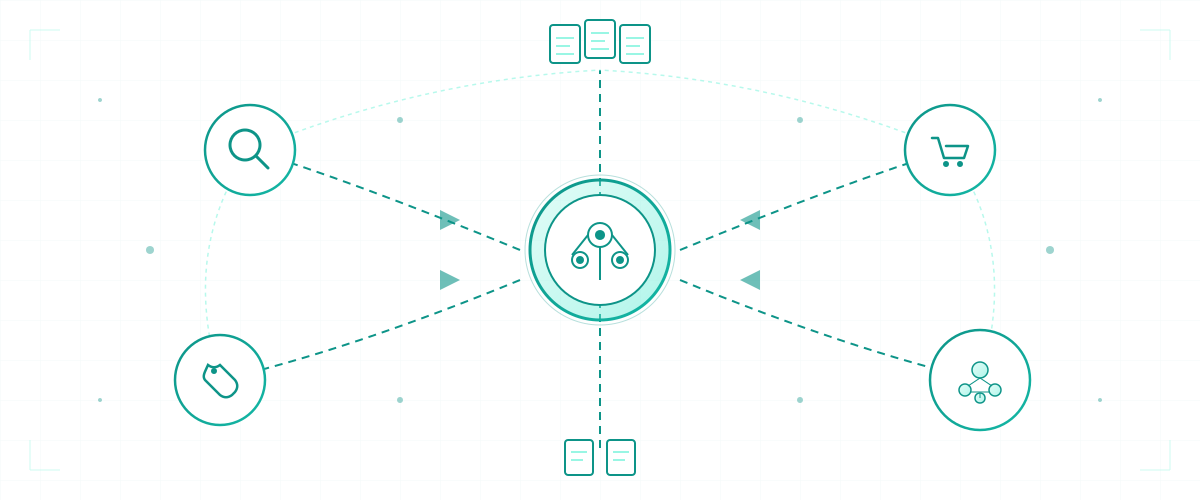
What Is Agentic SEO?
Agentic SEO is the practice of optimising web content, structured data, and technical infrastructure for autonomous AI agents that discover, retrieve, and act on information without human input at each step. Where traditional SEO targets users who browse search results and click through to pages, agentic SEO targets AI systems that plan multi-step tasks, call external tools, and complete goals on behalf of users autonomously.
The distinction matters because AI agents do not behave like search engine users. A user types a query, receives a list of results, and makes a choice. An agent receives a task, decomposes it into sub-queries using query fan-out, calls tools including web search, APIs, and MCP-compatible data sources, retrieves the most relevant passages using a RAG pipeline, and executes the task end to end. At no point does the agent "click through" to a page in the way a human would. It extracts structured information and moves on.
For businesses, this creates a new visibility challenge. If an AI agent cannot reliably extract your entity data, pricing, availability, or service attributes from your web presence, it will either skip your business or misrepresent it in the synthesised response delivered to the user. Agentic SEO is the discipline of making your content machine-actionable, not just human-readable.
How AI Agents Retrieve Web Content
AI agents retrieve web content through a layered pipeline that combines web search, vector retrieval, tool calling, and structured data extraction. Unlike a simple chatbot query that returns a single response, an agent orchestrates several retrieval steps in sequence or in parallel, depending on the complexity of the task assigned to it.
The retrieval process begins when the agent receives a task and decomposes it into a plan. For a task such as "compare the top three SEO agencies in Melbourne and book a discovery call with the most suitable one," the agent generates multiple parallel sub-queries covering: agency reputation signals, service scope, pricing availability, booking mechanisms, and contact options. Each sub-query triggers a separate retrieval step. The agent aggregates the results, re-ranks them using contextual relevance scoring, and proceeds to the next action.
Crucially, agents retrieve at the passage level, not the page level. A 3,000-word service page is broken into semantic chunks. Only the chunks that match the agent's sub-queries are retrieved and used. If your pricing information is buried in paragraph 14 of a wall of text with no structural markup, it may not be retrieved at all, even if it is technically on the page.
Agentic SEO vs Traditional SEO
Traditional SEO is built around the assumption that a human makes the final decision. The search engine's job is to surface the best options; the user's job is to evaluate and choose. Agentic SEO operates under a fundamentally different assumption: the AI agent makes the decision and acts on it. The user may never see the intermediate steps at all.
This shift has direct implications for what content signals matter. In traditional SEO, a compelling title tag and meta description influence whether a user clicks. In agentic SEO, these are largely irrelevant. What matters is whether the agent can extract the fact it needs (service type, price, availability, location, contact method) from a structured, machine-readable format, quickly and unambiguously.
The Agentic Retrieval Pipeline
The agentic retrieval pipeline describes the sequence of steps an AI agent takes from receiving a task to producing an outcome. Understanding each stage identifies where optimisation interventions have the highest impact on whether your business is discovered, selected, and acted upon.
Stage 1: Task Input. The user assigns a goal to the agent. This may be explicit ("book me an SEO audit") or implicit ("plan my website relaunch"). The agent's first action is to interpret the intent and determine what information it needs to proceed.
Stage 2: Agent Planning. The agent decomposes the task using query fan-out, generating multiple parallel sub-queries that each address a different aspect of the goal. A task about "finding an SEO audit service" might fan out into sub-queries covering: audit scope (technical, content, local), pricing models, turnaround time, reviews, and location. Each sub-query is optimised separately.
Stage 3: Tool Calling. For each sub-query, the agent selects the appropriate tool. This may include a web search API (returning ranked URLs and snippets), a structured data API (returning schema.org records), an MCP-compatible endpoint (returning real-time business data), or a vector database (returning semantically similar passages). Tools return results in structured form, not as rendered web pages.
Stage 4: Web Retrieval. The agent fetches content from the URLs or passages returned by tool calls. It uses a RAG pipeline to extract the relevant sections, embedding each passage into a vector space and scoring it against the sub-query. Passages with the highest semantic similarity to the sub-query are retained. Others are discarded. At this stage, content clarity, passage focus, and entity precision determine what survives.
Stage 5: Action or Response. The agent synthesises retrieved information into an action (booking a call, submitting a form, purchasing a product) or a response (a recommendation with supporting rationale). At this stage, the agent may have already contacted your business directly through an MCP-exposed endpoint, without the user ever seeing your website.
MCP, Tool Calling, and Machine-Readable Content
The Model Context Protocol (MCP), developed by Anthropic and now adopted across major AI platforms, is an open standard that allows AI agents to connect to tools, APIs, and data sources through a standardised interface. An MCP-compatible server exposes capabilities that agents can discover and invoke at runtime, without requiring the agent to scrape HTML or interpret rendered pages.
For businesses, implementing an MCP server means an AI agent can query your service catalogue, check appointment availability, retrieve current pricing, or initiate a booking, all programmatically. This is already live in agentic commerce contexts where ACP (Agentic Commerce Protocol) layers purchasing capabilities on top of MCP's tool connectivity foundation.
Even without a custom MCP implementation, existing Schema.org structured data on your website functions as a form of machine-readable signal that agents can parse via web retrieval. A correctly implemented Service schema with defined serviceType, areaServed, priceRange, and provider attributes gives an agent the structured facts it needs without requiring it to extract them from unstructured prose.
Key Signals for Agentic Discovery
Agentic discovery depends on signals that make content machine-actionable and entity-precise. The signals that most directly influence whether an AI agent retrieves and uses your content or business data differ substantially from the signals that drive traditional click-through rates.
Entity clarity is the highest-leverage signal. An AI agent needs to resolve your business as a named entity with defined attributes: type, location, services offered, authority signals, and relationships to other known entities. Content that states these attributes explicitly in the same passage, using the exact terminology agents are trained to recognise, is retrieved with significantly higher frequency than content that distributes these facts across multiple sections.
Structured data (Schema.org) functions as a direct signal layer that agents can access without full page parsing. A Service schema with defined serviceType, provider, areaServed, hasOfferCatalog, and priceRange attributes gives an agent actionable facts in a format it can process immediately. Organisation and LocalBusiness schemas contribute to entity recognition in knowledge graphs, which agents query for entity disambiguation and authority verification.
Answer-first paragraph structure directly affects passage retrieval scores. Agents using RAG pipelines score passages by semantic similarity to their sub-queries. A passage that opens with a direct, factual statement relevant to the query receives a higher similarity score than a passage that buries the key fact in the second or third sentence. Structure every section to answer its core question in the first sentence.
Machine-readable operational data covers pricing, availability, hours, location, and contact options. Agents tasked with booking decisions need these facts in structured form. An agent that cannot determine your pricing or availability from structured markup will often select a competitor whose data is accessible, even if your qualitative content is stronger.
How to Structure Content for AI Agents
Structuring content for agentic retrieval requires applying the principles of semantic chunking, entity precision, and answer-first formatting to every section of your site, not just your homepage or service pages. Agents retrieve at the passage level, so each passage must stand alone as a complete, retrievable unit of information.
The following principles apply across all content types targeted at agentic systems:
- One concept per passage. A passage that covers two topics embeds as a blended vector that scores poorly for both queries. Separate service descriptions, pricing information, and eligibility criteria into distinct, focused paragraphs. Each paragraph should answer one question completely. Use the ColBERT MaxSim Scorer to see exactly which passages on your pages are being retrieved for specific queries, and which are being discarded.
- Use the exact entity name in every passage where it is relevant. Agents resolve entity references by exact string matching and embedding similarity. A passage about "our Melbourne SEO service" and a passage about "SearchMinistry's local search optimisation in Victoria" embed differently and may not be retrieved by the same agent sub-query. Use consistent terminology aligned to the exact terms in your Schema.org structured data.
- Include numerical and factual anchors. Agents treat quantified facts as high-confidence retrieval signals. Prices, timeframes, success rates, geographic coverage areas, and technology stack specifications are examples of facts that agents actively seek. State them explicitly and consistently.
- Structure CTAs as machine-parseable actions. A "Contact Us" button is not actionable by an agent. A schema-marked ContactPoint with contactType, telephone, and availableLanguage attributes is. For agentic commerce contexts, implementing booking endpoints or MCP-compatible action APIs is the direct equivalent of having an "Add to Cart" button in a traditional e-commerce context.
- Register your entity in external knowledge bases. Google's Knowledge Graph, Wikidata, and industry-specific directories function as authority verification sources for agents. An entity with a confirmed Knowledge Graph entry and consistent NAP (name, address, phone) data across multiple authoritative sources is retrieved with higher confidence than an entity that exists only on its own website.
SEO and AI Search Implications
AI search systems including Google AI Overviews, Perplexity, and ChatGPT Search already implement partial agentic retrieval for complex queries. When a user asks a multi-part question, these systems decompose it using fan-out, retrieve passages from multiple sources, and synthesise a single answer. The content that appears in these synthesised answers is retrieved using the same passage-level signals that fully agentic systems use. Optimising for agentic SEO today directly improves performance in AI search citations now, while positioning content for the fully agentic web that is already in early deployment.
Example: Weak vs Strong Content for Agentic Retrieval
Before (agent cannot extract actionable facts)
"We offer a range of SEO services to help your business grow online. Our team has years of experience and we work with clients across Australia. Get in touch to find out more about what we can do for you."
After (agent can extract entity, service, location, and action)
"SearchMinistry Media provides technical SEO audits, AI SEO strategy, and local SEO services for Australian businesses. Engagements start at $2,500 for a one-time audit and from $1,500 per month for ongoing retainers. Based in Melbourne, serving clients nationally. Book a discovery call at searchministry.au/contact."
The weak version contains no extractable entity data, no defined service attributes, no pricing signals, and no machine-actionable contact method. An agent attempting to build a comparison or make a booking cannot use it. The strong version gives the agent a complete entity record in a single passage: business name, services (three named types), pricing (two models), geographic scope, and a direct contact URL.
- Audit every service page for passage-level entity completeness. Each section should name your business, the specific service it describes, the target audience or location, and a quantified outcome or price range. An agent querying "who offers technical SEO audits in Melbourne under $3,000" must find all four data points in a single passage to retrieve your page for that query. The On-Site SEO Analyser checks AI chunking quality, entity clarity, and structured data completeness across 90+ signals.
- Implement Schema.org Service markup on every service page. Include serviceType, provider (with name and url), areaServed, hasOfferCatalog (with named offers and prices), and contactPoint. This structured layer is readable by agents at Stage 3 of the retrieval pipeline, before they even access your prose content.
- Use consistent entity terminology across all touchpoints. Your business name, service names, and location descriptions should be identical across your website, Google Business Profile, LinkedIn, and any directory listings. Agents cross-reference these sources for entity verification. Inconsistencies reduce retrieval confidence and lower your probability of being selected.
- Structure FAQ sections to answer agent sub-queries directly. Agent sub-queries are often question-format strings such as "does SearchMinistry offer local SEO?" or "what is the price of an SEO audit at SearchMinistry?" FAQ sections structured with exact-match question headings and direct, factual answers are retrieved at above-average rates because their format matches the agent's sub-query structure precisely.
- Register with AI SEO services to build entity signals systematically. Entity establishment in Google's Knowledge Graph, Wikipedia-adjacent citations, and consistent structured data across authoritative directories are the foundation of agentic discoverability. These signals cannot be built in a single page update. They require a sustained, coordinated entity establishment programme.
Frequently Asked Questions
What is the difference between agentic SEO and traditional SEO?
Traditional SEO optimises content to rank well in search engine results pages where humans make the final click decision. Agentic SEO optimises content and structured data for autonomous AI agents that plan multi-step tasks, retrieve information programmatically, and complete goals without requiring a human to evaluate search results and click through. The key difference is the destination: traditional SEO leads to a page view; agentic SEO leads to a machine-executed action.
Do I need to implement MCP to rank in agentic search?
No, but it provides a significant advantage in agentic commerce contexts. Schema.org structured data on your existing web pages is the minimum viable implementation for agentic discoverability. A correctly implemented Service, Product, or LocalBusiness schema gives agents the structured facts they need during web retrieval without requiring a custom API. MCP implementation becomes important when you want agents to take real-time actions on your behalf, such as checking live inventory, booking appointments, or retrieving personalised pricing.
Which AI agents currently use agentic SEO signals?
Perplexity Pro uses agentic retrieval for complex multi-part queries, calling search tools and synthesising responses from multiple sources. ChatGPT with web browsing enabled performs agentic retrieval for research tasks. Google AI Overviews applies partial agentic query decomposition for certain query types. Claude Projects and Operator modes support full agentic workflows via MCP. As of mid-2026, fully autonomous agentic commerce agents are in active deployment by Shopify, Google, and Stripe's Agentic Commerce Protocol partners.
How does agentic SEO relate to AI Overviews and Answer Engine Optimisation?
AI Overviews and Answer Engine Optimisation (AEO) address the retrieval and citation layer of AI search: ensuring content appears in synthesised AI answers. Agentic SEO extends this to the action layer: ensuring AI agents can discover, evaluate, and act on your business, not just cite your content. The underlying retrieval signals overlap significantly. Content optimised for AI Overview citation (entity clarity, answer-first structure, semantic chunking) also performs well in agentic retrieval pipelines. Agentic SEO adds the structured data, MCP compatibility, and machine-readable operational data layers on top.
What Schema.org markup is most important for agentic SEO?
For service businesses: Service (with serviceType, provider, areaServed, hasOfferCatalog) and Organization (with name, url, sameAs linking to social profiles, and contactPoint). For e-commerce: Product (with name, description, offers containing price, priceCurrency, availability) and a complete AggregateRating. For local businesses: LocalBusiness (with PostalAddress, telephone, openingHoursSpecification, and geo coordinates). All schema should use absolute URLs for identifier fields and maintain consistent naming with your Google Business Profile and directory listings.
How long does it take to see results from agentic SEO optimisation?
Structured data improvements and passage-level content restructuring can improve AI search citation rates within four to eight weeks, as AI systems re-crawl and re-index updated content. Entity establishment in knowledge graphs and Wikipedia-adjacent sources takes three to six months to build sufficient authority for reliable retrieval. MCP implementation, once live, is immediately accessible to MCP-compatible agents. Full agentic commerce integration, including action endpoints and ACP compatibility, is a longer-term build that depends on the complexity of your service or product catalogue.
Build Agentic Discoverability for Your Business
SearchMinistry Media audits and implements the full agentic SEO stack: entity establishment, Schema.org structured data, passage-level content restructuring, and AI citation building. Start with an AI Visibility Audit to see how current AI agents represent your business and where the gaps are.

Tharindu Gunawardana
Founder and Director of SearchMinistry
Tharindu Gunawardana is the Founder of SearchMinistry Media and a search strategist with 17 years of experience across Sri Lanka, Singapore, and Australia. A former Agency SEO Director, he specialises in helping brands transition from traditional SEO to AI-driven discovery.