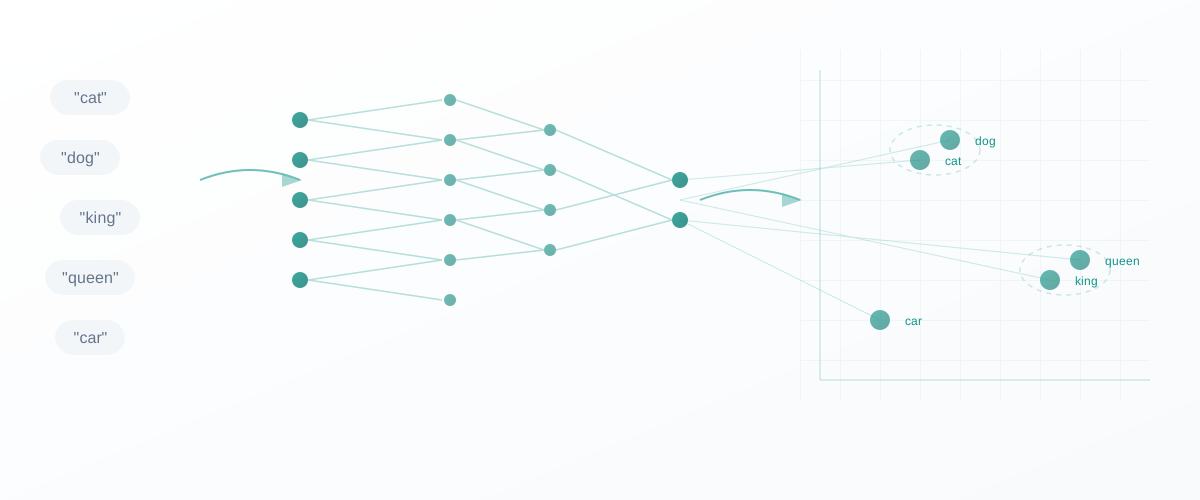
Vector embeddings are the mathematical foundation behind how AI systems understand language. Every time Google processes a search query, every time ChatGPT understands your prompt, and every time an AI Overview summarises web content, vector embeddings are at work. This guide explains what they are, how they work, and why they matter for SEO.
What Are Vector Embeddings?
A vector embedding is a list of numbers (a "vector") that represents a piece of text in a way that captures its meaning. Instead of treating words as arbitrary symbols, embedding models convert text into points in a high-dimensional mathematical space where similar meanings are close together.
For example, the words "dog" and "puppy" would be represented by vectors that are very close to each other, because they share similar meanings. The word "refrigerator" would be much further away. This is fundamentally different from traditional keyword matching, where "dog" and "puppy" would be treated as completely different strings with no relationship.
Simple definition
A vector embedding is a list of numbers that represents the meaning of a word, sentence, or document. Similar meanings produce similar numbers, allowing computers to measure how related two pieces of text are.
How Vector Embeddings Work
The process of creating a vector embedding involves three main steps: tokenisation, neural network processing, and output. Here is a visual overview of the full pipeline.
Step 1: Tokenisation
Before text can be processed by a neural network, it must be broken into smaller pieces called tokens. Modern models use sub-word tokenisation algorithms like Byte Pair Encoding (BPE), which split words into commonly occurring pieces. For example, "unhappiness" might become ["un", "happiness"] or ["un", "happ", "iness"].
Each token is assigned a numerical ID from the model's vocabulary (typically 50,000 to 100,000+ tokens). This converts text from characters into a sequence of integers the model can work with.
Step 2: Neural Network Processing
The token IDs are fed into a transformer neural network, the same architecture behind models like BERT, GPT, and Google's PaLM. The transformer processes these tokens through dozens of layers, with each layer refining the representation. Through a mechanism called self-attention, the model learns which tokens relate to each other and in what way.
For example, in the sentence "The bank of the river was steep," the model learns that "bank" relates to "river" and "steep," correctly interpreting it as a riverbank rather than a financial institution. This contextual understanding is what makes modern embeddings so much more powerful than earlier approaches.
Step 3: The Output Vector
The final output is a dense vector, a list of floating-point numbers, typically with 768 to 3,072 dimensions. Each dimension captures some aspect of meaning, though individual dimensions do not map to human-interpretable features. The meaning emerges from the pattern across all dimensions collectively.
Modern embedding models like OpenAI's text-embedding-3-large produce 3,072-dimensional vectors. Google's Gecko model produces 768-dimensional vectors. The higher the dimensionality, the more nuance the embedding can capture, but at increased computational cost.
Measuring Similarity
Once text is converted into vectors, measuring how similar two pieces of content are becomes a mathematical operation. The most common method is cosine similarity, which measures the angle between two vectors regardless of their magnitude.
Cosine similarity produces a score between -1 and 1, where 1 means identical direction (identical meaning), 0 means completely unrelated, and -1 means opposite meaning. In practice, most text comparisons fall between 0 and 1.
The classic analogy test
One of the most famous demonstrations of vector embeddings is the analogy: king - man + woman ≈ queen. When you take the vector for "king," subtract the vector for "man," and add the vector for "woman," the resulting vector is very close to the vector for "queen." This shows that embeddings capture relational meaning, not just individual word similarity.
Types of Embeddings
Not all embeddings are created equal. Different models produce embeddings at different levels of granularity.
| Type | What it Embeds | Example Models | Use Case |
|---|---|---|---|
| Word Embeddings | Individual words | Word2Vec, GloVe | Synonym detection, basic NLP |
| Contextual Embeddings | Words in context | BERT, ELMo | Understanding polysemy (multiple word meanings) |
| Sentence Embeddings | Full sentences or passages | SBERT, E5, Gecko | Semantic search, document retrieval |
| Multi-modal Embeddings | Text + images together | CLIP, SigLIP | Image search, visual content matching |
For SEO purposes, sentence and passage embeddings are the most relevant. These are what Google and AI search engines use to understand whether your content matches a user's query at the meaning level, not just the keyword level.
Vector Embeddings in Search
Modern search engines use vector embeddings at multiple stages of the search pipeline.
1. Query Understanding
When a user types a query, it is converted into a vector embedding. This allows the search engine to understand the intent behind the query, not just the literal words. A query for "how to fix a dripping faucet" is understood as semantically similar to "leaky tap repair guide" even though they share few keywords.
2. Document Retrieval
Web pages are pre-processed into embeddings and stored in a vector index. When a query comes in, the search engine finds documents whose embeddings are closest to the query embedding. This is how Google's systems can retrieve relevant results for queries it has never seen before, based purely on meaning.
3. Re-ranking
After initial retrieval, more sophisticated models (like cross-encoders) compare query-document pairs more carefully. This produces a refined ranking where the most semantically relevant documents rise to the top. Google's MUM and Gemini models perform this type of deep semantic matching.
4. AI Overviews and RAG
In AI search products like Google AI Overviews, Perplexity, and ChatGPT search, embeddings determine which sources are retrieved and fed into the language model. The content that is most semantically relevant to the query (measured by embedding similarity) is what the AI reads and potentially cites. See our guide on Retrieval Augmented Generation (RAG) for more on this process.
How Vector Embeddings Affect AI Search Retrieval
Understanding vector embeddings changes how you should think about content creation and optimisation. An effective AI SEO strategy starts with understanding how search engines represent and compare meaning.
Example: Keyword Density vs Semantic Coverage
Keyword-dense (weak embedding signal)
"Our vector embedding service helps with vector embeddings. Vector embedding is important for vector embedding SEO because vector embeddings improve vector embedding rankings."
Embedding collapses onto the repeated token. The vector is noisy and retrieves poorly for related queries like "semantic search" or "AI retrieval".
Semantically varied (strong embedding signal)
"Sentence embeddings represent meaning numerically, allowing retrieval systems to match a query against documents by semantic proximity. Models like OpenAI text-embedding-3 and Cohere Embed v3 power this retrieval layer."
Dense semantic signal. Retrieves accurately for "AI retrieval", "semantic search", "embedding models" and their paraphrases — without repeating any single term.
Semantic coverage matters more than keyword density
Because embeddings capture meaning, covering a topic thoroughly and using natural language variations is more effective than repeating the same keyword. Write about "vector embeddings," "numerical representations," and "semantic vectors" naturally rather than stuffing one phrase.
Topical authority builds stronger embeddings
Search engines build entity-level embeddings for websites. A site with deep, interconnected content about AI and machine learning will have a stronger topical embedding in that space than a generalist site with one article on the topic.
Structure helps embedding models extract meaning
Clear headings, concise paragraphs, and structured data help embedding models parse your content accurately. A well-structured page produces a cleaner, more focused embedding than a wall of unstructured text.
Entity clarity improves semantic matching
Clearly defining entities and their relationships on your page helps the embedding model understand exactly what your content is about. Use Schema.org markup, define key terms explicitly, and link to authoritative sources to reinforce entity signals.
Frequently Asked Questions
What is the difference between a vector embedding and a keyword?
A keyword is a literal string of characters. A vector embedding is a numerical representation of meaning. Two completely different keywords can have very similar embeddings if they mean the same thing. For example, "automobile" and "car" have different keywords but nearly identical embeddings.
How many dimensions does a typical embedding have?
Modern embedding models typically produce vectors with 768 to 3,072 dimensions. Google's Gecko model uses 768 dimensions. OpenAI's text-embedding-3-large uses 3,072 dimensions. Larger models can capture more nuance but require more storage and computation.
Does Google use vector embeddings for ranking?
Yes. Google has confirmed that neural embeddings play a role in search. Systems like MUM, Gemini, and the Neural Matching system all use embedding-based approaches to understand queries and documents. The transition from purely lexical matching to semantic matching has been gradual but fundamental.
Can I see the vector embedding of my content?
You cannot see Google's internal embeddings of your content. However, you can generate embeddings using publicly available models (like OpenAI's API or open-source models like E5 or BGE) to understand how your content would be represented. This can help you compare the semantic similarity between your content and target queries.

Tharindu Gunawardana
Founder and Director of SearchMinistry
Tharindu Gunawardana is the Founder of SearchMinistry Media and a search strategist with 17 years of experience across Sri Lanka, Singapore, and Australia. A former Agency SEO Director, he specialises in helping brands transition from traditional SEO to AI-driven discovery.