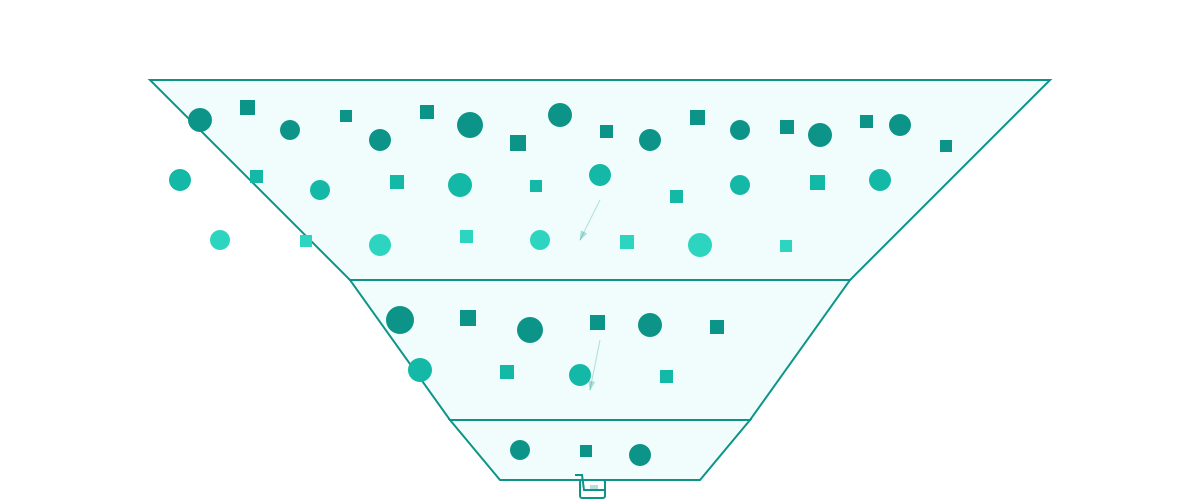
What Is the Buyer Intent Funnel?
The buyer intent funnel is a framework that maps the stages a potential customer moves through from recognising a need to completing a purchase. It describes how search behaviour changes as a shopper progresses from generic curiosity to specific product evaluation to active buying intent.
The framework matters for SEO because search queries at each stage have fundamentally different characteristics. A query like "how to choose trail running shoes" signals early-stage research. A query like "Brooks Cascadia 17 vs Hoka Speedgoat 5" signals active comparison. A query like "buy Brooks Cascadia 17 Australia free shipping" signals purchase readiness. Each requires a different type of content on a different type of page to rank and convert.
E-commerce brands that only invest in product and category page optimisation capture shoppers at the decision stage but miss the earlier stages where brand familiarity and trust are built. Brands that invest across all three stages benefit from compounding SEO returns: early-stage content captures future buyers, nurtures them through the evaluation process, and eventually converts them on pages specifically built for purchase intent.
The Three Stages Explained
The funnel is commonly divided into three stages: awareness (top of funnel, TOFU), consideration (middle of funnel, MOFU), and decision (bottom of funnel, BOFU). In e-commerce contexts these stages have distinct search patterns, content requirements, and conversion expectations.
Awareness (TOFU)
At the awareness stage, the shopper has a need or problem but has not yet settled on a category of solution. They are searching to understand, not to buy. Content at this stage should educate: explain concepts, answer common questions, and introduce the shopper to the problem space without aggressively pushing products. Blog posts, guides, and explainer pages serve this stage. They attract high search volumes but low immediate conversion rates.
The value of TOFU content is brand association. A shopper who reads your guide on choosing trail running shoes before they buy is more likely to return to your store when they are ready to purchase. Without TOFU content, your brand is invisible until the shopper reaches the decision stage, at which point they are evaluating multiple options including those that have already built familiarity through earlier-stage content.
Consideration (MOFU)
At the consideration stage, the shopper knows what category they want and is evaluating specific options. Comparison pages ("Brooks vs Hoka"), buyer's guides, and product review roundups serve this stage. These pages have lower search volume than TOFU content but much higher commercial value: the shopper clicking on a comparison page is much closer to purchase than one reading an educational explainer.
MOFU content is where semantic search plays a critical role. Google's systems have become highly accurate at distinguishing "what is" queries (TOFU) from "which is better" queries (MOFU). A page written to serve genuine product comparison intent will rank better for MOFU queries than a product page with a comparison section added as an afterthought.
Decision (BOFU)
Decision-stage queries are transactional. The shopper has chosen their product and is looking for the best place to buy it. Product detail pages, category pages, and local landing pages serve this stage. These pages should minimise friction on the path to purchase: clear pricing, availability, shipping information, and trust signals (reviews, return policy) are the priority.
BOFU content has the lowest search volume of the three stages but the highest conversion rate. A visitor landing on a product page from a "buy [product] Australia" query is often one click away from a transaction. The SEO investment in BOFU pages pays off in direct revenue attribution.
Search Query Signals by Stage
Identifying the intent stage of a keyword is the first step in building a content strategy. The fastest method is to look at the modifier words in a query. Certain words reliably signal specific stages of the funnel.
Location-based queries ("near me", "in Melbourne") are almost always transactional regardless of category. They indicate the shopper wants to buy locally or from a local provider. These queries map to city landing pages and Google Business Profile optimisation rather than product pages.
Comparative modifiers ("vs", "comparison", "alternatives") nearly always indicate commercial intent. These are among the highest-value keyword targets for e-commerce because they intercept shoppers at peak evaluation activity.
Content Mapping for E-commerce
Content mapping is the process of assigning specific content types to specific keyword clusters based on their intent stage. The output is a content plan where every page serves a defined purpose in the funnel rather than being created opportunistically.
A common mistake is to create product pages for informational queries. Google's systems identify the dominant intent of a search and prefer the content type that matches. If the dominant intent for "trail running shoes for beginners" is informational (a buying guide or explainer), a product category page will rarely outrank a well-written guide, regardless of how well-optimised the product page is. The correct approach is to create a guide that serves the informational intent and link from that guide to the relevant category page.
Internal linking between funnel stages is critical. TOFU content should link to MOFU comparison pages. MOFU comparison pages should link to BOFU product and category pages. This linking structure mirrors the natural shopper journey and passes link equity down the funnel to the pages that convert.
How AI Search Engines Read Intent
Modern AI search systems, including Google's AI Overviews and Perplexity, are sophisticated at identifying query intent. When a shopper asks "what are the best trail running shoes for marathon training", the AI system identifies this as a consideration-stage query and retrieves content from comparison and review pages rather than individual product pages.
This has direct implications for which pages AI systems cite. A blog post or guide that directly addresses a TOFU or MOFU query with substantive, factual content has a higher probability of being cited in an AI-generated answer than a product page with marketing copy. The LLMO Prompt Tester tests how your content performs when processed by AI systems, revealing whether your pages are likely to be cited for their target queries.
AI Overviews tend to consolidate answers from authoritative sources. For e-commerce brands, this means investing in genuinely useful TOFU and MOFU content builds AI citability that eventually drives awareness for the brand and its BOFU product pages, even for queries where the product pages themselves would not be the primary AI citation.
How the Buyer Intent Funnel Affects E-commerce SEO
Most e-commerce SEO programmes over-index on BOFU. Product and category pages receive the most optimisation effort because they are closest to revenue. The result is a content library with weak TOFU and MOFU coverage that leaves the top of the funnel open for competitors and content publishers to capture future buyers.
A full-funnel content strategy produces compounding returns. Each TOFU piece builds brand awareness and distributes link equity to MOFU and BOFU pages. Each MOFU piece captures shoppers at peak evaluation and directs them to BOFU product pages. BOFU pages convert visitors into buyers. Gaps at any stage break the chain and force the brand to compete from a disadvantaged position at the decision stage.
The E-commerce SEO service includes a full intent audit: every keyword cluster in your target market is mapped to a funnel stage, matched to an existing or planned page, and prioritised for creation or optimisation. Gaps in your current content library are identified and addressed as part of the SEO strategy. For checking how individual pages serve their target intent, the Product Page SEO Checker and Category Page SEO Checker audit pages against intent alignment and structural requirements.
Frequently Asked Questions
What is TOFU MOFU BOFU in SEO?
TOFU (top of funnel), MOFU (middle of funnel), and BOFU (bottom of funnel) are shorthand labels for the three stages of the buyer intent funnel. In SEO, they are used to categorise keywords and content by the searcher's stage: informational queries are TOFU, commercial comparison queries are MOFU, and transactional purchase-ready queries are BOFU. Each stage requires a different content type and page optimisation strategy.
How do I know which stage a keyword belongs to?
Check the modifier words in the query: "what is", "how to", and "guide" signal informational intent. "Best", "vs", and "review" signal commercial intent. "Buy", "price", "discount", and "near me" signal transactional intent. A reliable secondary check is to review the top 10 search results for the keyword: if the dominant page type is blog posts and guides, it is informational. If it is comparison or review pages, it is commercial. If it is product and category pages, it is transactional.
Do I need content at every funnel stage?
Yes, for a complete SEO strategy. Missing TOFU content means competitors and content publishers capture your future buyers before they reach your product pages. Missing MOFU content means shoppers who are actively comparing options do not encounter your brand during evaluation. BOFU-only investment produces revenue from existing demand but does not create new demand or build the brand awareness that compounds over time.
Can a single page serve multiple funnel stages?
Occasionally, but it is more common for single pages to serve a dominant intent. A detailed buyer's guide can serve both awareness and consideration stages. A well-structured category page can serve consideration and decision stages. Trying to make a single page serve all three stages usually results in content that serves none of them well, because the depth required for informational content conflicts with the transactional clarity required at the decision stage.
How does the buyer intent funnel relate to AI search?
AI search engines are intent-aware by design. When a user asks an AI assistant about product categories or comparisons, the AI retrieves content from pages that match the informational or commercial intent of the query, typically guides, reviews, and comparison content rather than product pages. E-commerce brands with strong TOFU and MOFU content are more likely to be cited in AI-generated answers, building brand visibility at early funnel stages even before a user reaches a traditional search results page.
What types of pages convert best at each funnel stage?
TOFU pages (blog posts, guides) convert best into email subscribers or return visitors rather than immediate purchases. MOFU pages (comparison guides, review roundups) convert best into category page visits and product page sessions. BOFU pages (product detail pages, category pages with strong filters and clear purchase CTAs) convert best into actual transactions. Tracking micro-conversions at each stage (newsletter signups, return sessions, add-to-cart events) gives a more complete picture of funnel performance than tracking purchases alone.

Tharindu Gunawardana
Founder and Director of SearchMinistry
Tharindu Gunawardana is the Founder of SearchMinistry Media and a search strategist with 17 years of experience across Sri Lanka, Singapore, and Australia. A former Agency SEO Director, he specialises in helping brands transition from traditional SEO to AI-driven discovery.