Technical SEO Audit
Crawl errors, indexation failures, and page speed problems silently destroy rankings. A technical SEO audit identifies every issue and the order to fix them.
SearchMinistry Media's technical SEO audit analyses your site's crawlability, indexation status, redirect architecture, Core Web Vitals, structured data implementation, and canonical tag configuration. We use Google Search Console data, Googlebot log file analysis, and live crawl tools to diagnose root causes, not surface symptoms. Every finding is prioritised by ranking impact so your development team works on what matters first.
Request Your Technical Audit
Crawl errors, indexation issues and speed problems identified and prioritised.
Request Your Technical Audit
Crawl errors, indexation issues and speed problems identified and prioritised.
Proprietary Tools Beyond Google Search Console
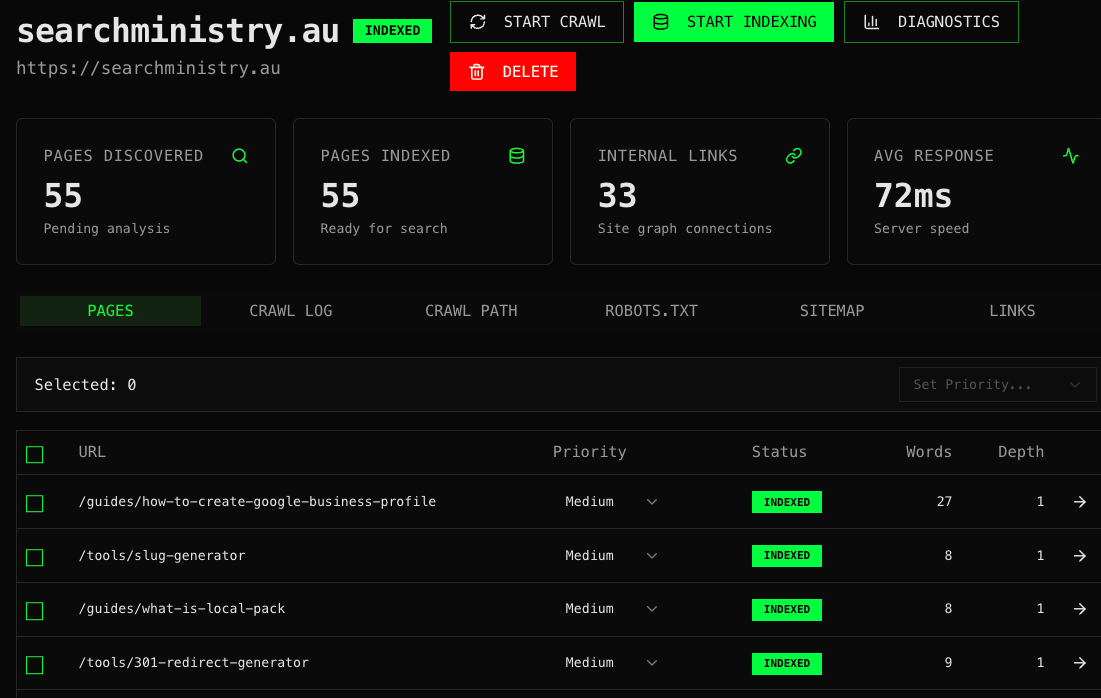
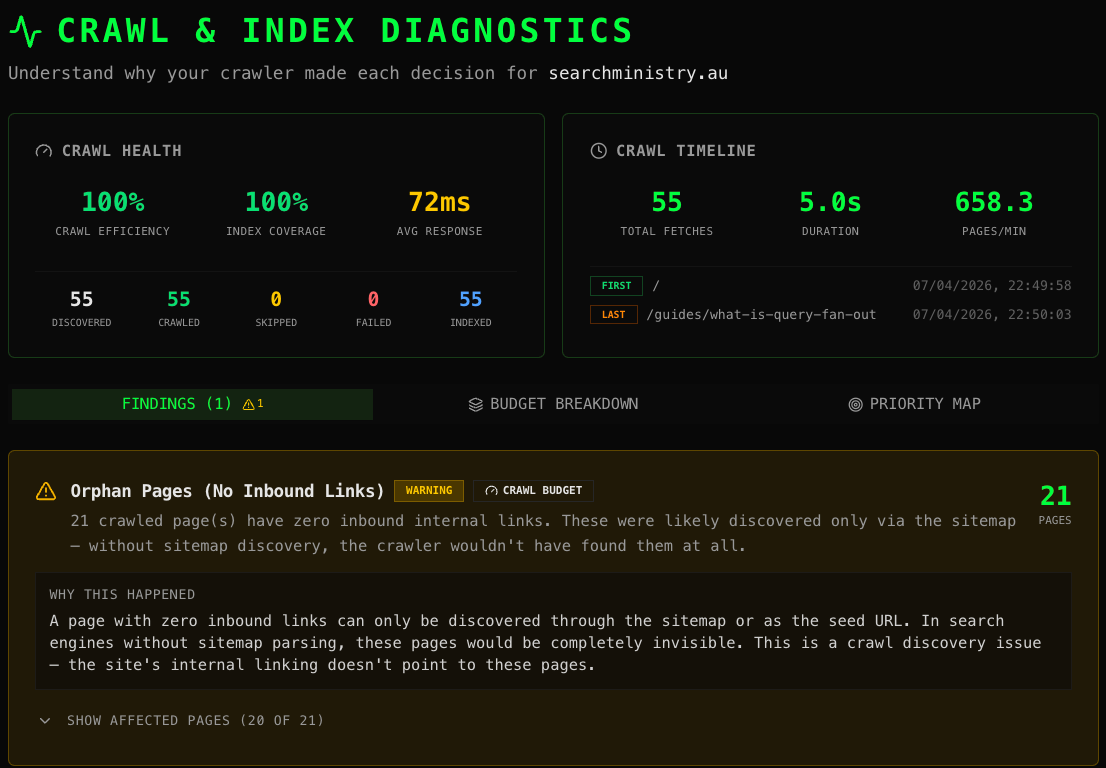
Google Search Console shows you what Google has already decided. Our audit goes further, using proprietary crawl and indexation tools that analyse your site's technical health in real time, before Googlebot forms its conclusions.
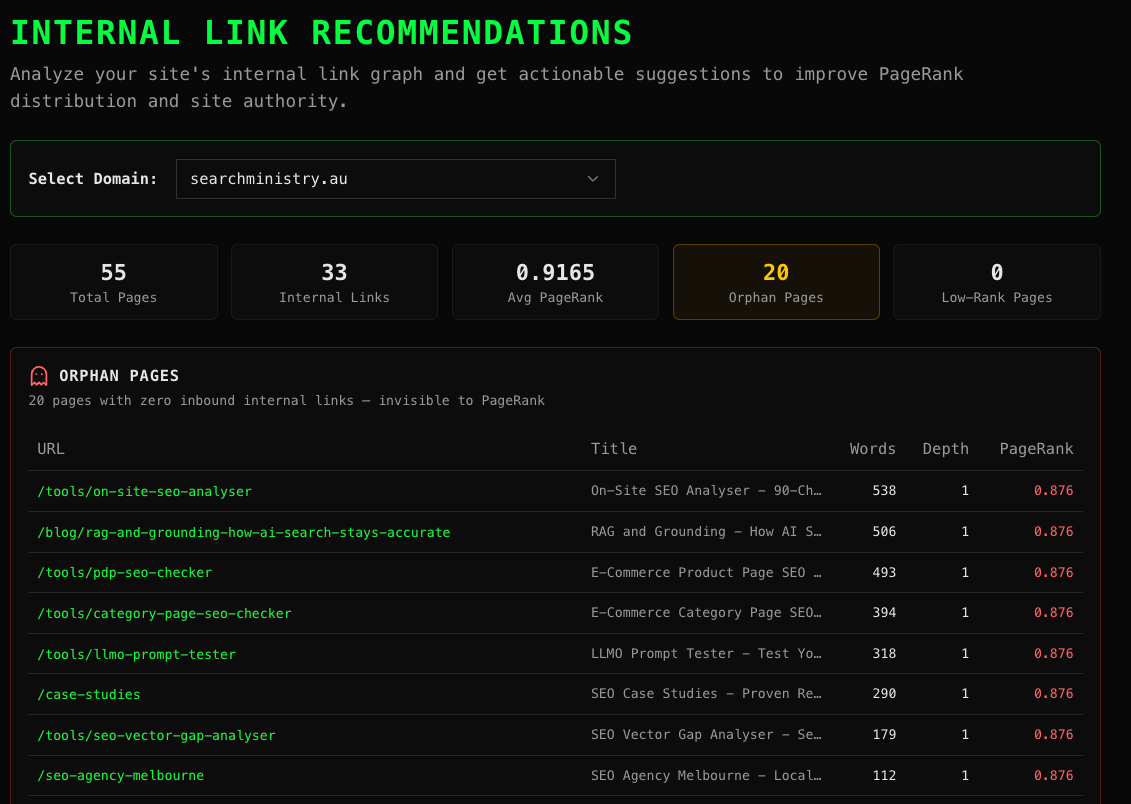
The dashboards below are from our own crawl stack. We track every URL discovered, every internal link connection, crawl efficiency, average server response time, and orphaned pages that only exist in your sitemap. Issues like zero-inbound-link pages and crawl budget waste appear in our reports days before they surface in GSC's coverage report.
Internal Link Optimisation Analysis
Our internal link optimisation goes well beyond the standard "find orphan pages and link to them" playbook. We start by generating a vector embedding for every page on your site, then use a similarity index (exact cosine for smaller sites, HNSW approximate nearest-neighbour search for large ones) to find pages that are genuinely topically related, not just structurally close.
We layer in harmonic centrality alongside PageRank to identify donor pages that are both authoritative and well-positioned in your site graph to actually distribute that authority. Each candidate link is then scored on a blended signal: rank flow, topical similarity, and query intent match from GSC, so we are not just moving PageRank around but moving it to pages that have a real chance of ranking.
Once a donor-target pair wins, we use passage-level placement to find the specific paragraph on the donor page where the link belongs contextually, and we generate entity-aware anchor text by intersecting the entities present on both pages with the queries your target page is already striking-distance for. The output is not a generic "link these two URLs" list. It is a precise instruction: which page, which paragraph, which anchor, and why it will move the needle.
How Crawl Errors Block Organic Rankings
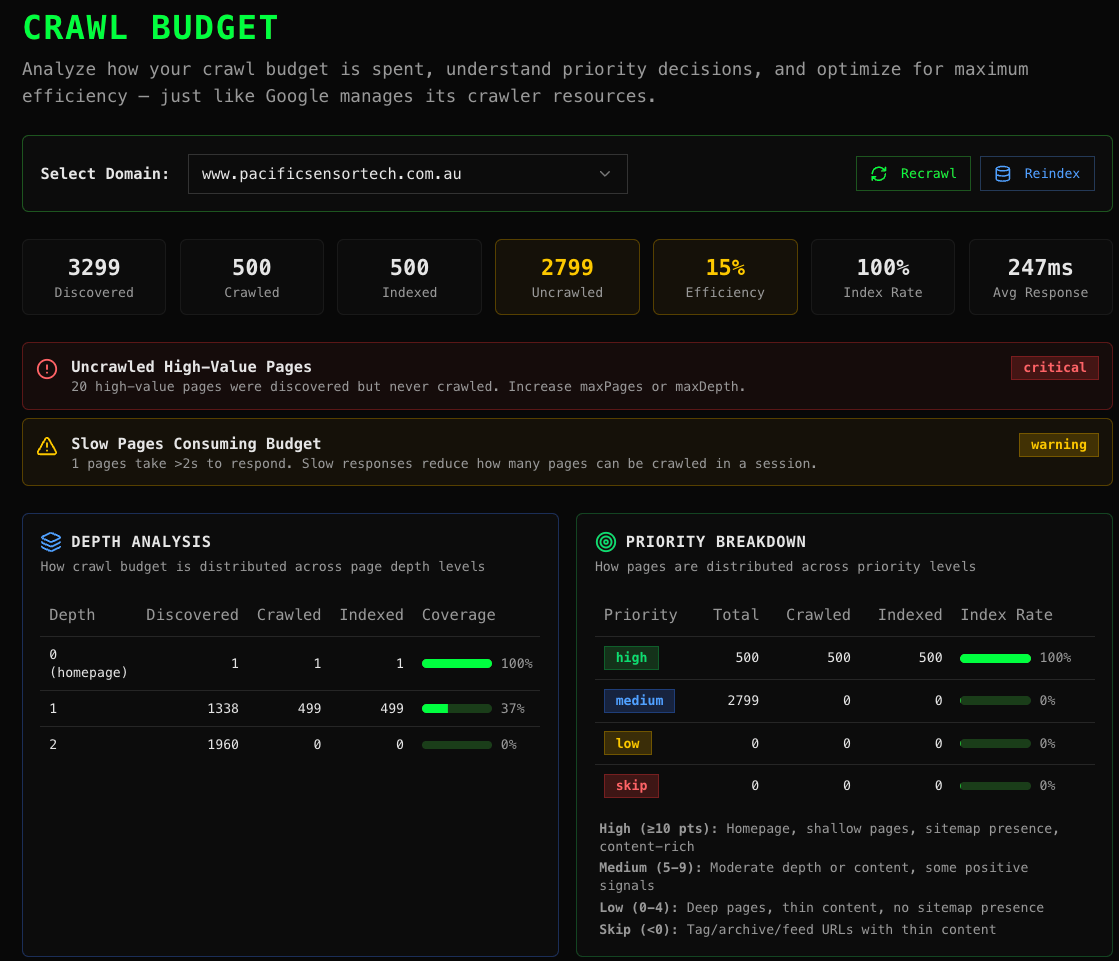
Googlebot allocates a crawl budget to every site based on its authority and server response speed. When crawl budget is consumed by redirect chains, soft 404 responses, duplicate URLs, or blocked JavaScript resources, Googlebot never reaches your highest-priority pages. The technical SEO audit maps exactly where crawl budget is being wasted and redirects it toward pages with genuine ranking potential.
Canonical tag errors create a separate class of problem. When a product page, category page, or blog post has conflicting canonical signals, Google must choose which version to index. It frequently chooses the wrong one. Ranking signals accumulated by the correct page are then attributed to a non-canonical variant, and the intended page ranks poorly or not at all.
40%
Crawl budget waste
Average waste from duplicate content and redirect chains on unaudited sites
53%
Bounce on slow load
Users leave if a page takes more than 3 seconds to load on mobile
24h
Deindex risk
A misconfigured robots.txt can remove a site from Google's index within 24 hours
What the Technical Audit Covers
Core Web Vitals became a confirmed Google ranking signal in 2021, and the addition of Interaction to Next Paint (INP) in 2024 expanded the scope of performance factors assessed. The technical audit evaluates LCP, INP, and CLS across your most important page types using real Chrome User Experience Report (CrUX) field data, not laboratory simulations.
Crawlability
- Full site crawl with redirect chain mapping
- Robots.txt and sitemap validation
- Googlebot log file analysis
- Crawl depth and internal link architecture
Indexation
- Google Search Console index coverage audit
- Canonical tag conflict identification
- Noindex tag audit across all template types
- Duplicate content URL mapping
Core Web Vitals
- LCP, INP, CLS measurement using CrUX field data
- Image optimisation and lazy-load configuration
- Third-party script performance impact
- Server response time (TTFB) analysis
Structured Data
- Schema markup validation against Rich Results Test
- Missing and incorrect property identification
- JSON-LD vs microdata consistency audit
- Dynamic availability value verification
What You Receive
Prioritised Fix List
Every technical issue ranked by ranking impact: critical fixes first, optimisations second. Includes severity rating and estimated effort for each item.
Technical Specification Document
Developer-ready specifications for each fix, including code examples, expected HTTP responses, and acceptance criteria.
Strategy Session
A 60-minute walkthrough of the audit findings with your team, covering the highest-impact fixes and a 90-day implementation roadmap.
Frequently Asked Questions
Start With a Free Instant Audit
Run our On-Site SEO Analyser for a 90-check automated technical audit with no signup required, or request a full manual technical audit below.