The world of search is undergoing a seismic shift. Gone are the days of simple keyword matching. Today, AI and Large Language Models (LLMs) are at the helm, driving a more semantic, contextual, and nuanced understanding of both user queries and web content.
Recent glimpses from Google litigation documents and patents (like US12158907B1 – "THEMATIC SEARCH") have pulled back the curtain, revealing a fascinating array of new technical terms and concepts.
This post explains the most commonly used technical jargon in AI search. Whether you're an SEO professional, a digital marketer, or simply a tech enthusiast, understanding these terms is crucial for navigating the future of search. We'll break down key jargon, organise it by how the search process works, and discuss what it means for you.
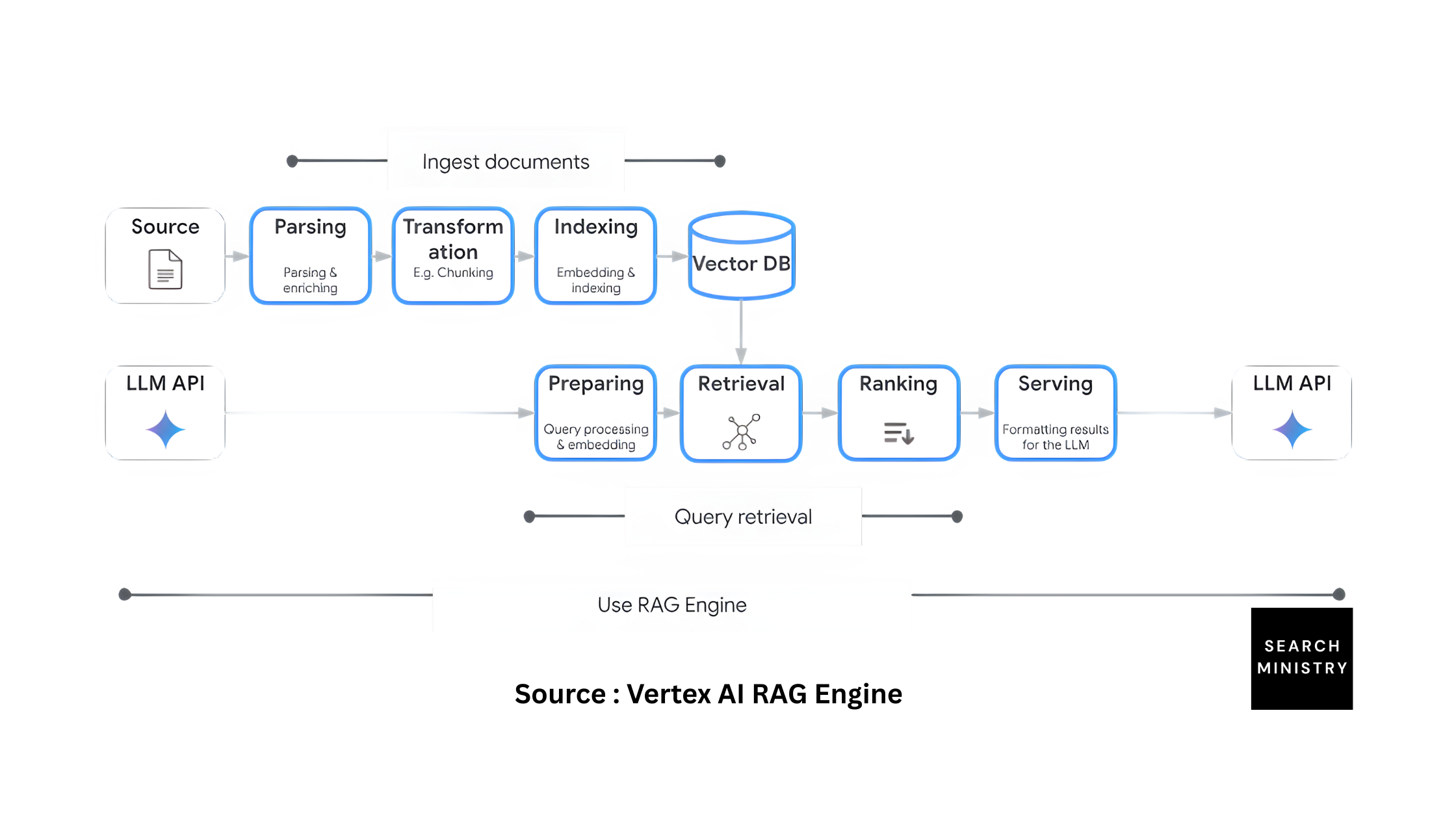
You may have seen illustrations of how search works previously. The following image illustrates the key concepts for understanding how AI search works (this is an illustration of Vertex AI RAG Engine).
Phase 1: Understanding You – The User's Query
The journey begins the moment a user types into the search bar. Modern AI search engines go far beyond just "reading" words.
Natural Language Processing (NLP)
What is NLP?
The foundational AI field enabling computers to understand, interpret, and generate human language.
In Search: NLP parses your query, identifies its grammatical structure, and forms the basis for deeper understanding.
Query Understanding / Query Interpretation
What: The AI's process of figuring out what you mean, not just what you typed.
Google's Lens: The litigation documents highlight that LLMs are improving "query interpretation."
Intent Recognition
Identifying your underlying goal. Are you looking for information (informational), a specific website (navigational), or to buy something (transactional)? This dictates the type of results the AI prioritises.
Entities
What: Real-world objects or concepts (people, places, products, brands) recognised within your query.
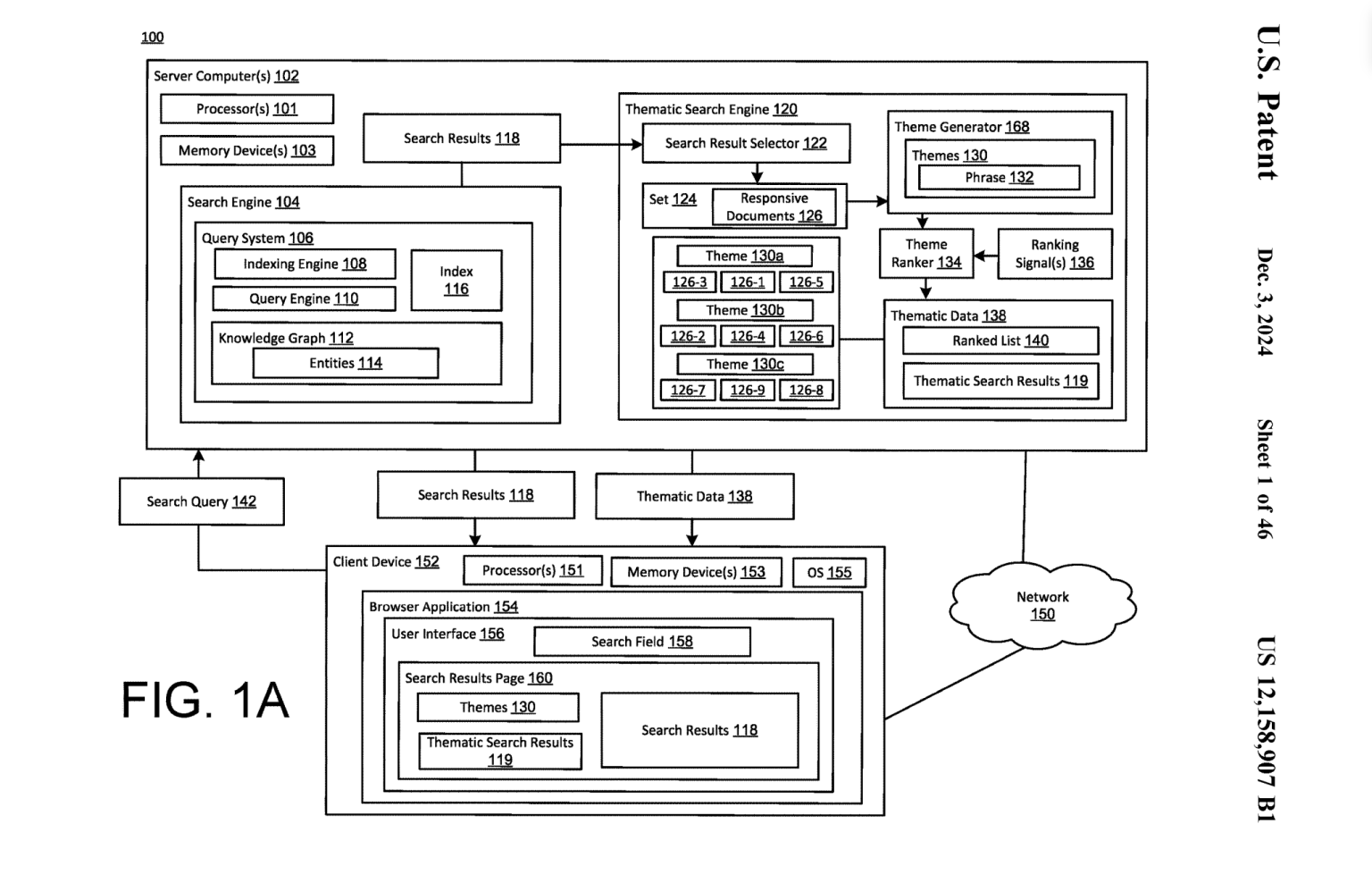
Google's Lens: Patent US12158907B1 shows "Entities 114" as part of its Search Engine, tying into its massive Knowledge Graph.
Query Expansion / Rewriting / Decomposition
What: The AI intelligently modifies your query, adding synonyms, related concepts, or breaking it into sub-questions, to retrieve more comprehensive results. This is where "thesaurus-like" knowledge (though vastly more advanced and AI-driven than a traditional thesaurus) comes into play.
Google's Lens: The litigation document mentions a "query expansion and decomposition process" visible in internal debugging tools. This is where "query fan-out" (generating multiple query variations to send to the index) happens.
Vectors & Embeddings (Query Embeddings)
What is a Vector?
A vector is a list of numbers (e.g., [0.12, -0.98, 0.34, …]) that captures the semantic meaning of your words/content. These vectors live in a high-dimensional space (~384 to 1536+ dimensions), where similar meanings are closer together, even if the words used differ.
Embeddings: Your query is transformed into a dense numerical list called a vector. This vector represents the query's meaning in a multi-dimensional "embedding space." Queries with similar meanings will have vectors that are close together in this space. To see this in practice with your own content, the free SEO Vector Gap Analyser uses real sentence embeddings and UMAP visualisation to identify semantic gaps between your pages and target topics.
Google's Lens: "RankEmbed is a dual encoder model that embeds both query and document into embedding space."
Phase 2: Preparing the Universe of Information – Document Indexing
Before you even search, AI systems are working tirelessly to understand and organise the web's content.
Corpus (Also Known as Index)
What: The entire collection of documents (webpages, PDFs, articles, etc.) that the search engine has access to.
Document
What: A single unit within the corpus. Google's Lens: Defined in the litigation docs as "Google's name for a webpage" or the version Google keeps in its database.
Passages / Chunking
What: Large documents are often broken down ("chunked") into smaller, semantically coherent "passages."
Why it Matters: This helps AI models (especially LLMs with context window limits) process content more effectively and allows for more granular retrieval, finding the exact relevant piece of information.
Google's Lens: Patent US12158907B1 describes extracting "Passages 145" for theme generation.
Embeddings (Document/Chunk/Passage Embeddings)
Just like queries, documents or their chunks/passages are converted into semantic vectors.
Index / Indexing Engine
A massive, highly organised database storing information about documents (including their text, metadata, and vector embeddings) for quick lookup. Patent US12158907B1 diagrams the "Index 116" and "Indexing Engine 108."
Vector Database / Vector Index
What: A specialised database optimised for storing and rapidly searching through billions of vector embeddings to find the most similar ones to a query vector.
Why it Matters: This is the backbone of modern semantic search.
Phase 3: Finding the Needles – Retrieval
This is where your (now understood and vectorised) query meets the (now indexed and vectorised) content.
Retrieval
The process of fetching the most relevant documents/chunks from the index based on the query.
Grounding
Grounding refers to ensuring that an AI model's output is based on real, accurate, verifiable information, not just generated from the model's training data or "imagination."
Here's the issue:
Large Language Models (LLMs) like ChatGPT or Gemini are trained on massive amounts of data, but they can sometimes hallucinate, meaning they produce plausible-sounding answers that are factually incorrect. To combat this, modern AI search systems (including Google's AI Overviews) are designed to ground their answers in trusted data sources.
Example:
- You ask AI search: "What is the latest interest rate from the Reserve Bank of Australia?"
- Without grounding: The AI might generate an outdated or incorrect answer based on old training data.
- With grounding: The AI retrieves the current rate from an authoritative source (RBA website) and builds its response based on that live data.
Okapi BM25
A classic (and still relevant) keyword-based ranking function. It's a form of "sparse retrieval." The litigation document notes that Google's "traditional approach to ranking was in the style of Okapi BM25."
Dense Retrieval
What: Retrieval based on the semantic similarity of dense vector embeddings (contrasting with sparse, keyword-based methods).
Why it Matters: This allows search engines to find relevant content even if it doesn't use the exact keywords from the query.
Vector Search / Similarity Search
The core of dense retrieval. It involves calculating the "distance" or "similarity" (e.g., using Dot Product or Cosine Similarity) between the query vector and document vectors. The litigation document states for RankEmbed: "Retrieval and ranking are then a dot product."
Nearest Neighbor Search (NNS) / Approximate Nearest Neighbor (ANN)
Algorithms that efficiently find the "closest" (most similar) document vectors to the query vector in the high-dimensional embedding space. ANN is used for speed in large systems.
Dual Encoder / Bi-Encoder
An AI architecture where the query and document are independently converted into embeddings. Google's Lens: "RankEmbed is a dual encoder model…"
Hybrid Search
Combines the strengths of keyword-based search (for precision with specific terms) and semantic search (for understanding broader meaning).
Phase 4: The Beauty Contest – Ranking & Re-ranking
Once a set of potentially relevant documents is retrieved, they need to be ordered.
Signals (Raw Signals, Top-Level Signals, Ranking Signals)
Hundreds of features and characteristics used to score and rank documents. The litigation doc mentions "over 100 raw signals" and that "Top-level signals are a linear combination of log of individual raw signals."
Key Google Signals Mentioned
- PageRank: Original link-based authority signal, still a factor in quality signals.
- Navboost: Based on user click frequency for a query-document pair (uses 13 months of data, segmented by location/device).
- Q* (Q star): "Google's measure of quality of a document." Likely incorporates factors beyond just links, focusing on reliability, trustworthiness, and content substance.
- RankBrain: An early ML system for novel/ambiguous queries.
- DeepRank: A BERT-based deep learning ranking model.
- RankEmbed: A primary LLM-trained signal for semantic matching. It's "extremely fast; high quality on common queries but can perform poorly for tail queries" and was trained on a "single month of search data."
Twiddlers
Systems that "re-rank a set of already selected results." This points to a multi-stage ranking process, allowing more computationally intensive scoring on a smaller, promising set of initial results.
Re-ranking / Re-ranker (Cross-Encoders)
A more refined ranking stage. Cross-encoders look at the query and a document together for a more nuanced relevance score.
Learning to Rank (LTR)
Using ML to learn the optimal way to combine various signals into a ranking score.
Phase 5: Beyond Links – Thematic Presentation & Generative AI
The future of search isn't just a list of blue links.
Large Language Models (LLMs)
Models like Gemini, GPT-4, etc., are revolutionising how search results are understood, summarised, and even how answers are generated.
Google's Lens: The litigation doc states, "Google is currently re-thinking their search stack from the ground-up with LLM taking a more prominent role." Patent US12158907B1 explicitly features a "Language Model 128."
Summary Descriptions
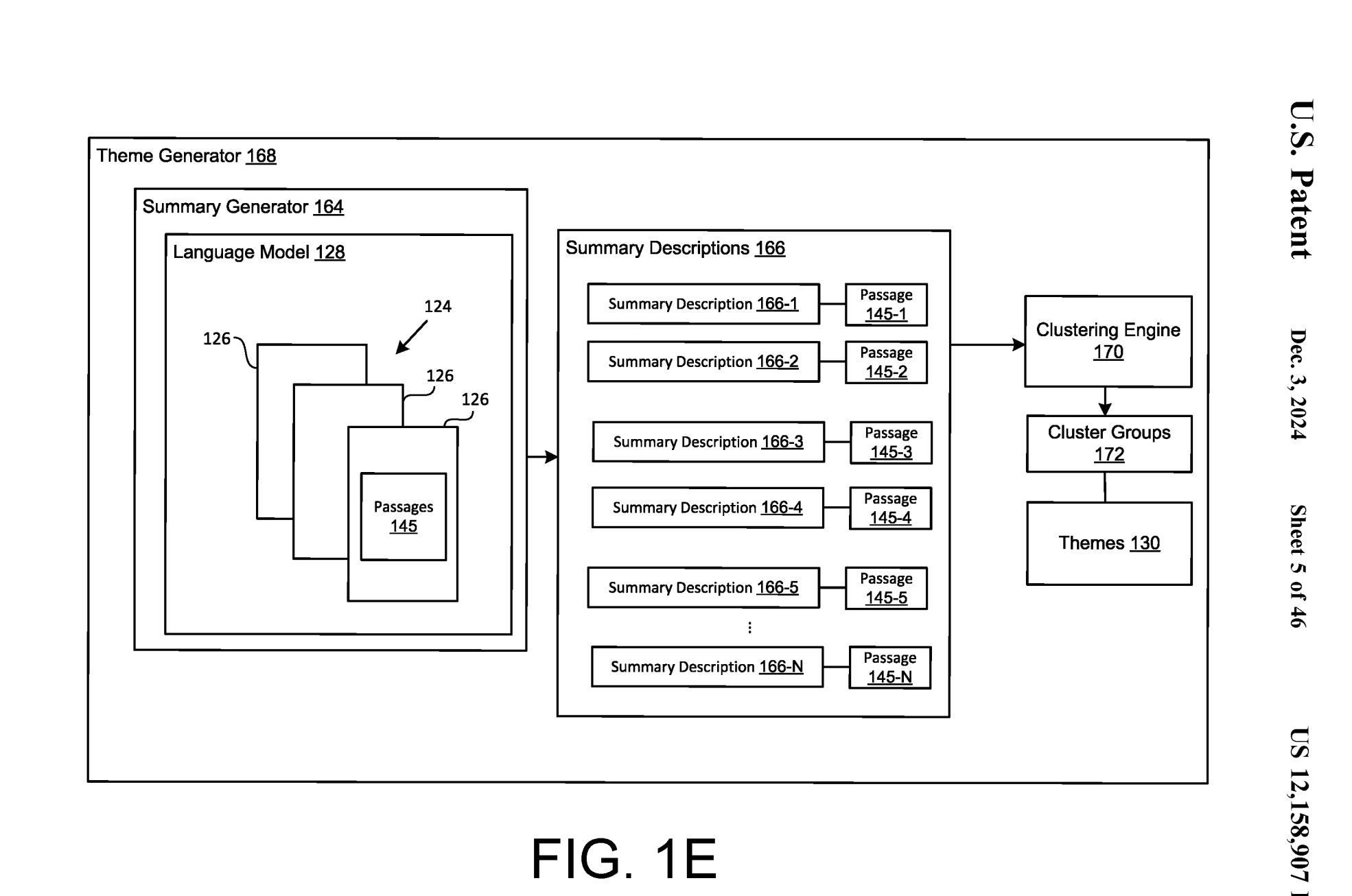
AI-generated summaries of documents or passages. Patent US12158907B1's "Summary Generator 164" creates these.
Clustering Engine / Cluster Groups / Themes
Systems that group search results or document summaries into coherent topics or "themes," often described by a representative phrase.
Google's Lens: Patent US12158907B1 ("THEMATIC SEARCH") details this, with a "Clustering Engine 170" creating "Cluster Groups 172" (Themes 130) to help users navigate results.
Theme Ranker
Ranks these generated themes based on signals like query relevance, authority, and popularity of underlying documents. Detailed in patent US12158907B1.
Retrieval Augmented Generation (RAG)
Key Concept
A powerful technique where an LLM generates an answer grounded in information retrieved from trusted documents. This makes LLM outputs more factual and less prone to "hallucination."
Google's Lens: The litigation document mentions "Google uses FastSearch as a RAG… mechanism on Vertex AI… and the Gemini app."
Context Window
The amount of text (tokens) an LLM can consider as input at one time. Crucial for RAG, as retrieved context must fit.
Hallucination
When LLMs generate incorrect or nonsensical information. RAG helps mitigate this.
What Does This All Mean for You?
Understanding this jargon isn't just academic; it has real-world implications:
- Semantic SEO is King: Optimising for keywords alone is no longer enough. You need to build content around topics, entities, and relationships that search engines can understand semantically.
- Content Quality Over Quantity: With AI evaluating content meaning deeply, thin or low-quality content will struggle. Focus on creating authoritative, comprehensive, and genuinely helpful content.
- Structured Data Matters More: Help search engines understand your content by using schema markup and clear content structure.
- User Experience Signals are Crucial: Navboost shows that Google tracks how users interact with results. Great content that people engage with will rank better.
- Prepare for Generative Search: As AI Overviews and thematic search become more prominent, ensure your content can be the source that AI models cite and ground their answers in.
Bottom Line: The shift to AI-driven search is not a threat. It's an opportunity. By understanding how these systems work and adapting your digital strategy, you position yourself not just to survive the transition, but to thrive in it.
Need help navigating AI SEO? Explore our AI SEO service or get in touch for a consultation.

Tharindu Gunawardana
Founder & Director, SearchMinistry Media
Tharindu Gunawardana is the Founder of SearchMinistry Media and a search strategist with 17 years of experience across Sri Lanka, Singapore, and Australia. A former Agency SEO Director, he specialises in helping brands transition from traditional SEO to AI-driven discovery. He is the creator of proprietary tools including Brandonomy.ai and SEOMigrator.io, focused on measuring and improving brand visibility within generative AI systems.