Content and Semantic SEO Audit
Google and AI systems rank pages with clear entity relationships and genuine topical depth. A content and semantic audit identifies where your content fails to meet that standard.
SearchMinistry Media's content and semantic audit maps every related entity, attribute, and value missing from your content using proprietary semantic analysis tools. We score semantic content gaps by opportunity size, identify topics to prioritise, and apply a Jobs-to-Be-Done framework to uncover the functional and emotional jobs your audience is trying to complete. Content that addresses real user outcomes, not just keyword targets, earns stronger rankings and more AI citations.
Request Your Content Audit
Entity coverage, topical authority gaps and AI citation readiness assessed.
Request Your Content Audit
Entity coverage, topical authority gaps and AI citation readiness assessed.
Entity, Attribute and Value Analysis
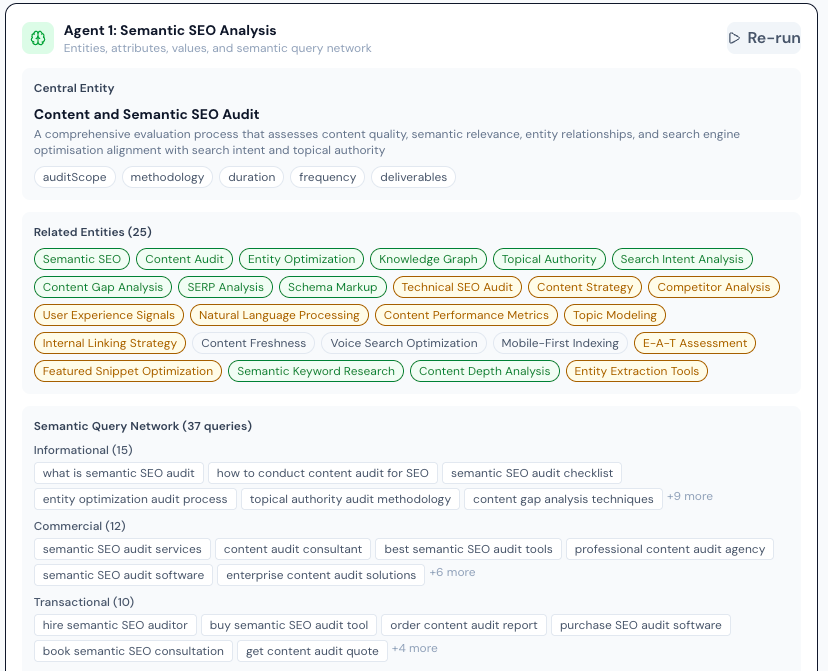
We use proprietary semantic analysis tools to map every related entity, attribute, and value connected to your topic. The tool builds a semantic query network across informational, commercial, and transactional query types, revealing exactly which entities your content establishes, which it is missing entirely, and which competitors have already captured.
The output ranks content gaps by opportunity size, scoring each missing entity against query volume, commercial intent, and the competitive density of pages currently ranking in the top five. You receive a prioritised content plan, not a list of observations.
- Related entities mapped per topic across your content
- Semantic queries mapped across informational, commercial and transactional intent
- Entity gap identification versus current ranking pages
- Content priority recommendations by opportunity size
Jobs-to-Be-Done Framework Analysis
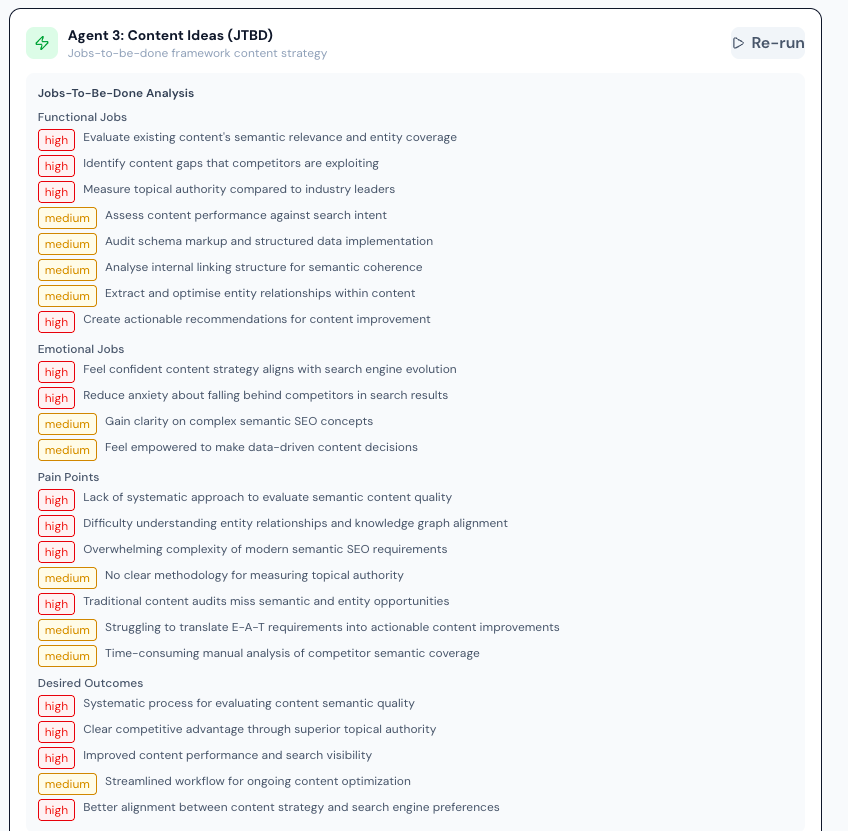
Semantic signals tell search engines what a page is about. Jobs-to-Be-Done analysis tells you why a real person would read it. We apply the JTBD framework to your target audience to uncover the functional jobs they are trying to complete, the emotional outcomes they need to feel, and the pain points that make them switch from one content source to another.
Content that addresses genuine functional and emotional jobs, not just keyword targets, produces lower bounce rates, higher time-on-page, and stronger E-E-A-T signals. The audit scores each page for audience job alignment and ranks rewrites by estimated ranking and engagement impact.
- Functional and emotional job mapping per content cluster
- Pain point identification by priority level
- Desired outcomes mapped to content restructuring opportunities
- Complements semantic analysis for complete content strategy
Why Thin Content and Entity Gaps Suppress Rankings
Google's Helpful Content system evaluates whether a page demonstrates genuine expertise about its subject matter. Pages that describe a topic without naming the relevant entities, citing authoritative sources, or explaining cause-and-effect relationships rank below pages that do, regardless of word count. A 3,000-word page built on vague language and generic observations signals thin content just as clearly as a 200-word stub.
For AI systems including Google AI Overviews and ChatGPT Search, the threshold is even higher. Retrieval-augmented generation systems chunk content at heading boundaries and embed each chunk independently. A page that repeats the same keyword across every H2 produces embedding vectors that are too similar to retrieve independently, effectively reducing the number of queries the page can answer. The content and semantic audit detects these retrieval failures before they suppress AI citation opportunities and organic rankings.
60%
Information gain gap
Average Australian SME site with manufacturer or templated descriptions has no original information gain
2.3x
Ranking improvement
Average position improvement after a targeted entity rewrite programme on striking-distance pages
34%
AI citation uplift
Increase in AI-generated answer citations after content restructured with semantic triple methodology
How the Semantic Audit Evaluates Your Content
The audit applies the same analytical lens used in SearchMinistry's content creation process: entity extraction, semantic triple density measurement, topical authority gap analysis, and search intent alignment scoring across every audited page.
Entity Coverage Mapping
- Primary entity identification per page
- Related entity gap analysis against ranking pages
- Authority source citation audit
- Entity chain consistency across sections
Topical Authority Assessment
- Topic cluster completeness mapping
- Competing page entity comparison
- Missing subtopic identification
- Internal link architecture for topical signalling
Content Quality Scoring
- Thin content identification (E-E-A-T signals)
- Duplicate and near-duplicate content detection
- Search intent alignment per page type
- Information gain scoring vs top 5 ranking pages
AI Retrieval Readiness
- Semantic chunking quality at H2 boundaries
- Answer-first formatting compliance
- FAQ schema and structured data presence
- LLM citation probability scoring per section
AI Citation Readiness Score
Traditional SEO optimises for ranking. AI search optimises for retrieval. Google AI Overviews, Perplexity, and ChatGPT Search do not rank pages and present a list. They retrieve specific passages from documents using up to 12 distinct methods, then generate a synthesised answer with inline citations. A page can sit at position 1 in Google Search and still never appear in an AI-generated answer if its content lacks the entity clarity, structured data, and semantic density these retrieval systems require.
The AI Citation Readiness Score measures your content against the 12 LLM retrieval methods identified in our research into how AI search pipelines work: vector similarity, Matryoshka embeddings, late interaction (ColBERT), BM25 and SPLADE sparse retrieval, hybrid fusion (RRF), cross-encoder reranking, HNSW graph connectivity, harmonic centrality, knowledge graph traversal, contextual compression, semantic chunking, and hypothetical document embeddings (HyDE). Each method can independently surface or exclude your content regardless of your traditional ranking position.
We use the same scoring framework as our LLMO Prompt Tester, which evaluates content against five categories: content authority, structural clarity, information density, unique value, and query alignment. During the audit, every page in scope receives a per-section score against these signals. Pages with the largest gap between their traditional search ranking and their AI citation readiness score are prioritised for rewriting.
Semantic Chunking
Very HighOne H2 section per topic with clear headings so AI systems split your content at meaningful boundaries, not arbitrary character counts.
Contextual Compression
Very HighKey fact or direct answer in the first sentence of every section so retrieval systems extract the right passage, not surrounding filler.
Cross-Encoder Reranking
Very HighAnswer-first structure with no preamble so joint query-document scoring at the reranking stage places your passage above competitors.
Hybrid Fusion (RRF)
Very HighPresence in both sparse (BM25) and dense (vector) retrieval lists simultaneously. Pages appearing in both score higher than those ranking first in only one.
Knowledge Graph Traversal
HighSchema.org markup with sameAs links to authoritative profiles so AI systems can follow multi-hop entity relationships to verify and cite your content.
Harmonic Centrality
HighInternal link architecture that keeps key pages within 2-3 clicks of the homepage so AI crawlers reach and index content at crawl frequency.
BM25 / SPLADE
HighExact terminology your audience uses in headings and opening paragraphs, covering sparse retrieval without keyword stuffing that degrades dense signals.
Vector Similarity
HighFocused, single-topic sections that produce tight embedding vectors and score well on cosine similarity against a specific query type.
HyDE Alignment
MediumExpert-register, authoritative writing that matches the style of a hypothetical ideal answer the AI system generates to query against your content.
What You Receive
Content Priority Matrix
Every page scored by ranking potential and rewrite effort. Striking-distance pages (positions 4-15) with high search volume are ranked first.
Entity Gap Report
Topic-by-topic breakdown of entities your site covers versus entities the top-ranking pages establish. Includes recommended new content to fill gaps.
Rewrite Briefs
For the top 10 highest-priority pages: a detailed rewrite brief with primary entity, semantic triples to embed, authority sources to cite, and heading structure.
Frequently Asked Questions
Check Your Content Against AI Retrieval Standards
Run our free LLMO Prompt Tester to see how AI systems currently interpret your content, or request a full semantic audit below.