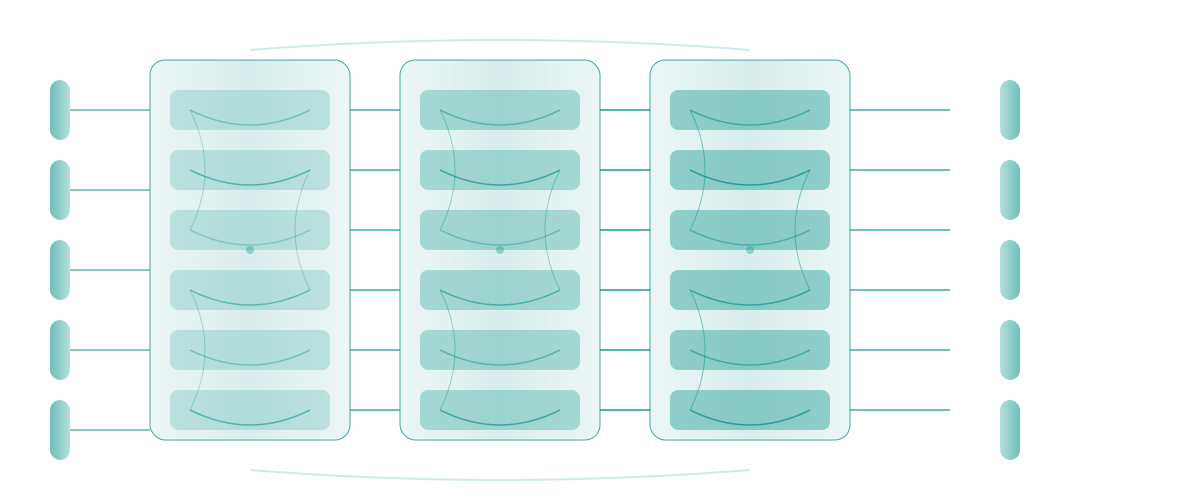
The Transformer architecture is arguably the most significant breakthrough in the history of Natural Language Processing (NLP). Since its introduction by Google researchers in the 2017 paper "Attention Is All You Need," it has become the standard engine powering everything from Google Search ranking to generative AI models like ChatGPT and Gemini.
What Is the Transformer Architecture?
A Transformer is a type of neural network architecture designed to process sequential data, such as text, by focusing on the relationships between all words in a sequence simultaneously.
Unlike previous models that read text from left to right, Transformers use a mechanism called self-attention to look at an entire sentence (or paragraph) at once. This allows them to understand context and nuance far better than earlier technologies, making them exceptionally good at understanding the "intent" behind search queries and the "meaning" of web content.
Key takeaway
Transformers allow computers to understand language contextually. Instead of looking at words in isolation, they look at how every word in a sentence relates to every other word, enabling deep semantic understanding.
Why Transformers Replaced RNNs
Before Transformers, the industry standard for NLP was Recurrent Neural Networks (RNNs) and Long Short-Term Memory (LSTM) networks. While revolutionary at the time, they had two major flaws:
- Sequential Processing: RNNs had to process words one by one. This made them slow and difficult to train on massive datasets.
- Vanishing Gradients: RNNs struggled to remember information from the beginning of a long sentence by the time they reached the end.
Transformers solved both problems. By using attention, they can process all words in parallel, making them incredibly fast to train. Furthermore, because every word is connected to every other word via the attention mechanism, there is no "forgetting" over long distances.
How Transformers Work
The architecture of a Transformer is built around "blocks" that perform specific mathematical operations to extract meaning from text.
The Self-Attention Mechanism
Self-attention is the "secret sauce" of the Transformer. It allows the model to assign different levels of importance (weights) to different words in a sentence when processing a specific word.
In the sentence "The animal didn't cross the street because it was too tired," the word "it" refers to the animal. In the sentence "The animal didn't cross the street because it was too wide," "it" refers to the street.
A Transformer uses self-attention to correctly identify these relationships by looking at the context words. This is exactly how Google's BERT model understands that a search for "2019 brazil traveler to usa need a visa" is about a Brazilian travelling to the US, not the other way around.
Encoder vs. Decoder Models
The original Transformer architecture consisted of an Encoder (which understands input) and a Decoder (which generates output). Over time, models have specialised into one of these two paths.
| Model Type | Primary Function | Famous Examples |
|---|---|---|
| Encoder-Only | Understanding and classifying text | BERT, RoBERTa |
| Decoder-Only | Generating new text (Autoregressive) | GPT-4, Claude, Llama |
| Encoder-Decoder | Translating or summarising text | T5, BART |
Transformers in Search Ranking
Google integrated Transformers into its core ranking algorithm in late 2019 with the introduction of BERT. This was described as "one of the biggest leaps forward in the history of Search."
Before BERT, Google largely relied on matching keywords and identifying entities. With Transformers, Google can now:
1. Understand Prepositions and Nuance
Words like "to," "for," and "from" used to be ignored. Transformers allow Google to understand how these small words change the entire meaning of a query.
2. Better Long-Tail Matching
For conversational or complex queries, Transformers help Google find the most relevant paragraph within a massive document, even if the exact keywords aren't present.
3. Power AI Overviews
Google's AI Overviews (formerly SGE) use multi-modal Transformer models (Gemini) to read web content, synthesise it, and generate a summary for the user.
Impact on SEO Strategy
The rise of Transformer-based search means that old-school SEO tactics like keyword frequency are essentially obsolete. Here is how to adjust your strategy:
Example: How Transformers Handle Ambiguous vs Specific Content
Ambiguous (transformer cannot resolve)
"The model processed it and the results were better. It then applied this to the output and it improved significantly."
Pronouns "it" and "this" have no clear antecedents. The transformer's contextual vector is diffuse, producing low relevance scores against most queries.
Specific (transformer resolves correctly)
"The BERT encoder processed the query and the cosine similarity score improved from 0.61 to 0.89. BERT then applied cross-attention across all tokens and retrieval precision increased by 14%."
Named entities and explicit subjects throughout. The transformer produces a precise contextual vector, scoring high for "BERT", "cross-attention", and "retrieval precision" queries.
Focus on Specificity and Clarity
Because Transformers look at context, ambiguous content performs poorly. Ensure your sentences are clear and your pronouns (like "it," "they," "this") have clear antecedents that the model can resolve.
Answer Questions Directly
Transformer models are trained on tasks like Question Answering (QA). Formatting your content to clearly state a question followed by a concise, accurate answer makes it much easier for BERT-like models to rank your content highly for featured snippets.
Optimise for Semantic Relevance
Don't just use synonyms; use related concepts. If you're writing about "Transformer Architecture," you should naturally mention "self-attention," "neural networks," "BERT," and "training data." Transformers expect these concepts to appear together in high-quality content.
Frequently Asked Questions
Is BERT a Transformer?
Yes, BERT stands for Bidirectional Encoder Representations from Transformers. It is an "encoder-only" transformer model, meaning it is designed to understand text rather than generate it.
What is the difference between BERT and GPT?
The main difference is their objective. BERT is an encoder that reads text bidirectionally (left to right and right to left) to understand context. GPT is a decoder that reads text unidirectionally (left to right) to predict the next word in a sequence. BERT is better for search and classification, while GPT is better for content generation.
How do Transformers affect SEO?
Transformers allow search engines to understand the semantic meaning of content rather than just matching keywords. This means that high-quality, contextually relevant, and well-structured content is more important than ever, while keyword stuffing has become ineffective.
What is self-attention in simple terms?
Self-attention is a way for a computer model to look at every word in a sentence and decide which other words are most important for understanding its meaning. It allows the model to link pronouns to the correct nouns and understand how adjectives modify specific subjects.
Are Transformers still used in 2026?
Absolutely. While there have been many refinements (like FlashAttention and Linear Transformers), the core Transformer architecture remains the foundation for almost all state-of-the-art AI models, including GPT-5, Gemini 2.0, and modern search ranking systems.
Master AI-Driven Search
Understanding the architecture of search is the first step. The next is implementing an AI SEO strategy that aligns with how these models actually process your content.

Tharindu Gunawardana
Founder and Director of SearchMinistry
Tharindu Gunawardana is the Founder of SearchMinistry Media and a search strategist with 17 years of experience across Sri Lanka, Singapore, and Australia. A former Agency SEO Director, he specialises in helping brands transition from traditional SEO to AI-driven discovery.