What Is Semantic Chunking?
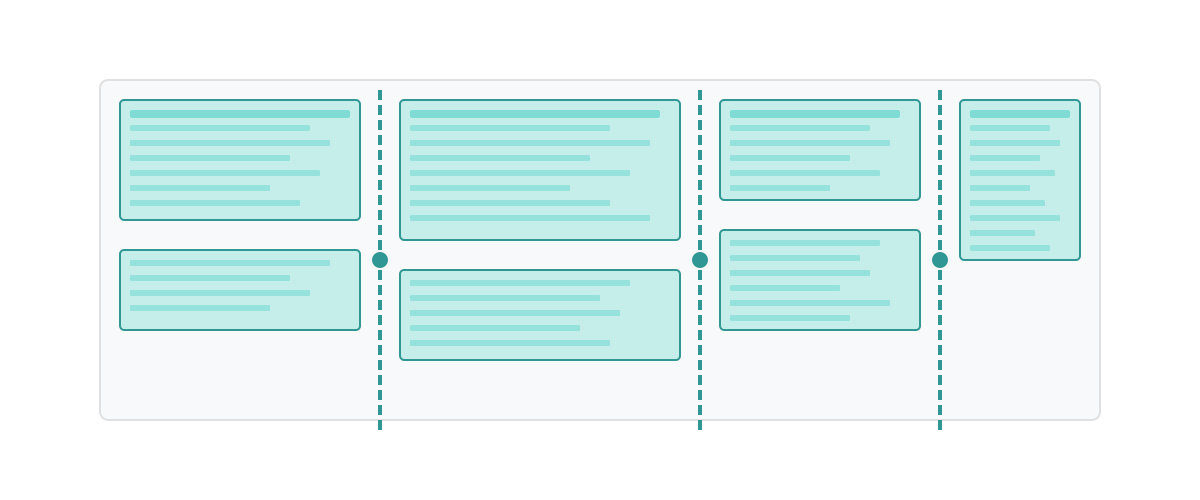
Semantic chunking is a document preprocessing technique that splits text into chunks at natural topic boundaries rather than at fixed character or token counts. The goal is to ensure each chunk covers a single coherent topic so its vector embedding is focused and precisely retrievable for relevant queries.
In a RAG pipeline, documents are split into chunks, embedded, and stored in a vector index. When a query arrives, the system retrieves the chunks with the highest embedding similarity to the query. If chunks contain mixed topics, their embeddings represent an average of multiple concepts, reducing the precision of retrieval for any single topic.
Semantic chunking detects topic shifts by computing the cosine similarity between consecutive sentence embeddings. A sharp similarity drop indicates a topic transition: the previous sentence belongs to one topic, and the next belongs to another. The chunk boundary is placed at this transition point. Chunks are therefore variable in length, reflecting the natural length of each topic in the document.
How Semantic Chunking Affects AI Retrieval Accuracy
AI search systems that use RAG pipelines to ground their answers rely on the quality of document chunks in their indexes. For content creators, the structure of your content directly affects how it is chunked by these systems, and therefore how precisely it is retrieved and cited.
Example: Bad Chunk vs Good Chunk for the Same Content
Source article covering semantic chunking and HNSW graphs, split two different ways
Fixed-size split (poor chunks)
"...splits content at topic boundaries. HNSW graphs are a data structure used for approximate nearest neighbour search. The graph has multiple layers, with the top layer containing the fewest nodes..."
Cut mid-topic. One chunk mixes semantic chunking and HNSW. Embedding is diffuse. Retrieved weakly for queries about either topic individually.
Semantic split (focused chunks)
Chunk A: "Semantic chunking splits documents at topic boundaries by measuring cosine similarity between adjacent sentences. A sudden drop in similarity signals a topic change."
Chunk B: "HNSW graphs are a data structure for approximate nearest neighbour search, using a layered graph with fewer nodes at higher layers to navigate quickly to candidates."
Each chunk covers one topic cleanly. High cosine similarity to relevant queries. Retrieved accurately and cited independently.
- Write one topic per section: Dedicated H2 and H3 sections for each distinct topic create natural topic boundaries. AI indexing systems will split your content at these boundaries, producing focused chunks aligned with specific queries.
- Avoid topic-blending paragraphs: Paragraphs that introduce a new concept, then immediately jump to a related but distinct concept, produce low-similarity sentence pairs that confuse semantic chunkers. Each paragraph should develop one idea from introduction to conclusion.
- Put the key fact first: In a chunk that begins with the answer to a question, the embedding of that chunk will be most similar to queries phrased as questions seeking that answer. This increases retrieval probability for query-answer aligned content.
- Long-form content should use clear section structure: A 3,000-word article with good heading structure and single-topic sections will be chunked into 8-12 focused, high-quality chunks. The same length of prose without structure will be split arbitrarily by fixed-size chunkers, producing poor-quality embeddings.
- Chunking is a key component of our AI SEO strategy: We analyse how content will be chunked and embedded before publishing, and restructure it to maximise retrieval precision.
Why Chunking Strategy Matters
Fixed-size chunking is the simplest approach: split every 512 tokens regardless of content. The problem is that 512-token boundaries rarely fall at topic transitions. A chunk may begin mid-sentence, containing the end of one topic and the start of another. The resulting embedding is an average over both topics and is a precise match for neither.
This matters for retrieval quality. If a user queries about topic B, but the chunk containing topic B also contains topic A, the chunk's embedding will be pulled toward the mid-point between both topics' vector representations. The chunk may rank lower than a dedicated topic B chunk would, and may not retrieve at all if topic A is semantically distant from topic B.
The practical effect is that fixed-size chunking forces a choice between two bad options: smaller chunks (fewer mixed-topic problems, but loss of surrounding context) or larger chunks (more context, but worse embedding precision). Semantic chunking avoids this dilemma by sizing chunks according to topic length rather than token count.
Topic Boundary Detection
The standard algorithm for semantic boundary detection uses sentence-level embeddings. Each sentence is embedded independently using a sentence transformer model. Then the cosine similarity between each consecutive sentence pair is computed. A similarity score above 0.7-0.8 indicates that the two sentences are likely part of the same topic. A score below 0.5 indicates a probable topic shift.
A threshold value controls sensitivity. A lower threshold (0.4) produces fewer splits, resulting in larger, potentially mixed-topic chunks. A higher threshold (0.7) produces more splits, resulting in smaller, more focused chunks. The optimal threshold depends on the document type: technical documentation with abrupt topic shifts needs a lower threshold; narrative text with gradual transitions needs a higher one.
A sliding window variant averages the embeddings of a small window of sentences rather than comparing single consecutive sentences. This smooths out noisy individual sentence comparisons and produces more stable boundary detections. The LangChain SemanticChunker implements this approach with configurable window size and threshold.
More sophisticated approaches use topic modelling (LDA or neural topic models) to identify topic segments, or use discourse markers ("In conclusion", "Moving on to") as explicit boundary signals combined with embedding similarity.
Chunk Size Trade-offs
Even with semantic chunking, chunk size affects retrieval quality. Very small chunks (one to two sentences) have precise embeddings but may lack enough context for the language model to generate a useful answer. Very large chunks have rich context but may span multiple sub-topics, diluting the embedding.
A practical approach is to add minimum and maximum size constraints to semantic chunking. If a detected topic segment is smaller than 64 tokens, it is merged with the adjacent chunk. If a segment exceeds 800 tokens, it is split using a secondary strategy (sentence-level recursive splitting) regardless of embedding similarity.
Chunk overlap adds a configurable number of sentences from the previous chunk to the start of the next. This preserves context that spans a boundary: if a key term is defined in the final sentence of chunk 1 and used in the opening sentence of chunk 2, the definition will appear in chunk 2's context through overlap. Typical overlap is 10-20% of chunk size.
Implementations and Tools
The most accessible implementation is LangChain's SemanticChunker, which takes an embedding model and a breakpoint threshold type (percentile, standard deviation, or fixed threshold) and splits text accordingly. It requires an embeddings object compatible with the LangChain interface (OpenAI embeddings, HuggingFace, Bedrock, etc.).
LlamaIndex provides similar functionality through its SemanticSplitterNodeParser. The underlying algorithm is the same: embed sentences, compute consecutive cosine similarities, split at significant drops.
For production systems, semantic chunking is typically applied during an offline document ingestion pipeline, not at query time. The chunked and embedded documents are stored in a vector database such as Pinecone, Qdrant, or Weaviate with the chunk text as a metadata field alongside the embedding vector.
Semantic chunking is complementary to contextual compression: chunking ensures each retrieved chunk is likely to be topically coherent, and compression further filters within the chunk to extract only the query-relevant sentences.
Frequently Asked Questions
Is semantic chunking always better than fixed-size chunking?
For documents with clear topic structure — articles, documentation, guides — semantic chunking consistently outperforms fixed-size chunking for retrieval precision. For documents with continuous prose without clear topic transitions (narrative fiction, legal contracts), semantic chunking may produce erratic splits and fixed-size chunking with overlap may be more reliable. The best approach depends on the document type.
How does semantic chunking affect indexing time?
Semantic chunking requires embedding every sentence in the document during the splitting phase, in addition to embedding the final chunks for the retrieval index. This approximately doubles the embedding computation during indexing compared to fixed-size chunking, which only embeds the final chunks. For large corpora, this overhead is manageable but worth accounting for in indexing pipeline design.
What embedding model should I use for semantic chunking?
The embedding model used for boundary detection should ideally match the model used for the retrieval index, so that similarity scores reflect the same semantic space. However, any capable sentence transformer (all-MiniLM-L6-v2, BGE-small, or similar) works for boundary detection. Using a lightweight model for chunking and a more capable model for the retrieval index is a reasonable cost trade-off.
Does semantic chunking work for non-English content?
Yes, provided the sentence embedding model supports the target language. Multilingual models such as paraphrase-multilingual-mpnet-base-v2 and LaBSE support semantic chunking in dozens of languages. For best results, use a model specifically fine-tuned on the target language rather than a general multilingual model.
How is semantic chunking different from sentence-level chunking?
Sentence-level chunking treats every sentence as an independent chunk. Semantic chunking groups consecutive sentences that discuss the same topic into a single chunk. Individual sentences are often too short to embed with enough context for precise retrieval. Semantic chunking produces variable-length chunks that capture complete ideas rather than isolated statements.

Tharindu Gunawardana
Founder and Director of SearchMinistry
Tharindu Gunawardana is the Founder of SearchMinistry Media and a search strategist with 17 years of experience across Sri Lanka, Singapore, and Australia. A former Agency SEO Director, he specialises in helping brands transition from traditional SEO to AI-driven discovery.