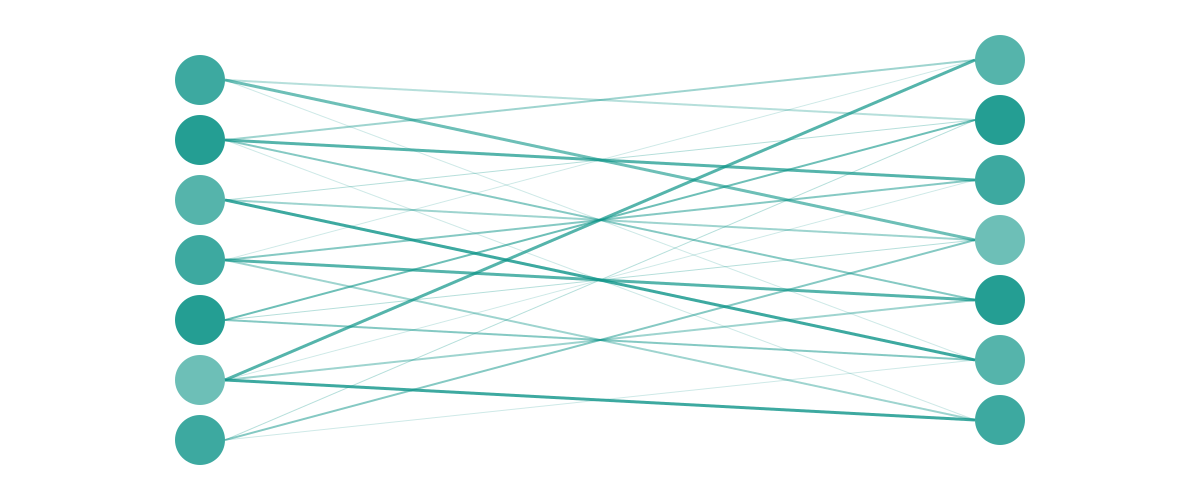
What Is Late Interaction?
Late interaction is a retrieval architecture that sits between bi-encoders and cross-encoders. A bi-encoder compresses each text into a single vector, then compares those vectors. A cross-encoder reads query and document together in a single forward pass, which is accurate but too slow for large-scale retrieval. Late interaction takes a middle path: query and document are encoded independently into token-level vectors, and the relevance score is computed by comparing every query token against every document token at retrieval time.
The most important implementation of late interaction is ColBERT, which stands for Contextualized Late Interaction over BERT. It was introduced by researchers at Stanford in 2020 and has since become a reference architecture for high-precision, scalable retrieval. ColBERT v2 refined the original with more compact token representations and improved training, and the PLAID retrieval algorithm made it practical at billion-document scale.
How Late Interaction ColBERT Affects Content Retrieval
AI search systems increasingly use retrieval pipelines that go beyond simple bi-encoder search. Understanding late interaction matters for content strategy because it changes how document token coverage affects retrieval.
Example: MaxSim Token Matching in Practice
Query: "how does attention work in transformer models?"
Shallow mention (low ColBERT score)
"Transformer models use attention. Attention is a key mechanism. Attention helps the model focus on relevant parts of the input."
"attention" appears repeatedly but with minimal variation. Query tokens for "transformer", "work", "models" match weakly. Overall MaxSim score is low.
Deep coverage (high ColBERT score)
"Self-attention computes a score between every token pair in the sequence. The softmax-weighted sum of value vectors lets the encoder represent each word in relation to every other word in the input."
Diverse token coverage. Query tokens "attention", "transformer", "work", and "models" each find high-similarity matches in different parts of the passage. MaxSim score is high.
- Token coverage matters: ColBERT scores documents by summing per-token similarities. A document that contains the concepts from a query spread across multiple sections will score higher than a document that mentions them briefly in one sentence.
- Semantic variation helps: Because ColBERT uses contextualised token vectors, using synonyms and related phrases helps individual query tokens find high-similarity matches in the document, even without exact keyword overlap.
- Depth of coverage is rewarded: A thorough document with multiple angles on a topic produces more diverse, high-value token vectors than a shallow document. This aligns with AI SEO strategy focused on comprehensive entity coverage.
- Chunking affects token vector quality: If a document is split into chunks before indexing, semantic chunking at topic boundaries ensures each chunk's token vectors form a coherent semantic space.
How ColBERT Works
ColBERT processes a query and a document through the same BERT-based encoder, but keeps the output at the token level rather than pooling into a single vector. For a query of 32 tokens, ColBERT produces 32 vectors. For a document of 180 tokens, it produces 180 vectors. Each vector is typically projected down to 128 dimensions to reduce index size.
At indexing time, every document in the corpus is encoded and its token vectors are stored in a compressed index. This means index size scales with the number of tokens in the corpus, not just the number of documents. A 10 million document corpus might store 1.5 billion token vectors, which requires careful engineering. The PLAID algorithm addresses this with centroid-based candidate pruning: clusters of token vectors are precomputed offline, and only the nearest cluster members are fully scored at query time.
At query time, the query is encoded into its token vectors and the MaxSim scoring function runs across the candidate document token vectors. This process is slower than a single cosine similarity call between two pooled vectors, but faster than a full cross-encoder pass, which would require a separate forward pass for every candidate document.
MaxSim Scoring Explained
MaxSim is the scoring function that defines late interaction. For each query token vector, ColBERT finds its maximum cosine similarity to any token vector in the document. The final relevance score is the sum of these per-token maximums across all query tokens.
Consider a query containing the token "ranking". If the document contains the word "ranking" in context, that query token will find a high-similarity match. If the document discusses the same concept using the phrase "ordering by relevance", the contextualised BERT representations may still find a high-similarity match because both token vectors reflect the same semantic space. This is the key advantage over BM25-style exact term matching.
Summing across query tokens means longer, more specific queries produce larger absolute scores, which is appropriate. A query with five specific technical tokens should score more confidently than a two-word general query. This aligns with BM25's term frequency behaviour while adding semantic richness.
Indexing and Retrieval Pipeline
The ColBERT pipeline is split into an offline indexing phase and an online retrieval phase. During indexing, each document is encoded into token vectors and stored in a compressed index. The RAGatouille library makes this process accessible in Python with minimal configuration. For very large corpora, FAISS-backed centroid indexing reduces memory requirements.
During retrieval, the process follows four steps. First, the query is encoded into token vectors. Second, the index retrieves candidate documents using approximate nearest neighbour search over token vector centroids. Third, MaxSim is applied to the full token vectors of the candidates. Fourth, the documents are ranked by their MaxSim scores and returned.
ColBERT is commonly used as a first-stage retriever (instead of BM25 or a bi-encoder) or as a re-ranker applied after an initial retrieval step. In the re-ranker role, it replaces or supplements a cross-encoder reranker, offering better throughput at a slight accuracy trade-off.
ColBERT vs Bi-Encoders vs Cross-Encoders
Each retrieval architecture occupies a distinct point on the speed-accuracy curve. Bi-encoders are fastest because query and document are encoded once and compared with a single dot product. Cross-encoders are most accurate because they process query and document jointly with full attention, but they require a forward pass per candidate at query time. ColBERT sits between them.
- Bi-encoder: 1 query vector, 1 document vector. Similarity = cosine or dot product. Fast but lossy: token-level detail is discarded at encoding time.
- Cross-encoder: Query and document concatenated, full attention over all tokens. Most accurate, but requires a forward pass for every candidate. Suitable as a reranker over a small candidate set (top 50-100).
- Late interaction (ColBERT): Token vectors stored offline. MaxSim computed at retrieval time. More accurate than bi-encoders, faster than cross-encoders. Index is larger than a bi-encoder index.
ColBERT is particularly effective in domains where exact phrasing varies but meaning is consistent: scientific literature, legal documents, and technical documentation. In these domains, bi-encoders lose too much precision in the single-vector bottleneck.
Frequently Asked Questions
Is ColBERT the same as a cross-encoder?
No. A cross-encoder processes query and document jointly in a single forward pass, which is more accurate but slower. ColBERT encodes query and document independently (like a bi-encoder) and computes interaction at retrieval time via MaxSim. This makes ColBERT much faster at inference than a cross-encoder at the cost of some accuracy.
Why is ColBERT's index larger than a bi-encoder index?
A bi-encoder index stores one vector per document. ColBERT stores one vector per token across all documents. A document with 200 tokens requires 200 vectors. This typically makes ColBERT indexes 10 to 20 times larger than bi-encoder indexes for the same corpus, which is the main practical trade-off.
What is PLAID and how does it help ColBERT?
PLAID (Performance-optimized Late Interaction Driver) is an efficient retrieval algorithm for ColBERT that precomputes centroid clusters of token vectors offline. At query time, it first identifies the nearest centroids, then only fully scores the documents whose tokens belong to those clusters. This reduces the number of MaxSim computations by orders of magnitude, making ColBERT practical at billion-scale corpora.
Can ColBERT be used for re-ranking instead of first-stage retrieval?
Yes. ColBERT is commonly deployed as a re-ranker applied to the top 100 or 200 candidates from a BM25 or bi-encoder first stage. In this role it provides accuracy close to a cross-encoder at much lower latency, because MaxSim only needs to run over the small candidate set.
Do search engines like Google use ColBERT?
Google has not disclosed the specific retrieval architectures used in production. However, the principles of late interaction align with documented investments in token-level representation and semantic matching. The academic ColBERT work was conducted at Stanford; similar techniques are actively researched at major search labs.

Tharindu Gunawardana
Founder and Director of SearchMinistry
Tharindu Gunawardana is the Founder of SearchMinistry Media and a search strategist with 17 years of experience across Sri Lanka, Singapore, and Australia. A former Agency SEO Director, he specialises in helping brands transition from traditional SEO to AI-driven discovery.