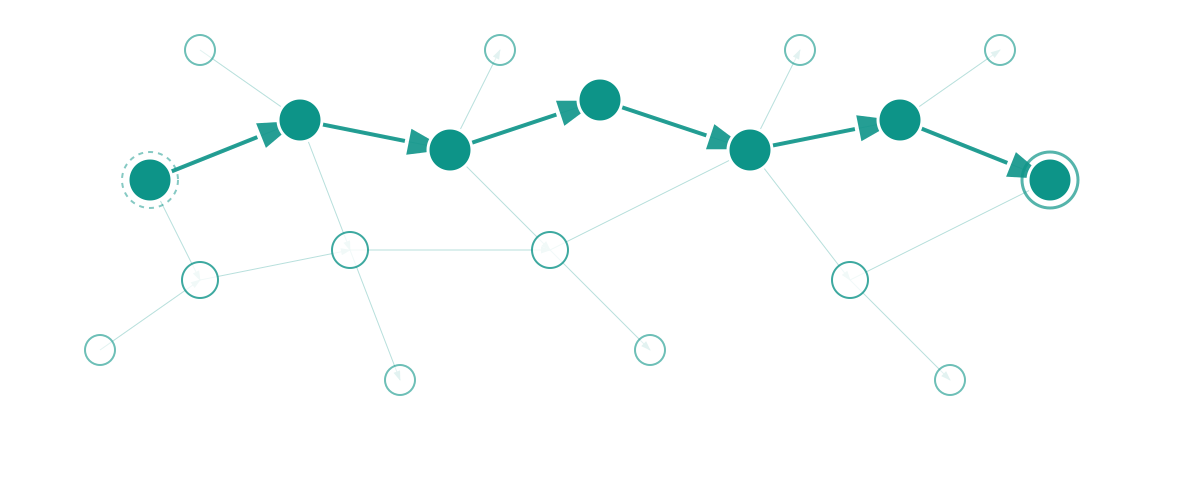
What Is Knowledge Graph Traversal?
Knowledge graph traversal is the process of navigating a structured network of entities and relations to answer a query or retrieve information. A knowledge graph stores facts as triples: subject entity, relation type, object entity. For example: (Albert Einstein, field_of_work, Physics). Traversal begins at a known entity and follows relation edges to reach other entities, accumulating facts along the path.
This is distinct from keyword search, which matches text patterns in documents. Traversal navigates structured fact relationships. The difference is the difference between searching for "Einstein" and asking "What institution did the person who developed the theory of relativity work at, and who led it at the time?"
Traversal is the core operation behind knowledge base question answering, graph-enhanced RAG (Retrieval Augmented Generation), and the factual grounding layer in AI Overviews. It is how systems move from recognising an entity in a query to retrieving connected facts about it from a structured knowledge store.
How Knowledge Graph Traversal Affects AI Search Visibility
Knowledge graph traversal is how AI search systems verify and extend factual claims about entities. For brands, organisations, and people, being represented accurately in structured knowledge sources is a prerequisite for appearing in traversal-based AI answers.
Example: Multi-Hop Traversal in an AI Answer
Query: "Who leads the SEO agency behind the SearchMinistry blog?"
"SearchMinistry blog" resolves to entity: SearchMinistry Media (Organisation)
Traverse "founder" relation from SearchMinistry Media → Tharindu Gunawardana (Person)
AI returns: "Tharindu Gunawardana is the founder of SearchMinistry Media, the agency behind the SearchMinistry blog."
This answer is only possible if both the organisation-to-founder relation and the blog-to-organisation relation exist as structured edges in the knowledge graph. Missing either edge stops traversal.
- Entity presence in the knowledge graph is non-negotiable: If an entity is not in the graph, traversal cannot start from it. Establishing entity presence through Wikipedia, Wikidata, schema.org structured data, and authoritative citations is the foundation of AI search visibility.
- Relation coverage matters more than description length: A page describing an organisation's founding date, location, industry, CEO, and products covers more traversal edges than a page with extensive prose about the same entity with no structured properties. Schema.org markup makes relation data machine-readable.
- Multi-hop visibility: Your entity may appear in AI answers not because someone searched directly for you, but because traversal reached you through a related entity. Being accurately connected to relevant entities (industry bodies, events, locations, people) expands your graph reachability.
- AI SEO strategy must address the structured data layer: Our AI SEO services include knowledge graph entity building and schema.org implementation to maximise traversal-based AI search visibility.
Entity Hops Explained
An entity hop is one step in graph traversal: moving from a source entity to a neighbouring entity via a relation edge. Each hop follows exactly one relation type. A one-hop query can be answered by reading a single fact directly connected to the query entity. A two-hop query requires traversing two edges, passing through an intermediate entity.
Hop count is a measure of query complexity. Most simple factual questions require one to two hops. Complex comparison or inference questions may require three or more. The number of candidate paths grows exponentially with hop count: at 3 hops, a node with 50 average neighbours could produce 50 * 50 * 50 = 125,000 candidate paths. Traversal algorithms must prune this search space efficiently.
AI systems use entity recognition (see Named Entity Recognition) to identify the anchor entity in a query, then begin traversal from that entity in the knowledge graph. If the anchor entity is not in the graph, or is incorrectly disambiguated, the traversal starts from the wrong point and returns incorrect facts.
Relation Paths and Multi-Hop Queries
A relation path is a sequence of relation types connecting two entities through one or more intermediate entities. The path describes the type of connection, not just that a connection exists. For the path (OpenAI, uses_search, Bing, made_by, Microsoft, co-founded_by, Bill Gates), the relation path is [uses_search, made_by, co-founded_by].
Relation paths matter because the same two entities may be connected by multiple paths of different lengths and relation types. The semantically appropriate path for a query depends on the question being asked. Neural traversal models are trained to identify the most relevant relation path given a query, rather than exploring all paths and filtering afterward.
In systems such as Google's Knowledge Graph, relation paths are encoded as schema.org properties. The relation worksFor connects Person to Organisation. foundingDate connects Organisation to Date. Knowing these relation types allows AI systems to construct traversal plans before executing them against the graph.
Traversal Algorithms
Breadth-first search (BFS) is the standard algorithm for knowledge graph traversal in question answering. It explores all entities reachable in one hop before exploring two-hop entities, ensuring the shortest-path answer is found first. BFS is used in SPARQL query execution and in graph databases like Neo4j.
Depth-first search (DFS) follows one path as deep as possible before backtracking. It is more memory efficient but may miss shorter paths. DFS is useful for reasoning chain generation, where the goal is to produce a coherent multi-step argument, not necessarily the shortest factual answer.
Learned traversal uses a neural model to predict which relation edges to follow at each step, rather than exploring all options. Models such as MINERVA and KGReasoning train a reinforcement learning agent to navigate a graph. Given the exponential search space of multi-hop paths, learned traversal is the most practical approach for large knowledge graphs with millions of entities.
Beam search is a practical middle ground: it maintains a fixed number (beam width) of the most promising partial paths at each hop and discards the rest. This trades completeness for tractability, and is the most common approach in production knowledge graph QA systems.
Traversal in AI Search Systems
Modern AI search systems combine vector retrieval with knowledge graph traversal. Vector retrieval identifies the most semantically relevant text chunks for a query. Knowledge graph traversal retrieves the specific facts that answer the query, providing structured, verifiable information rather than unstructured text passages.
Google's Search Generative Experience (SGE) and AI Overviews use the Knowledge Panel graph to ground responses about entities. When a user asks "Where did the CEO of [company] study?", the system traverses the graph from the company entity to the CEO relation to the person entity, then follows the education relation to retrieve the answer. This is faster and more precise than retrieving and summarising multiple text passages.
Knowledge-augmented RAG systems combine standard RAG retrieval with graph traversal. The retrieved text chunks provide contextual grounding, while the graph traversal provides precise factual verification. This combination reduces hallucination in AI-generated answers by anchoring claims to structured knowledge rather than statistical language patterns.
Contextual compression systems often use traversal to identify which retrieved passages are factually relevant to the query before passing them to the language model. See contextual compression for how this filtering step works.
Frequently Asked Questions
What is the difference between knowledge graph traversal and vector search?
Vector search finds semantically similar text based on the directional proximity of embedding vectors. Knowledge graph traversal follows explicit entity-relation edges to retrieve structured facts. Vector search is better for open-domain semantic retrieval; graph traversal is better for precise factual question answering over known entities. Modern AI search systems use both.
How many hops can AI systems traverse accurately?
Most production systems handle one to three hops reliably. Beyond three hops, the search space grows exponentially and error rates increase, since each hop introduces a small probability of following the wrong edge. Research systems using beam search or learned traversal can handle up to five or six hops on curated graphs, but accuracy degrades significantly.
Does Google use knowledge graph traversal in AI Overviews?
Google has not published the full technical architecture of AI Overviews. However, Google's Knowledge Graph has been central to search since 2012, and the company has published extensive research on knowledge graph question answering. It is highly likely that entity-based traversal contributes to factual grounding in AI Overview responses, particularly for queries about specific entities.
How does schema.org markup help with knowledge graph traversal?
Schema.org markup provides machine-readable entity properties and relations that search engines can extract and add to their knowledge graphs. Properties like foundingDate, employee, memberOf, and sameAs create explicit relation edges that traversal algorithms can follow. Without structured markup, AI systems must infer relations from unstructured text, which is less reliable.
What is a relation path in knowledge graph terminology?
A relation path is the sequence of relation types (not entity names) that connects two entities through intermediate nodes. For example, the path "person works_at organisation located_in city" describes a pattern: any person connected to any organisation connected to any city through those relation types matches this path. Relation paths are used to express query patterns in graph query languages like SPARQL.

Tharindu Gunawardana
Founder and Director of SearchMinistry
Tharindu Gunawardana is the Founder of SearchMinistry Media and a search strategist with 17 years of experience across Sri Lanka, Singapore, and Australia. A former Agency SEO Director, he specialises in helping brands transition from traditional SEO to AI-driven discovery.