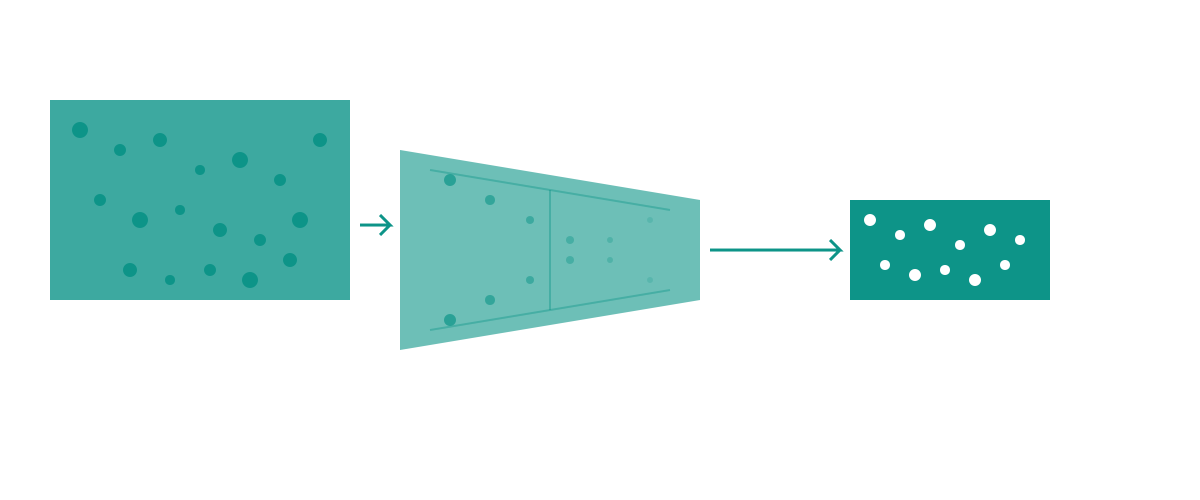
What Is Contextual Compression?
Contextual compression is a post-retrieval technique in Retrieval Augmented Generation (RAG) pipelines. After the retrieval step returns a set of document chunks, a compressor processes each chunk and produces a shortened, filtered version containing only the content relevant to the specific query. The compressed excerpts are then passed to the final language model for answer generation.
The term was formalised in the LangChain library with the ContextualCompressionRetriever, which wraps any base retriever and adds a compression step. However, the concept applies to any system where retrieved content is filtered or extracted before being placed into an LLM's context window.
The core problem contextual compression solves: retrieved chunks often contain a mix of relevant and irrelevant text. A 400-word chunk retrieved for the query "What is the capital of France?" might contain one relevant sentence about Paris and 399 words about French history. Passing the full chunk wastes tokens, increases cost, and can confuse the final LLM by burying the relevant sentence in noise.
How Contextual Compression Affects AI Citation Probability
Contextual compression is a key stage in the retrieval pipelines that power AI Overviews, Perplexity, and similar systems. Understanding it reveals why content structure affects AI citation probability more than content volume.
Example: What the Compressor Extracts and Discards
Query: "what is contextual compression in RAG?"
Full retrieved chunk (600 tokens)
"Contextual compression is a post-retrieval step that extracts only the sentences relevant to the query from a retrieved chunk. It reduces token usage and improves answer quality. [...four paragraphs about RAG architecture history, vector search infrastructure, and embedding model comparisons...] The LLM then receives a compressed context window containing only the relevant sentences."
Buried answer (discarded by compressor)
Four paragraphs of surrounding context. Compression filters them out as irrelevant to the query. Never reaches the LLM context window.
Extracted sentences (survive compression)
"Contextual compression is a post-retrieval step that extracts only the sentences relevant to the query from a retrieved chunk." The compressor surfaces this. The LLM cites it.
Place your key definitions and direct answers in the first two sentences of each section. The compressor selects by relevance, not by position, but answer-first writing ensures the most citable sentences are also the most semantically aligned with the query.
- Dense, focused paragraphs survive compression better: A paragraph that answers one question clearly will be extracted intact by the compressor. A paragraph that covers five topics loosely may have two sentences extracted. Content written to address one specific query per paragraph is structurally aligned with how compression works.
- Answer-first writing gets compressed to the right sentences: Journalistic inverted pyramid structure (key fact first, supporting detail after) means the most important sentence appears first. Compression is more likely to extract the topic sentence and surrounding context than to extract a buried conclusion.
- Off-topic content within a chunk reduces overall relevance: If a chunk contains the answer to query A but also discusses unrelated topic B, the embedding similarity to query A may be diluted by the topic B content. Compression then has to separate them. Good semantic chunking prevents this mixing.
- Our AI SEO approach accounts for compression: We structure content so that the most valuable information appears in the first few sentences of each chunk and paragraph, maximising survival through the compression filter.
Why Compression Is Needed
Retrieval systems operate at the chunk level: they return the k chunks whose embedding vectors are most similar to the query. But vector similarity is a coarse measure. A chunk can have a high similarity score to a query because it shares several related keywords and concepts, while containing very little that actually answers the question. This is particularly common with:
- Long chunks: Fixed-size chunking (e.g., 512 tokens) often puts relevant and irrelevant content in the same chunk. The relevant part raises the chunk's similarity score enough to retrieve it, but the irrelevant part is passed to the LLM unnecessarily.
- Mixed-topic documents: Articles covering multiple related topics will have chunks with moderate similarity to many queries, but no chunk will be a precise match for any single query.
- Dense reference documents: Technical documentation, legal texts, and academic papers often pack multiple distinct facts per paragraph. Vector retrieval retrieves the right paragraph but the LLM must process many facts to find the one relevant to the query.
Without compression, increasing the number of retrieved chunks (to improve recall) directly increases the token cost of every query and can degrade answer quality by overwhelming the final LLM with noisy context. Compression breaks this trade-off: more chunks can be retrieved for high recall, and compression reduces them to only the useful content.
How the Compression Pipeline Works
The compression pipeline runs after retrieval and before the final answer generation. For each retrieved chunk, the compressor receives the chunk text and the query, and produces a compressed output. The compressor's task is extraction: identify which sentences or passages in the chunk are relevant to the query, and discard the rest.
If the compressor determines that a chunk has no relevant content for the query, it can return an empty string, and the chunk is dropped entirely from the context. This is important when the retriever returns k=10 chunks for robustness but only 3 are actually relevant; the other 7 are dropped, and the final LLM only processes a compact, signal-dense context.
The compressor adds latency and cost because it requires an LLM call per chunk. Production systems manage this by batching compression calls in parallel, or by using a lighter embedding-based filter to drop clearly irrelevant chunks before running the more expensive LLM extractor on the remainder.
Types of Contextual Compression
The most accurate form is LLM-based extraction: a language model is prompted to extract only the relevant passages from each chunk. The prompt typically specifies the query and instructs the model to return an empty string if no relevant content is found. This approach handles paraphrases and semantic relevance that literal keyword matching misses.
The faster alternative is embedding-based filtering: each sentence or sub-chunk is embedded, and only those with cosine similarity to the query above a threshold are retained. This requires no additional LLM calls and adds minimal latency, but operates at a coarser level than sentence extraction and can miss semantically relevant content that scores below the threshold.
A third approach, used in cross-encoder reranking, scores each retrieved chunk against the query with a cross-encoder model. Chunks below a relevance threshold are dropped. This is more accurate than embedding filtering but less accurate than LLM extraction. It is significantly faster than LLM extraction because cross-encoders are smaller, specialised models.
Implementation in Practice
LangChain's ContextualCompressionRetriever is the most widely used implementation. It wraps a base retriever (such as a Chroma or Pinecone retriever) with a compressor. Two built-in compressors are available: LLMChainExtractor (LLM-based extraction) and EmbeddingsFilter (embedding-based filtering). The two can be combined with DocumentCompressorPipeline for a hybrid approach.
Outside LangChain, the same pattern can be implemented with any LLM API. The key design decisions are: which LLM to use for compression (smaller is faster; Claude Haiku and GPT-4o-mini are common choices), how to structure the extraction prompt, and whether to run compression sequentially or in parallel across chunks.
Semantic chunking reduces the need for aggressive compression because semantically coherent chunks are more likely to be entirely relevant or entirely irrelevant to a given query, making the compressor's task simpler and its output more consistent.
Frequently Asked Questions
Does contextual compression change the meaning of retrieved content?
Extraction-based compression only removes irrelevant sentences; it does not rewrite or paraphrase. The extracted content is a verbatim subset of the original chunk. This is important for factual accuracy: the compressor surfaces what the original author wrote, it does not generate new claims. Summarisation-based approaches (which are less common) do rewrite content and introduce a higher hallucination risk.
How much does contextual compression reduce token usage?
Compression ratios depend heavily on chunk size and query specificity. In practice, compression often reduces context by 50-80% for specific factual queries against heterogeneous documents. For queries matched to highly targeted chunks, compression may extract 80-100% of the chunk, providing little benefit. The trade-off is most favourable when retrieving large numbers of chunks from a diverse corpus.
Does contextual compression add latency to AI search?
Yes, LLM-based compression adds latency because it requires additional LLM calls. However, these calls can be parallelised across all retrieved chunks simultaneously. With parallel execution using a fast model (Haiku, GPT-4o-mini), compression typically adds 200-800ms of latency. Embedding-based filtering adds near-zero latency since it only requires vector comparisons.
Should I use contextual compression if I already use semantic chunking?
Semantic chunking reduces but does not eliminate the need for compression. Even well-chunked documents can have a chunk that covers two related sub-topics, only one of which is relevant to a specific query. Compression provides a safety net. The combination of semantic chunking and embedding-based filtering (a fast, cheap compressor) is a practical production approach.
Is contextual compression the same as summarisation?
No. Summarisation generates new text that condenses the original content. Contextual compression (in its extraction form) returns only sentences from the original text. Extraction preserves exact wording and is factually safer. Summarisation may be used in some systems but introduces paraphrase risk and is harder to attribute to the original source.

Tharindu Gunawardana
Founder and Director of SearchMinistry
Tharindu Gunawardana is the Founder of SearchMinistry Media and a search strategist with 17 years of experience across Sri Lanka, Singapore, and Australia. A former Agency SEO Director, he specialises in helping brands transition from traditional SEO to AI-driven discovery.