On March 20, 2025, Google LLC published patent application US20250094838A1, "Image Analysis by Prompting of Machine-Learned Models Using Chain of Thought." Despite the image-focused title, the patent describes a general reasoning framework that Google's AI models apply when processing and evaluating content for any query. For SEO practitioners, it is a rare instance of Google publishing specific detail about the reasoning architecture its models use when evaluating content.
The patent is not a ranking algorithm document. It is a description of a reasoning architecture. It tells you how the model thinks when it evaluates your page, which is ultimately more useful than knowing which signals are weighted. If you understand the architecture, you can adapt your content to any topic.
Key Takeaways for SEO
- 1Google's AI can follow a reasoning path, not just retrieve facts. Google's AI is learning how to think through a problem, not just what answer to return. When the AI sees a new question, it follows a similar reasoning pattern step by step before generating an answer.
- 2The patent outlines three core AI reasoning mechanisms. Chain of Thought for step by step reasoning, Self-Consistency for validating answers across multiple reasoning paths, and Query Recursion for breaking complex questions into smaller sub-questions before generating a final answer.
- 3Chain of Thought (CoT). The patent outlines three core AI reasoning mechanisms: Chain of Thought for step-by-step reasoning, Self-Consistency for validating answers across multiple reasoning paths, and Query Recursion for breaking complex questions into smaller sub-questions before generating a final answer.
- 4Self-Consistency (SC). Every section of your page is a potential reasoning path. If different sections of your page lead the model to different conclusions, confidence in your page drops.
- 5Query Recursion (QR). For complex, multi-part questions, rather than attempting to answer a complex query directly, the model decomposes it into foundational sub-questions, resolves them first, and then uses those resolved sub-questions as inputs to answer the main query. The main question is answered last.
- 6Every major claim in your content should follow a four-part structure. Establish a premise, show the mechanism, draw the conclusion, and state the implication for the reader.
- 7Structure content the way Google's AI processes recursive queries. Break the main query into foundational sub-questions, order them from simplest to most dependent, turn each into an H2 section, and answer the main query last after all supporting questions are resolved.
- 8Google's self-consistency mechanism checks whether multiple independent reads of your content reach the same conclusion. Your headline, introduction, conclusion, and FAQs should all reinforce the same core answer without contradictions.
- 9Google's AI systems use title tags, meta descriptions, image ALT tags, schema data, and headers as early reasoning signals, or "trace nodes," to understand the logical direction of a page. Instead of only targeting keywords, these elements should introduce the context, problem, or reasoning path the content will resolve, giving the model a stronger trace to follow from the very first point of contact.
- 10E-E-A-T signals work best when expertise and citations are embedded directly within the content's reasoning process, not separated into author bios or reference sections. Instead of simply claiming expertise, content should demonstrate it through clear explanations, real experience, and supporting evidence placed exactly where important claims are made.
What the Patent Actually Says
The core claim of the patent is that Google has developed a method for generating an "instructive trace," a sequence of intermediate reasoning steps, that allows a machine-learned model to solve new queries by following the same reasoning pattern. The model does not just retrieve a fact; it follows a reasoning trail from premise to conclusion, validating each step before producing an answer.
The patent describes this at paragraph [0028]:
Patent: Para. [0028] The Instructive Trace
"An instructive sequence can include an instructive query, an instructive response, and an instructive trace of intermediate states from the instructive query to the instructive response. The machine-learned model can be prompted with the instructive sequence and a new target operative query, and the model can provide a response and operative trace for the operative query."
US20250094838A1, paragraph [0028]
In simple terms, the AI learns from example questions, the reasoning process behind the answers, and the final responses. It then applies similar reasoning patterns to new queries, meaning your content can become part of the material used in those reasoning paths.
The Three Mechanisms
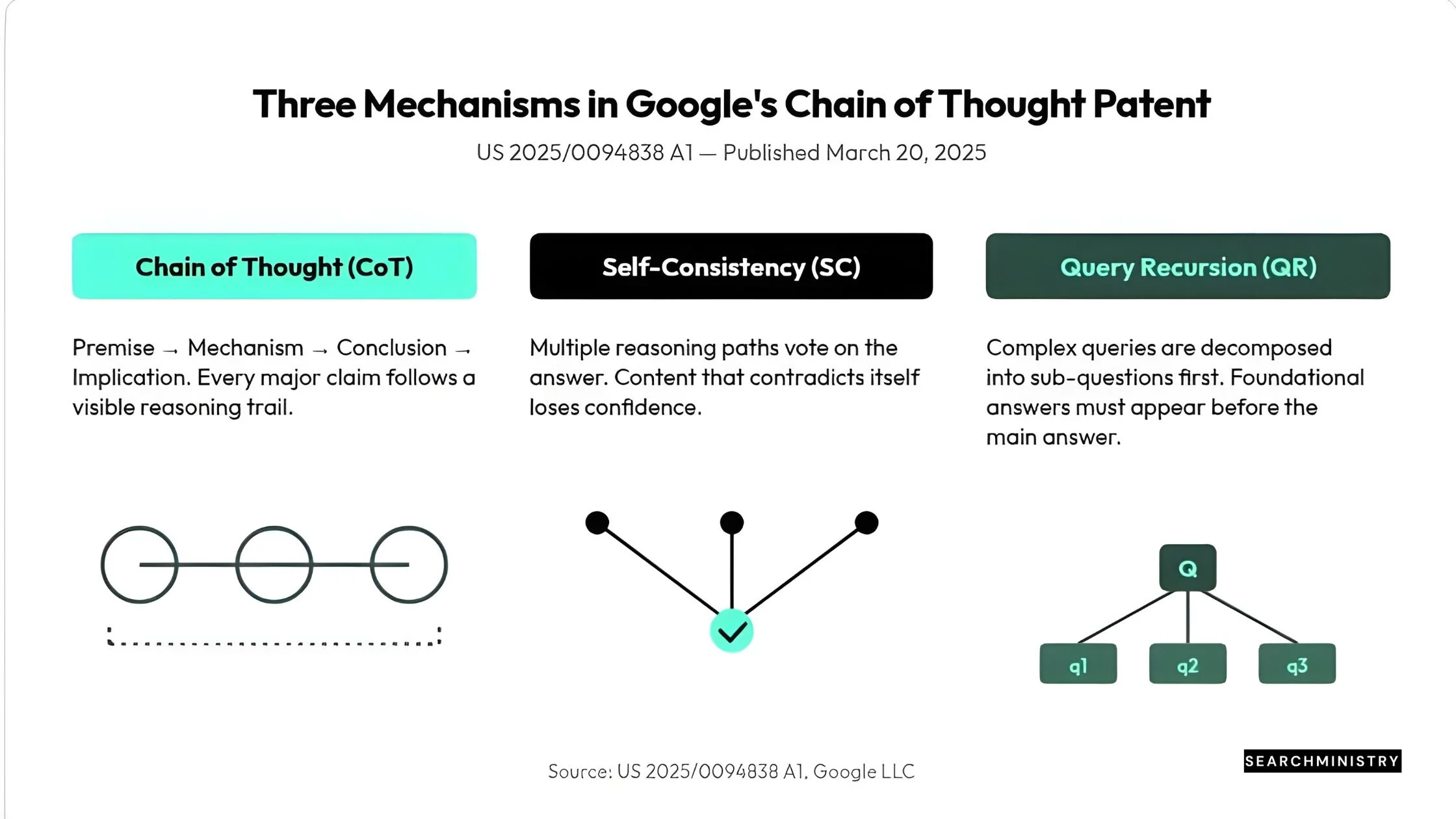
The patent describes three distinct mechanisms. Every content tactic in this guide maps directly to one of them. Understanding which mechanism a tactic targets tells you why the tactic works and how to adapt it to any niche.
| Mechanism | What the patent defines | Primary SEO implication |
|---|---|---|
| Chain of Thought (CoT) | Instructive trace: premise, intermediate states, conclusion | Write every claim as a visible reasoning chain |
| Self-Consistency (SC) | Multiple reasoning paths, majority vote selects the answer | Eliminate all internal contradictions across headline, intro, body, FAQ |
| Query Recursion (QR) | Complex query decomposed into ordered sub-questions | Answer sub-questions first, main query last |
1. Chain of Thought (CoT)
Chain of Thought is the mechanism that gives the patent its name. The model generates a sequence of intermediate reasoning steps, a "trace," that connects a query to its answer. This is not about retrieving a fact; it is about following a logical path.
Patent: Para. [0029] Intermediate States
"An instructive trace can include one or more intermediate states from the instructive query to the instructive response. For instance, a trace can include intermediate steps from a starting state (e.g., a starting known) to a final state (e.g., the resolution of the instructive query)."
US20250094838A1, paragraph [0029]
The key phrase is "intermediate states." The model is not looking for a conclusion in isolation. It is looking for the traceable path from premise to conclusion. Content that provides those intermediate states is structurally aligned with how the model was trained to evaluate reasoning.
What this means for SEO: when Google's model evaluates your page for a query, it is looking for an instructive trace: intermediate reasoning steps, not just a conclusion. A page that says "X is the best option" gives the model nothing to trace. A page that says "X is best because A enables B, which satisfies requirement C" gives the model three traceable intermediate states. Pages with visible reasoning chains are structurally aligned with how this model was trained to validate content.
2. Self-Consistency (SC)
Self-consistency is the mechanism that makes Google's model robust against pages that are internally contradictory. The model generates multiple independent reasoning paths for the same query and selects the answer that the majority of paths converge on.
Patent: Para. [0030] The Self-Consistency Mechanism
"In some embodiments, a machine-learned model can output a plurality of responses (and corresponding traces). The plurality of responses can be leveraged to determine a consistency metric. For instance, a consistency metric can be evaluated across a sampling of diverse traces (e.g., representing diverse approaches to resolving the query) and corresponding responses. For example, a set of outputs with diverse reasoning strategies can be polled to obtain a majority or plurality 'vote' on the ultimate answer."
US20250094838A1, paragraph [0030]
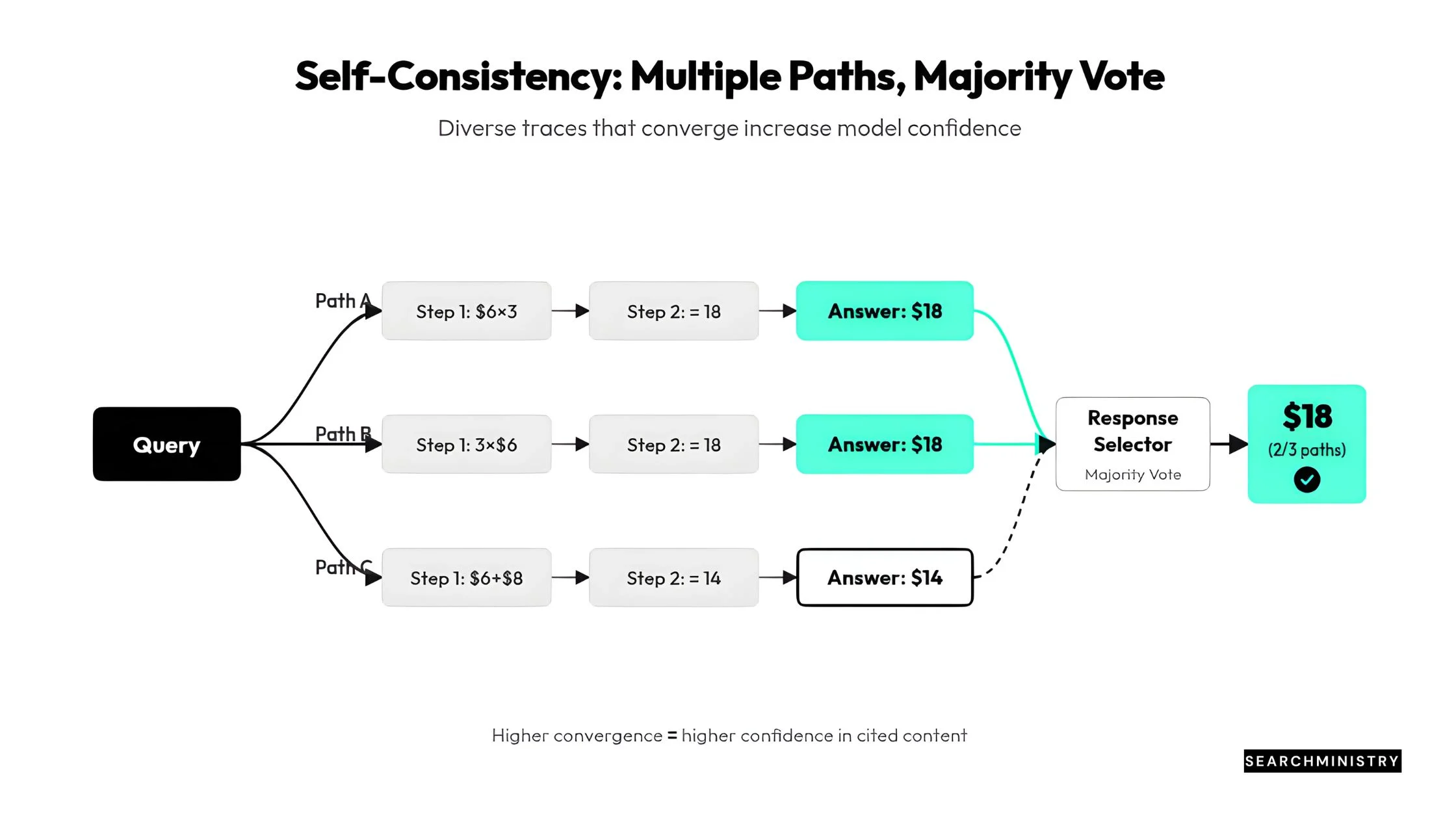
The patent confirms at Para. 0055 that "a plurality or majority of diverse traces that arrive at the same ultimate resolution can be indicative of a response associated with a higher confidence." In SEO terms: every section of your page is a potential reasoning path. If different sections of your page lead the model to different conclusions, confidence in your page drops. If all paths converge on the same answer, confidence increases.
3. Query Recursion (QR)
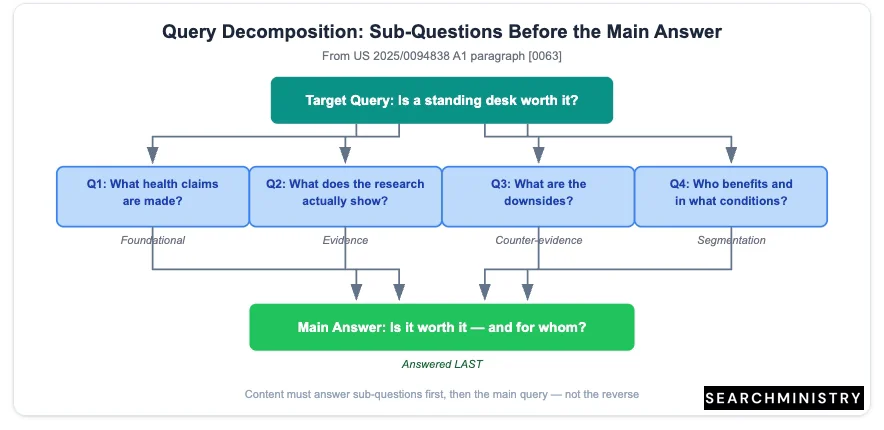
Query recursion is how the model handles complex, multi-part questions. Rather than attempting to answer a complex query directly, the model decomposes it into foundational sub-questions, resolves those first, and then uses those resolved sub-questions as inputs to answer the main query.
Patent: Para. [0031] How Query Decomposition Works
"In some embodiments, a chain of thought can span multiple queries processed by the machine-learned model. For instance, a target query may include a complex or multi-part question. The target query can be broken down or reduced into one or more query components. The query components can then be recursively processed by the model."
US20250094838A1, paragraph [0031]
Paragraph [0063] goes further, specifying that sub-questions must be ordered "from basic (or foundational) queries to complex (or follow-on) queries" and that they must be "tractable component queries that can be resolved before tackling the task from the target query itself." This is a direct description of how your content should be structured.
Part 1: Content Writing Applications
The Reasoning Chain Paragraph
The most direct application of the CoT mechanism is paragraph structure. The patent's instructive traces follow a specific architecture: declare a known starting state, derive an intermediate state, then reach a conclusion. Your paragraph structure should mirror this.
The formula. Every major claim in your content should follow this four-part structure:
- 1Establish a premise. State the starting condition or fact.
- 2Show the mechanism. Explain why or how it works.
- 3Draw the conclusion. State what follows from the mechanism.
- 4State the implication. Tell the reader what this means for them.
As an example para:
The second version gives the model four traceable intermediate states. Each step follows from the previous. This is an instructive trace in paragraph form.
- 1How variable rates are linked to RBA cash rate movements
- 2What fixed rates protect against and why they worked in 2022
- 3Why the benefit of fixing depends on timing in the rate cycle
- 4What a proper fixed vs variable comparison actually requires
The same structure applies to any niche. Here is the same pattern applied to an SEO context:
Query Decomposition for Content Planning
Before writing content, break the main query into smaller sub-questions the way Google's AI would. This helps you understand what sections your page needs and the best order to present them.
As an example: "Should I fix my home loan rate in Australia right now?" That is the main query a borrower types. The decomposition process turns it into a structured content plan in five steps:
Write the target query
State the exact phrase you are targeting. Be specific. For example: 'Should I fix my home loan rate in Australia right now?' rather than just 'fixed rate home loan'.
Ask what a reader needs to know first
What prerequisite knowledge is required before this question makes sense? These are your foundational sub-questions. For the home loan query: 'How does a fixed rate loan work?' and 'How does the RBA cash rate affect variable loans?' must come before the reader can evaluate whether fixing is right for them.
List the sub-questions in order of dependency
Order them from most foundational to most complex. Sub-question 1 should require no prior knowledge. Each subsequent sub-question should build on the resolution of the previous one.
Assign each sub-question to an H2 section
Each sub-question becomes a section of your page. The sub-question is the section's topic sentence. The section answers it completely before moving on.
Place the main query answer last
After all sub-questions are resolved, your final section answers the main query. This is counter-intuitive for writers trained to lead with the answer, but it is structurally aligned with how the model processes recursive queries.
Here is a practical example using the query "how much does it cost to replace a hot water system":
| Sub-question | Complexity order | Becomes |
|---|---|---|
| What is a hot water system and when does it need replacing? | 1. Foundational | H2: What Is a Hot Water System and How Long Does It Last? |
| How does the replacement process work from start to finish? | 2. Mechanism | H2: How a Hot Water System Replacement Works |
| What do most replacement jobs cost? | 3. Evidence | H2: Hot Water System Replacement Cost: What to Expect |
| What makes some jobs cost more than others? | 4. Counter-evidence | H2: Factors That Affect the Final Price |
| Should I repair my existing unit or replace it? | 5. Main query (specific decision) | H2: Repair or Replace: How to Decide |
Self-Consistency Auditing
The self-consistency mechanism means Google's model effectively runs multiple independent reads of your content and checks whether they converge. You can run this audit on any existing page in under ten minutes.
Read each of the following in complete isolation and write down the conclusion each implies:
- Your headline and subheadings only (no body text)
- Your introduction only
- Your conclusion or summary section only
- Your FAQ answers only
All four should point to the same answer. If they do not, identify where the divergence occurs and reconcile it explicitly.
Page topic: "Is intermittent fasting safe?"
Headline: "The Science-Backed Benefits of Intermittent Fasting"
Intro: "IF has been shown to support weight loss, improve metabolic health, and reduce inflammation"
Section 3: "Recent studies show IF may increase cortisol and stress hormones, particularly in women"
Conclusion: "Overall, IF is a powerful tool for most people"
Problem: three reads conclude "safe and beneficial"; one concludes "potentially harmful for a large population segment." The conclusion ignores Section 3 entirely. Traces diverge.
Page topic: "Is intermittent fasting safe?"
Headline: "Is Intermittent Fasting Safe? It Depends on These Factors"
Intro: "IF is effective and safe for most people, with one important exception..."
Section 3: "Women with adrenal sensitivity may experience elevated cortisol, requiring a modified approach..."
Conclusion: "IF is safe for most people. Women with adrenal sensitivity should use shorter windows and fewer fasting days before committing to a full protocol."
Every read (headline, intro, body, conclusion) converges on the same nuanced answer. Maximum self-consistency confidence.
Part 2: On-Page SEO Applications
Title Tags as Trace Markers
Your title tag and meta description are the first "trace nodes" the model encounters. They should frame the reasoning the rest of the page will follow, not just target a keyword. The most effective title tag structure for CoT alignment frames the decision or tension the page resolves.
Title: Best Variable Rate Home Loans 2026
Meta: Compare variable home loan rates from Australian lenders. Find the lowest rate for your mortgage.
Title: Best Variable Rate Home Loans 2026 (After the RBA Rate Rise)
Meta: The RBA rate rise increased repayments for most variable borrowers. We track how lenders have passed on the increase and explain why the comparison rate, not the headline rate, determines your real repayment cost.
The second version signals the reasoning frame (the RBA rate rise changed which loans offer real value), the intermediate factor (comparison rate vs headline rate), and an authority signal (tracking how individual lenders responded). The model has a stronger trace to work with from the first point of contact.
Header Hierarchy as a Reasoning Map
Your H1 to H3 hierarchy should function as a visible query decomposition tree, directly mirroring the QR mechanism. A model should be able to read only your headers and trace the complete logical path from the broad question to the specific conclusion.
H1: How to Improve Your Credit Score
H2: Pay Bills on Time
H2: Reduce Credit Utilisation
H2: Don't Open Too Many Accounts
// H2s are parallel tips. No logical progression. Model cannot derive a trace from these.
H1: How to Improve Your Credit Score (Step-by-Step)
H2: How Your Credit Score Is Actually Calculated
H3: Payment History (35%): The Single Biggest Factor
H3: Credit Utilisation (30%): The Fastest to Change
H2: What to Fix First: A Priority Order Based on Impact
H2: A Realistic Timeline: What to Expect at 30, 60, and 90 Days
// Headers form a causal chain. Model can trace a complete reasoning path from headers alone.
Schema Markup as Structured Trace Data
Schema markup gives the model pre-structured trace data without requiring it to parse prose. The most CoT-aligned schema types are those that embed explicit reasoning structures. HowTo schema maps directly to the intermediate-state trace format; each HowToStep is a discrete trace node.
// HowTo schema: each step is a clean intermediate state for the model
{
"@type": "HowTo",
"name": "How to Fix Slow LCP on WordPress",
"step": [
{ "@type": "HowToStep", "name": "Identify Your LCP Element" },
{ "@type": "HowToStep", "name": "Check If It Is Render-Blocked" },
{ "@type": "HowToStep", "name": "Preload the LCP Element" }
]
}
FAQ schema answers should include the reasoning trace, not just the conclusion. A one-line FAQ answer gives the model a Q&A pair but no trace. A three-sentence answer that includes "because X, therefore Y" gives the model a complete instructive sequence, far more likely to be used as citation material in an AI Overview.
Tip: Internal Links as Trace Connectors
Internal links are trace pathways the model can follow between sub-questions and the main topic. Anchor text should label the relationship, not just say "click here" or "read more." Instead of "read more about RAG," write: "Before evaluating whether RAG retrieval will surface your content, understand how RAG pipelines select source passages, which determines whether your content structure qualifies as a retrievable chunk."
Part 3: Image SEO Applications
Alt Text as Reasoning Context
Claim 1 of the patent specifically describes applying the Chain of Thought mechanism to image processing queries. The model generates a reasoning trace about images the same way it does about text. Alt text is the primary input to that trace; it needs to give the model something to reason with, not just identify what is depicted.
Patent: Claim 1 (Image Analysis)
"A computer-implemented method for performing image analysis, the method comprising: obtaining, by a computing system comprising one or more processors, an instructive sequence descriptive of an instructive query, an instructive response, and an instructive trace of intermediate states from the instructive query to the instructive response; inputting, by the computing system and to a machine-learned model, the instructive sequence and an operative image processing query comprising image data."
US20250094838A1, Claim 1
The alt text reasoning framework follows the same three-part structure: what the image shows, what it demonstrates or proves, and why that matters in the context of this page.
| Image type | Descriptive alt (no trace value) | Reasoning-context alt (complete trace input) |
|---|---|---|
| Medical / diagnostic | x-ray image of spine | Lateral X-ray of lumbar spine showing L4-L5 disc narrowing consistent with degenerative disc disease, illustrating why lower back pain from this condition originates in the disc space rather than the surrounding muscles |
| Data / analytics | graph showing revenue growth | Line graph showing 43% revenue growth from Q1 to Q4 2024, driven primarily by enterprise subscription expansion rather than new customer acquisition, supporting the argument that retention outperformed acquisition as a growth lever |
| Product / ecommerce | standing desk | Height-adjustable standing desk at sitting position (72cm) and standing position (112cm), showing the 40cm adjustment range that accommodates users from 5'2 to 6'4 without additional configuration |
Captions follow the same logic. They are an opportunity to provide a complete instructive trace attached to visual evidence: what the image shows, what this proves or illustrates, and how this supports the page's main argument. Captions that say only "Figure 1" or repeat the heading are trace dead ends.
Part 4: AI Overviews and Featured Snippets
AI Overviews are the model's visible reasoning chain: the publicly rendered trace it constructs from source pages to answer a query. When Google cites a page in an AI Overview, that page is functioning as one or more instructive traces in the model's reasoning. To be cited, your page needs to provide trace nodes the model cannot find elsewhere, or provide them more clearly and consistently than competitors.
A page gets cited when it covers a sub-question the model needs answered as part of its decomposition, answers it with a clear reasoning chain, and is internally consistent with what other cited pages say. Before writing or optimising a page for AI Overview inclusion, search the target query and examine the AI Overview structure: what sub-questions does it answer in sequence, and which sub-questions have no cited source? Those gaps are your entry point.
For featured snippet selection, the most effective structure is a dedicated section near the top of the page that functions as a self-contained trace block. Take the query "should I fix or stay variable on my home loan?", one of the most searched mortgage questions following every RBA decision. Most pages answer it with a hedge. A trace block answers it with a reasoning chain the model can follow and cite:
Answer: "It depends on whether you think rates will go up or down. If you think rates will rise, fix. If you think they'll fall, stay variable."
Fixed vs Variable Home Loan: The Decision Comes Down to One Number, Your Break-Even Rate
A fixed rate loan locks your repayments for a set term, protecting you if the RBA raises rates above your fixed rate during that period. A variable rate loan moves with the RBA cash rate, so repayments fall when rates drop but rise when they increase.
The decision reduces to a single comparison: calculate the rate rise needed for your variable loan to cost more than the fixed option over the same period. If the RBA raises rates beyond that break-even point during your fixed term, fixing wins. If rates hold or fall, variable wins.
Most borrowers fix during rate uncertainty to protect cash flow, not because they predict RBA decisions accurately. Variable suits borrowers with repayment buffers who want to benefit if rates fall, and who need the flexibility to make extra repayments without incurring break costs.
Part 5: E-E-A-T Through a CoT Lens
The patent's self-consistency mechanism partly validates content by checking whether its reasoning is consistent with established domain knowledge. E-E-A-T signals are how Google determines whether to weight your reasoning traces as credible. The key insight from the patent is that credentials should be placed where they validate a trace, not just declared in an author bio.
The second version makes the expertise visible within the reasoning chain. The model can trace: observed clinical pattern, mechanism explanation, conclusion about practice limitation. The experience is not declared; it is demonstrated through the quality of the reasoning trace.
Citations follow the same principle. They are most valuable when placed at the point in the reasoning chain where the claim is introduced, not collected at the end. A citation at the end of a paragraph validates nothing specific. A citation immediately after a specific factual claim validates that exact intermediate state in the trace.
Priority Action Checklist: Applying CoT Principles to Your Content
These six actions, in this order, give you the highest CoT alignment impact for the least time investment. They apply to any website in any niche.
Rewrite your most important pages as reasoning chains
Identify the 3-5 pages most critical to your business. Audit each paragraph: does it follow premise, mechanism, conclusion, implication? Where you find bare assertions, expand them to show the reasoning. This single change has the highest CoT alignment impact.
Run the four-point self-consistency audit on every key page
Read your headline, introduction, conclusion, and FAQ answers in isolation. Write down what conclusion each implies. If they diverge, reconcile them explicitly in your conclusion section. Pages with high self-consistency score better under the SC mechanism.
Restructure content to answer sub-questions before the main query
For any page targeting a complex query, list the foundational questions a reader needs answered first. Make those your early H2 sections, ordered simplest to most complex. Move the main query answer to after all sub-questions are resolved. This mirrors QR directly.
Rewrite alt text as reasoning context, not description
Every image on a key page needs alt text that gives the model something to reason with: what the image shows, what it demonstrates or proves, and why that matters in context. Descriptive alt text ("graph showing revenue") is a dead end for CoT processing. Reasoning-context alt text is a complete trace node.
Use HowTo schema for process content to expose trace steps to AI parsers
Google deprecated FAQPage rich results for most websites in 2023, so FAQPage schema no longer produces SERP rich snippets. However, HowTo schema still serves a CoT purpose: each HowToStep element becomes a discrete, machine-readable trace node that AI parsers can extract without reconstructing prose. Use HowTo schema on process and instructional content where the steps represent intermediate states in a reasoning chain. If you already have FAQPage schema in place, keep it as a structured signal for AI crawlers, but do not add it with the expectation of rich result visibility.
Audit your domain for self-consistency across pages
Use site:yourdomain.com [topic] to find all indexed pages on your core topics. Read the conclusion of each. If an older post contradicts a newer guide, update or consolidate them. Inter-page contradictions trigger domain-level self-consistency failures, not just page-level ones.
Request Your Content Strategy Review
Our team reviews your key pages against the Chain of Thought patterns in this guide, identifying where your content lacks reasoning traces, has internal inconsistencies, or misses sub-question coverage that AI models need to cite your page.
Request a Content ReviewThe three principles beneath all the tactics in this guide mirror the patent's mechanisms directly. Show your working: the model validates reasoning chains, not just conclusions, so every claim should have a visible path from premise to conclusion. Answer the sub-questions first: content that addresses foundational sub-questions before the main question is structurally aligned with how the model processes recursive queries. Be consistent everywhere: the self-consistency check means every reading of your content (headline, intro, body, conclusion, FAQ, image captions) should converge on the same answer.
These principles do not require longer content. They require more reasoned content. The length is secondary; the logical architecture is what determines whether the model can build a reliable trace from your page. If you want a full AI SEO strategy applied across your site, our team audits content architecture, entity structure, and reasoning-chain alignment end to end.
For deeper coverage of how AI systems retrieve and rank content, the guide on 12 LLM retrieval methods reshaping AI SEO covers the full pipeline from first-stage vector retrieval to cross-encoder reranking. For the broader shift to agentic search, the guide on what agentic SEO means for content discovery explains how AI agents retrieve and synthesise content across tool-calling pipelines.
Frequently Asked Questions
What is Google's Chain of Thought patent about?
US20250094838A1, published March 20, 2025, describes a method for applying Chain of Thought reasoning to image processing and general query resolution. It patents three core mechanisms: Chain of Thought (structured intermediate reasoning steps), Self-Consistency (multiple reasoning paths with majority-vote selection), and Query Recursion (breaking complex queries into ordered sub-questions). The patent describes how Google's AI models validate content before generating answers.
Does the Chain of Thought patent change how I should write content?
Yes, in a specific and measurable way. The patent reveals that Google's model does not just retrieve content; it validates a reasoning chain. Content written as bare assertions ("X is the best option") gives the model nothing to trace. Content structured as premise, mechanism, conclusion, and implication gives the model four traceable intermediate states. Pages with visible reasoning chains are structurally aligned with how this model was trained to validate and cite content.
What is the self-consistency mechanism and why does it matter for SEO?
Self-consistency means Google's model generates multiple independent reasoning paths for the same query and selects the answer that the majority of paths converge on. For SEO, this means every part of your page (headline, introduction, body sections, conclusion, and FAQ answers) should converge on the same conclusion. If your headline implies one answer and your conclusion implies another, the model's self-consistency check produces low confidence for your page, reducing citation probability.
How does query recursion affect content structure?
Query recursion means the model decomposes complex queries into foundational sub-questions and resolves them in order before answering the main query. Your content structure should mirror this: foundational sub-questions become your early H2 sections, ordered from simplest to most complex, with the main query's answer appearing last. A page that answers the main question first, without establishing the prerequisite context, is misaligned with how the model processes the query.
Does this patent apply to Australian search results?
Google's AI systems, including the reasoning mechanisms described in this patent, operate globally. Australian searches on Google Search, AI Overviews, and Google's generative experience features all run through the same underlying models. The citation and content validation logic described in this patent applies equally to Australian content. Businesses targeting Australian queries benefit from the same reasoning-chain content structure as any other market.
Is this patent about the same thing as Chain of Thought prompting used by developers?
Related but different. The developer technique of Chain of Thought prompting asks a language model to show its reasoning step by step, which improves accuracy on multi-step problems. Google's patent applies this same principle to content evaluation: when the model processes a page to determine whether it should be cited in an answer, it looks for an instructive trace (an explicit reasoning chain) in the content itself. The patent is about the model reading your content for a reasoning trail, not about prompting the model.
What schema markup best supports the Chain of Thought mechanisms?
HowTo schema maps directly to the intermediate-state trace format; each HowToStep is a discrete trace node the model can parse cleanly. FAQPage schema mirrors the instructive sequence format from the patent (question, reasoning, answer). For complex technical content, combining Speakable, FAQPage, and HowTo schema on a single page gives the model both prose traces and a structured map of the trace, which reduces ambiguity and increases citation confidence.
How do I audit my existing pages for self-consistency failures?
Read each of the following in complete isolation and write down the conclusion each implies: (1) your headline and subheadings only, (2) your introduction only, (3) your conclusion or summary section only, (4) your FAQ answers only. All four readings should converge on the same answer. If they point to different conclusions, identify where the divergence occurs and reconcile it explicitly in your conclusion. This is the same operation the model performs when running its self-consistency check.

Tharindu Gunawardana
Founder & Director, SearchMinistry Media
Tharindu Gunawardana is the Founder of SearchMinistry Media and a search strategist with 17 years of experience across Sri Lanka, Singapore, and Australia. A former Agency SEO Director, he specialises in helping brands transition from traditional SEO to AI-driven discovery.